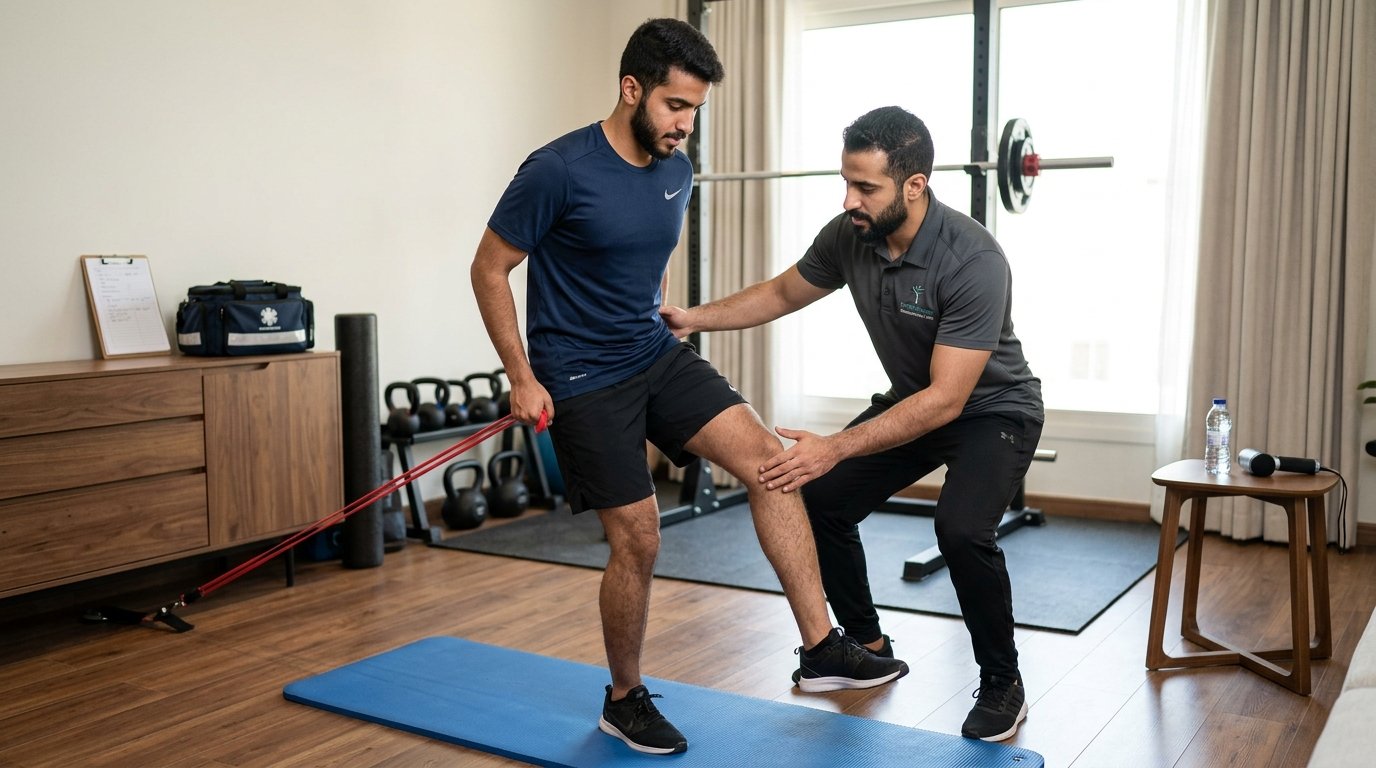
Advanced In-Home Sports Physiotherapy & Athletic Rehabilitation
Evidence-based clinical rehabilitation engineered to accelerate soft-tissue repair, optimize kinetic chain mechanics, rebuild explosive power, and ensure safe return-to-sport clearance within your home across Dammam, Khobar, and Eastern Province.
Comprehensive In-Home Clinical Evaluation (60-75 Mins)
Detailed functional & neuro examination, home safety audit, and custom protocol with portable equipment — no upfront package commitments.
Flexible appointments 7 days a week (8 AM - 10 PM) • Payment upon visit completion
1,500+ Successful Home Recoveries
Certified Clinical Physiotherapists
Assessment-First Protocol
Thorough physical evaluation before any treatment plan starts
Specialized Male Therapists
Professional licensed therapists visiting your residence
100% In-Home Rehabilitation
No clinic travel friction or waiting room discomfort
Targeted Functional Goals
Focused on daily stairs, walking endurance, and independence
Emergency Medical Red-Flags & Home Care Boundaries
Emergency Notice: If you experience complete inability to bear weight, an audible snap with immediate joint deformity, or numbness in the foot, immediately dial 997 or visit the nearest emergency room.
Across the Eastern Province of Saudi Arabia, athletic participation has reached unprecedented heights in alignment with the ambitious wellness objectives of Vision 2030. From competitive padel tournaments and community football leagues to beachfront running along the Dammam and Khobar Corniches and high-intensity CrossFit training, active individuals are continually testing their physical limits. However, elevated training volumes, rapid changes of direction on synthetic turf, and unconditioned kinetic chains frequently culminate in debilitating acute joint trauma and chronic repetitive strain injuries.
At Bidaya In-Home Physiotherapy & Sports Rehabilitation, we deliver high-performance sports medicine directly to the athlete's residence. We understand that an injured athlete grapples with intense competitive frustration; the drive to resume play prematurely often provokes inadequate scar remodeling, recurrent muscle tears, and long-term joint instability. Conversely, prolonged passive immobilization degrades cardiovascular conditioning, induces severe neuromuscular inhibition, and amplifies re-injury risks.
Our mobile sports physical therapy specialists bridge this critical gap. We discard antiquated passive treatments, anchoring our recovery models in modern tissue-healing paradigms (POLICE and PEACE & LOVE). Rather than merely treating the anatomical site of pain, we execute comprehensive kinetic chain screenings to pinpoint proximal core and lumbo-pelvic instability, prescribe progressive eccentric resistance protocols, retrain dynamic multi-planar deceleration, and conduct validated return-to-sport clearance batteries. Our hands-on domestic care empowers athletes across Dammam, Khobar, and Dhahran to return to competitive sports stronger, faster, and more biomechanically resilient than before.
Clinical Scope of Sports Injuries Managed at Home
Precision Diagnostics Covering High-Incidence Athletic Conditions in the Eastern Province
Our clinical team manages the full continuum of athletic soft-tissue trauma and overuse syndromes: 1. Acute Skeletal Muscle Strains: Grade I and Grade II hamstring complex strains (biceps femoris, semitendinosus), rectus femoris quadriceps tears, adductor longus groin strains, and medial gastrocnemius tears (tennis leg). 2. Joint Sprains and Ligamentous Disruptions: Acute inversion ankle sprains (anterior talofibular and calcaneofibular ligament tears), medial collateral ligament (MCL) sprains, and conservative non-operative or pre-operative anterior cruciate ligament (ACL) management. 3. Overuse Tendinopathies and Friction Syndromes: Patellar tendinopathy (jumper's knee), Achilles tendinopathy (mid-portion and insertional), rotator cuff impingement/tendinopathy in overhead athletes, and iliotibial band (ITB) friction syndrome in long-distance runners. 4. Racquet and Padel-Specific Injuries: Lateral epicondylalgia (tennis/padel elbow), triangular fibrocartilage complex (TFCC) wrist sprains, and acute lumbar facet locking provoked by repetitive rotational smash strokes.
Acute Soft Tissue Management: The Shift from RICE to PEACE & LOVE
Aligning Early In-Home Intervention with Contemporary Regenerative Sports Science
Bidaya strictly implements the internationally recognized PEACE & LOVE clinical paradigm, replacing outdated ice-and-immobilize protocols: - Acute Protection Phase (PEACE): * Protect: Unload the injured structure for the first 24 to 48 hours to minimize tissue bleeding, while avoiding prolonged absolute immobilization. * Elevate: Position the injured limb above heart level to facilitate interstitial fluid resorption. * Avoid Anti-Inflammatory Modalities: Prohibiting excessive NSAID consumption and continuous ice application during early phases, preserving essential chemical mediators necessary for primary macrophage tissue repair. * Compress: Utilizing calibrated elastic cohesive bandages to restrict intra-articular and intramuscular hematoma expansion. * Educate: Counseling the athlete on realistic recovery timelines, active rehabilitation benefits, and avoiding passive dependency. - Subacute Loading Phase (LOVE): * Load: Introducing mechanical loading early to stimulate cellular mechanotransduction and align newly formed type-I collagen fibers. * Optimism: Fostering positive psychological expectations to extinguish movement-related apprehension and kinesiophobia. * Vascularisation: Initiating non-impact cardiovascular exercise (such as stationary upper-body ergometry) to elevate tissue perfusion. * Exercise: Delivering progressive neuromuscular, proprioceptive, and mobility drills.
Complete Kinetic Chain and Movement Biomechanics Screening
Uncovering Distant Biomechanical Flaws That Overload Injured Distal Tissues
Athletic breakdown rarely originates in isolation; it almost invariably results from dysfunctions elsewhere in the linked kinetic chain: - Gluteal Activation and Pelvic Control: Weakness in the gluteus medius and maximus permits excessive contralateral pelvic drop (Trendelenburg sign) and dynamic knee valgus collapse during single-leg landings, representing the primary mechanical trigger for non-contact ACL tears and patellofemoral pain. - Core Stiffness and Rotational Force Transfer: Insufficient activation of the transversus abdominis and internal obliques leaks rotational energy during athletic maneuvers, forcing the lumbar spine or shoulder complex to absorb compensatory torque. - Talocrural Joint Mobility and Subtalar Pronation: Restricted ankle dorsiflexion limits tibial advancement over the foot during deceleration, transferring excessive shock vectors proximally into the patellar tendon and hip joint.
Eccentric Tendon Loading and Heavy Slow Resistance (HSR) Frameworks
Stimulating Tenocyte Matrix Remodeling to Forge High-Tension Tendinous Architectures
Tendons possess low metabolic vascularity and demand specific mechanobiological tensile cues to resolve degenerative tendinosis: - Eccentric Resistance Paradigms: Executing the evidence-based Alfredson eccentric drop protocol for Achilles tendinopathy and Nordic hamstring curls for hamstring strain prevention, which clinical trials demonstrate reduces re-injury rates by over 50%. - Heavy Slow Resistance (HSR) Protocols: Administering high-load, low-velocity closed-chain exercises (3-second concentric and 3-second eccentric cadences at 70-85% 1RM), stimulating tendon tenocyte collagen cross-linking and dramatically increasing tensile stiffness. - Sustained Isometric Neuromodulation: Prescribing 45-second isometric quad extensions or calf holds to induce immediate corticomotor inhibition, suppressing localized tendon pain before advancing into dynamic drills.
Dynamic Agility, Deceleration, and Reactive Neuromuscular Retraining
Conditioning Protective Spinal Reflexes for High-Velocity Competitive Transitions
True athletic recovery extends beyond isolated muscular hypertrophy to encompass reactive motor control under fatigue: - Multi-Planar Proprioceptive Perturbations: Utilizing balance air cushions and closed-eyes balance drills to condition rapid ankle-foot mechanoreceptor adjustments within milliseconds. - Deceleration and Landing Mechanics: Coaching athletes in soft, energy-absorbing jump landings emphasizing symmetrical hip and knee flexion, eliminating stiff-legged landings that shock joint cartilage. - Reactive Change-of-Direction Drills: Utilizing domestic patio or courtyard spaces to conduct visual and auditory reaction drills, forcing the nervous system to coordinate sharp cutting angles without conscious hesitation.
Objective Return-to-Sport (RTS) Testing and Clearance Batteries
Eliminating Guesswork Through Quantitative, Criterion-Based Clearance Metrics
Bidaya strictly prohibits arbitrary time-based return to play. Our clinicians administer comprehensive, quantitative RTS testing: - Limb Symmetry Index (LSI): Mandating that the injured limb achieve at least 90% to 95% strength and functional capacity compared to the uninjured contralateral side across all standardized tests. - Standardized Functional Hop Test Battery: * Single Hop for Distance: Measuring single-leg explosive forward propulsion and landing stability. * Triple Hop for Distance: Evaluating sequential power generation and dynamic postural capture. * Crossover Hop Test: Assessing rotational control and lateral deceleration across a 15-cm strip. * 6-Meter Timed Hop: Quantifying explosive speed-power maintenance over distance. - Y-Balance Dynamic Test: Evaluating multi-directional anterior, posteromedial, and posterolateral reaching excursion to confirm dynamic single-leg postural control. - Psychological Clearance (ACL-RSI): Screening for fear of re-injury, ensuring the athlete possesses full mental confidence before re-entering competitive play.
Clinical Red Flags and Immediate Emergency Trauma Screening
Recognizing Severe Musculoskeletal and Vascular Emergencies Requiring Urgent Escalation
Our mobile sports therapist performs rigorous diagnostic triage during initial evaluations to rule out catastrophic athletic pathology: - Ottawa Ankle and Knee Rules: Inability to bear weight immediately following injury and during evaluation for at least 4 steps, coupled with localized bony tenderness over the malleolar tips or patella/fibula head, necessitates immediate radiographic referral to exclude fractures. - Audible Pop and Immediate Hemarthrosis: A loud auditory snap accompanied by gross knee or Achilles swelling within 2 hours strongly signals an acute anterior cruciate ligament rupture or complete Achilles tendon tear. - Neurovascular Deficit: Absence of distal pedal pulses, severe distal pallor, or progressive sensory loss along peripheral dermatomes requires immediate orthopedic surgical consultation. In severe sports trauma emergencies, immobilize the limb and immediately dial the Saudi Red Crescent Authority at 997.
Frequently Asked Questions about In-Home Physiotherapy
Yes, Grade I and Grade II muscle strains and ligament sprains respond exceptionally well to structured in-home physical therapy. Our clinicians deliver manual therapy, phased eccentric loading, and functional drills directly to your living space without requiring outpatient clinic visits.
Related Clinical & Regional Pathways
Specialized Musculoskeletal Physiotherapy→
Evidence-based clinical rehabilitation for spinal disorders
Specialized Post-Operative Physiotherapy→
Evidence-based surgical rehabilitation protocols engineered to restore joint range of motion
Specialized Neurological Physiotherapy→
Evidence-based neurological physical therapy harnessing neuroplasticity
Specialized Comprehensive In-Home Sports Injury & Athletic Physiotherapy Hub→
Specialized sports injury rehabilitation delivered directly to your home in Dammam
Specialized Acute Muscle Strain & Tear Rehabilitation→
Specialized sports injury rehabilitation delivered directly to your home in Dammam
Specialized Hamstring Strain & Eccentric Loading Rehabilitation→
Specialized sports injury rehabilitation delivered directly to your home in Dammam
Specialized Quadriceps Strain & Contusion Rehabilitation→
Specialized sports injury rehabilitation delivered directly to your home in Dammam
Specialized Calf Strain & Gastrocnemius-Soleus Complex Rehabilitation→
Specialized sports injury rehabilitation delivered directly to your home in Dammam