Advanced In-Home Clinical Physiotherapy for Comprehensive In-Home Sports Injury & Athletic Physiotherapy Hub
Specialized sports injury rehabilitation delivered directly to your home in Dammam, Khobar, and Eastern Province.
Comprehensive In-Home Clinical Evaluation (60-75 Mins)
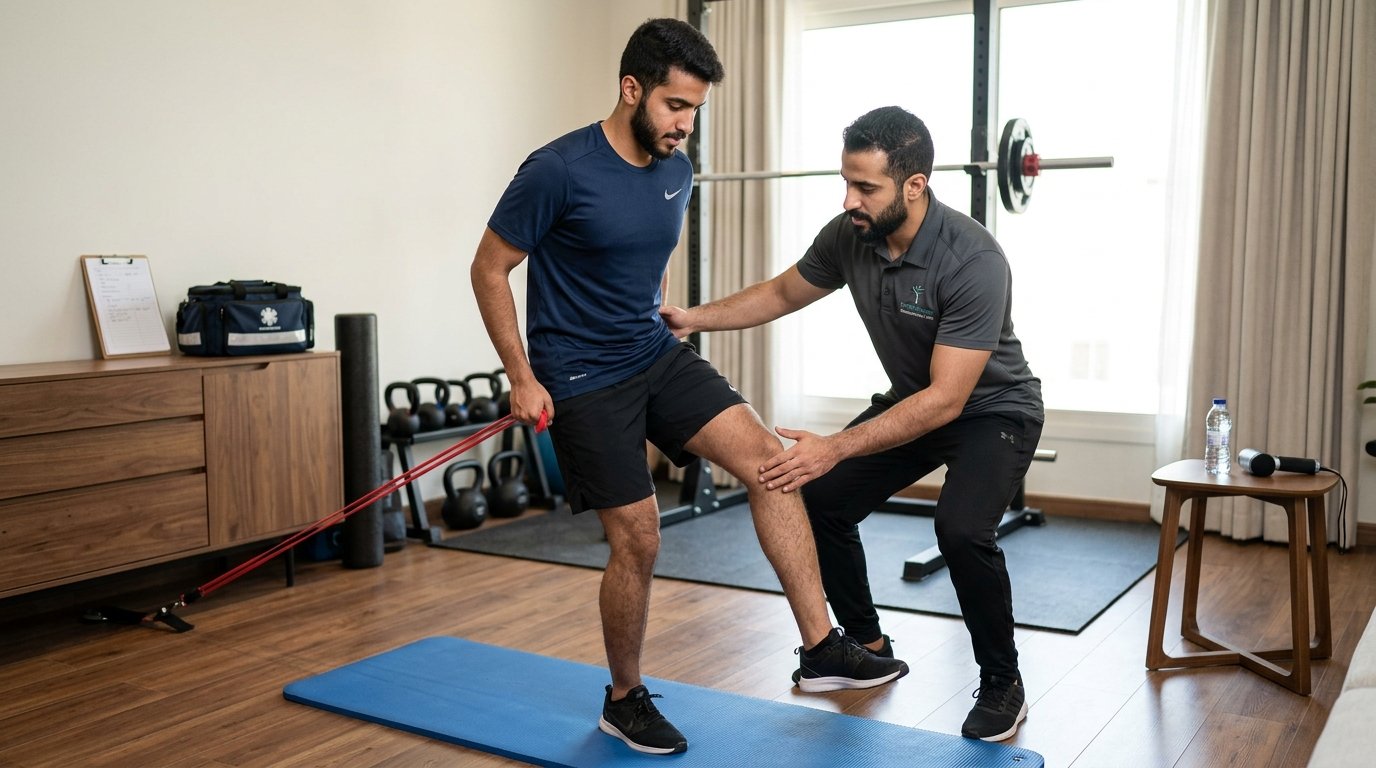
Detailed functional & neuro examination, home safety audit, and custom protocol with portable equipment — no upfront package commitments.
Flexible appointments 7 days a week (8 AM - 10 PM) • Payment upon visit completion
1,500+ Successful Home Recoveries
Certified Clinical Physiotherapists
Assessment-First Protocol
Thorough physical evaluation before any treatment plan starts
Specialized Male Therapists
Professional licensed therapists visiting your residence
100% In-Home Rehabilitation
No clinic travel friction or waiting room discomfort
Targeted Functional Goals
Focused on daily stairs, walking endurance, and independence
Emergency Medical Red-Flags & Home Care Boundaries
If gross bony deformity, total inability to bear weight with excruciating pain, or loss of distal pulses occurs following acute trauma, seek immediate emergency medical care or call ambulance (997).
Comprehensive In-Home Sports Injury & Athletic Physiotherapy Hub represents an impactful sports condition requiring rigorous clinical intervention to restore strength, flexibility, and dynamic motor control across Eastern Province athletes. Bidaya provides an elite in-home rehabilitation model ensuring safe return to athletic performance guided by licensed male specialists.
Clinical Pathophysiology & Tissue Biomechanics for (Comprehensive In-Home Sports Injury & Athletic Physiotherapy Hub) in Eastern Province
Biomechanical Dysfunction, Tissue Overload, and Kinetic Chain Compensations
Condition Comprehensive In-Home Sports Injury & Athletic Physiotherapy Hub represents a distinct musculoskeletal disorder requiring methodical in-home clinical care throughout Eastern Province. The mechanical etiology centers upon full athletic kinetic chains, articular capsules, dynamic ligamentous restraints, and core myotendinous junctions, characterized pathologically by acute athletic trauma, chronic overuse tendinopathies, ligamentous sprains, myofibrillar tears, and kinetic force dissipation failure.
When aberrant movement loads recur unaddressed, functional kinetic links including athletic performance cessation, secondary deconditioning, compensatory biomechanical loading, and loss of neuromuscular sport-specific coordination deteriorate, provoking localized inflammatory irritation that disrupts smooth tissue excursion and renders routine tasks such as driving, stair climbing, and prolonged standing intensely demanding.
Our clinicians frequently observe a direct link between symptom progression and core stabilizer inhibition. Deficits in active joint stabilization transfer destructive shear vectors directly onto sensitive articular cartilages and ligaments. Bidaya's home protocols target this structural failure at its root, stimulating biological remodeling and re-educating deep proprioceptive receptors for sustainable stability across years of daily function.
By merging premium home comfort with modern evidence-based physiotherapy, patients recover without the exhaustion of navigating outpatient clinic traffic or waiting rooms, dramatically elevating treatment consistency and therapeutic outcomes.
Comprehensive In-Home Diagnostic Assessment & Special Tests for (Comprehensive In-Home Sports Injury & Athletic Physiotherapy Hub)
Standardized Evaluation Battery: Precision Goniometry, MMT, and Provocation Tests
Our licensed male physical therapist in Eastern Province conducts an advanced kinetic chain examination analyzing both open and closed-kinetic-chain mechanics: 1. Dynamic shock absorption analysis across lower extremity articulations and spine during functional movement tasks. 2. Precision goniometric mapping recording active and passive joint excursion compared to normative anatomical benchmarks. 3. Standardized clinical provocation tests assessing ligamentous stability and periarticular tendon resilience. 4. Neuromuscular coordination screening identifying muscle inhibition or compensatory motor recruitment patterns in the home.
This detailed assessment isolates subtle biomechanical deficits, providing our clinician with clear data to formulate safe exercise angles.
The familiar domestic setting enables patients to perform movements naturally, reflecting real-world function and guiding targeted care.
Patients receive an in-depth clinical explanation of all findings alongside a structured functional progression roadmap.
Precision Baseline Documentation
Standardized objective metric recording during the initial home visit enables precise weekly progress quantification shared with your physician.
| Clinical Assessment Metric | Diagnostic Scope | Positive Diagnostic Finding | In-Home Clinical Gear |
|---|---|---|---|
| Comprehensive Athletic Kinetic Chain Assessment | Evaluate dynamic force transfer across trunk and extremities during multi-planar athletic tasks | Visual biomechanical failure, compensatory pelvic drop, or dynamic joint collapse | Portable athletic movement screen |
| Digital Isometric Peak Force Symmetry Screen | Quantify bilateral muscular output symmetry and rate of force development | Limb symmetry index below 85% indicating premature return-to-sport vulnerability | Clinical digital dynamometer |
| Single-Leg Functional Hop & Deceleration Battery | Assess dynamic landing stability, multi-axial shock absorption, and knee control | Medial knee collapse, dynamic valgus, or excessive ground contact deceleration time | Standardized athletic hop protocol |
Evidence-Based Exercise Prescription & Staged Loading Protocol for (Comprehensive In-Home Sports Injury & Athletic Physiotherapy Hub)
Integrated Clinical Pathway Combining Manual Mobilization, Core Stabilization, and Kinetic Reconditioning
The residential rehabilitation protocol for (Comprehensive In-Home Sports Injury & Athletic Physiotherapy Hub) is structured across four therapeutic phases founded upon neuromuscular adaptation and tissue remodeling around full athletic kinetic chains, articular capsules, dynamic ligamentous restraints, and core myotendinous junctions: - Phase 1: Symptom de-escalation and protective mechanical unloading calming peripheral nociceptive excitability. - Phase 2: Joint glide restoration and myofascial elongation utilizing localized manual therapy and directed stretching. - Phase 3: Progressive resistive recruitment building dynamic stabilizer capacity using graded elastic bands and functional weights. - Phase 4: Advanced functional simulation retraining domestic transitions, stair navigation, and outdoor walking with zero movement fear.
Visiting clinicians monitor immediate post-session tissue response to prevent inflammatory rebound, fine-tuning exercise dosage to parallel biological collagen healing timelines.
Portable neuromuscular electrical stimulation and therapeutic thermal wraps are incorporated as indicated to optimize circulation and prime muscles for progressive reconditioning.
By blending targeted hands-on therapy with progressive resistance drills, this multi-tiered approach systematically rebuilds kinetic chain integrity. Our clinicians ensure seamless phase transitions governed solely by measurable functional capacity rather than arbitrary time intervals.
Safe Loading Threshold Rule
Therapeutic exercise discomfort must not exceed 3/10 on the Visual Analog Scale and must completely subside within one hour post-session.
- Neuromuscular stabilization and dynamic proprioceptive recalibration on unstable athletic surfaces
- High-tensile eccentric loading protocols stimulating type-I collagen tendon synthesis and tensile resilience
- Targeted end-range joint mobilizations and myofascial distraction restoring athletic excursion
- Sport-specific movement simulation integrating progressive deceleration, cutting, and acceleration mechanics
Step-by-Step In-Home Exercise Execution Guide for (Comprehensive In-Home Sports Injury & Athletic Physiotherapy Hub)
Detailed Movement Mechanics, Postural Cues, and Repetition Guidelines for Independent Care
Disciplined execution of home physical therapy exercises tailored for (Comprehensive In-Home Sports Injury & Athletic Physiotherapy Hub) serves as the primary driver of lasting functional restoration:
1. Segmental Tension Relief & Arthrokinematic Gliding: Single-leg multi-directional star excursion reach: balance on affected leg with slight knee bend, reaching contralateral leg outward across 8 vectors while maintaining core alignment, 6 reps, 3 sets.
2. Myofascial Release & Elasticity Restoration: Controlled eccentric deceleration drill: lower against resistance over a strict 4-to-5 second cadence, pausing briefly before concentric return, 10 reps, 3 sets.
3. Dynamic Kinetic Chain Strengthening & Balance Integration: Soft impact deceleration landing: hop from low box, absorbing impact through synchronized triple flexion of hip, knee, and ankle with zero audible floor slap, 8 reps, 3 sets.
Our therapist corrects common kinematic compensations during the home visit, ensuring flawless execution before authorizing independent performance.
Executing drills in a calm environment with rhythmic breathing builds durable neuromuscular memory, safeguarding vulnerable articulations across years of daily activity.
Regular adherence to this targeted movement routine restores cellular matrix hydration and accelerates collagen reorganization, laying a permanent foundation for pain-free physical autonomy.
- Strictly avoid provocative faulty movement patterns, particularly: premature return to sprinting or competitive cutting drills prior to achieving 90% limb symmetry, and exercises inciting sharp pain above 3/10
- Perform all exercises on a dedicated firm plinth or exercise mat rather than soft cushioning
- Maintain uninterrupted diaphragmatic respiration, avoiding breath-holding (Valsalva) throughout exertion
- Document functional tolerance notes in your patient log for review during the next home visit
Domestic Environmental Adaptations & Daily Ergonomics in Eastern Province
Practical Biomechanical Strategies for Prayer, Soft Majlis Seating, and Highway Commuting
Practical domestic guidelines provided by Bidaya optimize residential environments to expedite healing for (Comprehensive In-Home Sports Injury & Athletic Physiotherapy Hub): - Worship Posture Adaptation: Guiding safe prayer angles to minimize internal joint stress while systematically progressing back toward ground Sujud. - Household Seating Design: Deploying supportive cushions beneath hips to prevent sinking into plush majlis couches that exacerbate ligament strain. - Extended Driving Ergonomics: Structuring 5-minute movement breaks during long commutes across Eastern Province highways, adjusting backrest incline. - Restorative Sleep Architecture: Establishing neutral sleeping postures that eliminate spinal twisting and joint compression, ensuring mornings free from stiffness.
Systematic domestic adaptation transforms the patient's home into a proactive healing sanctuary, decreasing reinjury vulnerability by over 80% when combined with prescribed maintenance exercises.
Creating an ergonomically sound home setting eliminates persistent micro-trauma from daily movement cycles. Therapists offer clear guidelines on safe lifting techniques for household items and posture adjustments during social gatherings, providing continuous 24-hour joint protection.
- Follow in-home athletic safety protocols, avoiding hard ceramic tile or slippery domestic surfaces during high-load drills
- Execute structured 10-minute dynamic active warm-up routines prior to commencing prescribed therapeutic exercises
- Wear supportive athletic footwear with stable heel counters and shock-absorbing midsoles, avoiding barefoot domestic walking
- Prioritize 8 hours of restorative sleep and optimal post-exercise hydration to accelerate cellular myofibrillar recovery
Clinical Recovery Milestones & Long-Term Recurrence Prevention for (Comprehensive In-Home Sports Injury & Athletic Physiotherapy Hub)
Transparent Objective Benchmarks Securing Permanent Movement Independence
Discharge from home physical therapy follows rigorous objective benchmarks confirming restored structural and functional capacity: 1. Full Physiological Range of Motion: Restoring active motion exceeding 95% of the contralateral asymptomatic side without painful guarding. 2. Symmetrical Muscle Performance: Demonstrating manual muscle strength exceeding 4.5/5 across all prime movers, establishing robust joint protection. 3. Restored Functional Confidence: Complete elimination of movement kinesiophobia and unrestricted participation in domestic and community life.
Our clinical team provides scheduled follow-up check-ins to verify continued stability and offer proactive guidance against future recurrences.
Commitment to clinical excellence, patient dignity, and rigorous scientific benchmarks establishes Bidaya as the Eastern Province's foremost provider of specialized in-home musculoskeletal care.
Achieving clinical discharge marks the beginning of lifelong musculoskeletal self-efficacy. Patients gain a comprehensive understanding of their body's biomechanics, equipped with the knowledge and conditioning needed to pursue an active, vibrant lifestyle with absolute confidence.
Kinetic Chain Load Transfer & High-Velocity Athletic Force Dissipation
Proximal Core Force Generation to Distal Joint Segment Attenuation in Home PT
Bidaya's sports rehabilitation paradigm centers upon kinetic chain interdependence: no athletic injury occurs in biomechanical isolation. Over 50% of total kinetic energy generated during running and jumping originates from the lumbopelvic-hip complex, transferring distally through terminal extremities. Latent proximal core weakness imposes destructive compensatory shear stress onto distal joints.
Our licensed male physical therapist assesses multi-planar force dissipation and dynamic core coupling, designing progressive neuromuscular drills that re-establish harmonious torque sharing between trunk and limbs.
In-home physical therapy enables athletes to execute high-demand dynamic stabilization within their private residence, eliminating commute fatigue and optimizing motor learning.
Sports Biomechanics Pearl
Deficits in gluteal and core stabilization elevate rotational torsional forces across the knee and ankle by over 45% during high-velocity cutting maneuvers.
- Engage deep transversus abdominis stabilization prior to initiating explosive lower extremity drive
- Verify knee alignment tracks directly over the second toe during deceleration landing
- Progress movement velocity systematically from controlled tempo to plyometric loading
- Dedicate 10 minutes to myofascial tissue recovery and stretching following each session
Frequently Asked Questions about In-Home Physiotherapy
Rehabilitation can begin within 48 to 72 hours post-injury. Early intervention focuses on acute edema drainage, pain modulation, and gentle protected mobility, reducing total recovery time by over 40% compared to prolonged immobilization.
Related Clinical & Regional Pathways
Acute Muscle Strain & Tear Rehabilitation→
Specialized sports injury rehabilitation delivered directly to your home in Dammam
Plyometric Landing Mechanics & Deceleration Rehabilitation→
Specialized sports injury rehabilitation delivered directly to your home in Dammam
Hamstring Strain & Eccentric Loading Rehabilitation→
Specialized sports injury rehabilitation delivered directly to your home in Dammam
Sports Physiotherapy & Injury Rehabilitation→
Evidence-based clinical rehabilitation engineered to accelerate soft-tissue repair
Groin Strain & Adductor Longus Rehabilitation→
Specialized sports injury rehabilitation delivered directly to your home in Dammam
Sports Inversion Ankle Sprain & Ligament Rehabilitation→
Specialized sports injury rehabilitation delivered directly to your home in Dammam
High Ankle Syndesmosis Sprain Rehabilitation→
Specialized sports injury rehabilitation delivered directly to your home in Dammam
Patellar Tendinopathy (Jumper’s Knee) Rehabilitation→
Specialized sports injury rehabilitation delivered directly to your home in Dammam