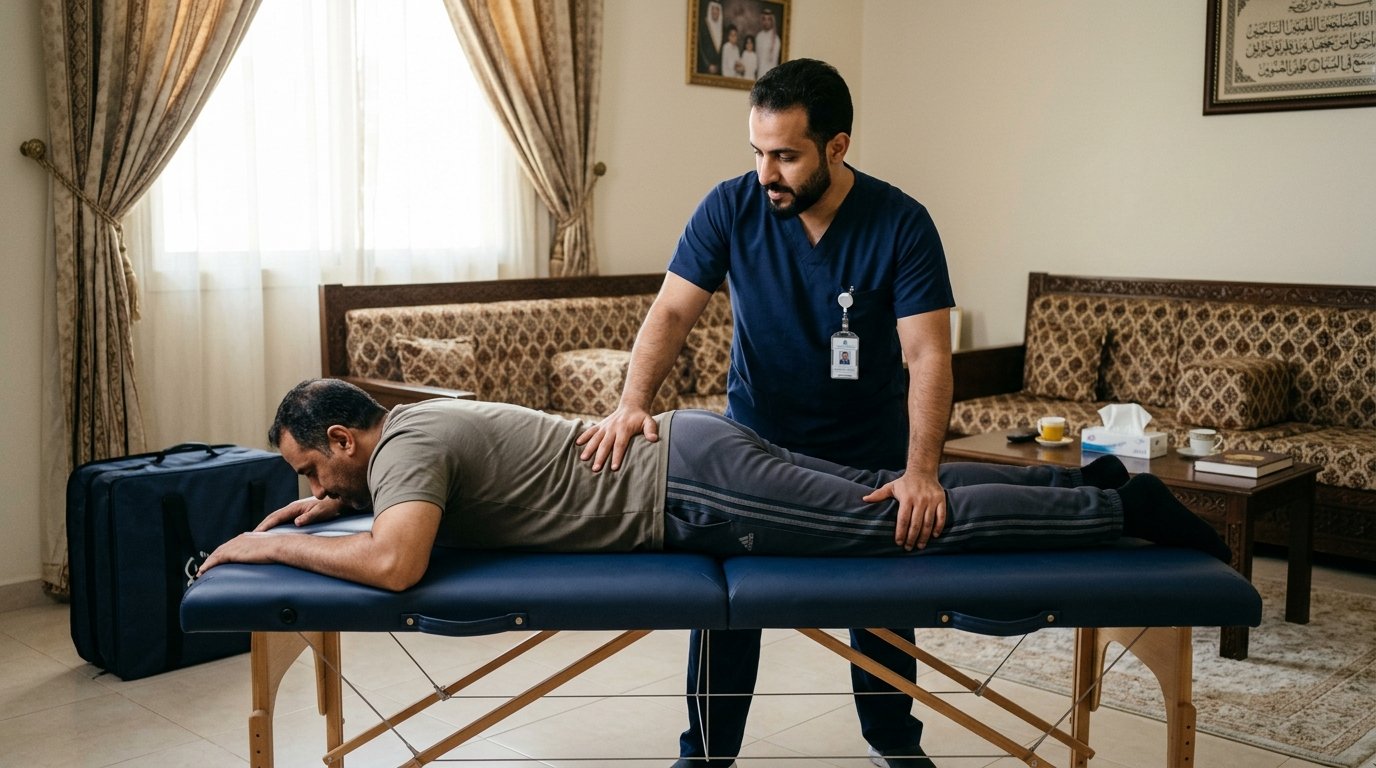
Advanced In-Home Musculoskeletal & Spine Physiotherapy
Evidence-based clinical rehabilitation for spinal disorders, disc herniations, degenerative joint arthritis, and musculoskeletal pain syndromes delivered directly within your home across Dammam, Khobar, and Eastern Province.
Comprehensive In-Home Clinical Evaluation (60-75 Mins)
Detailed functional & neuro examination, home safety audit, and custom protocol with portable equipment — no upfront package commitments.
Flexible appointments 7 days a week (8 AM - 10 PM) • Payment upon visit completion
1,500+ Successful Home Recoveries
Certified Clinical Physiotherapists
Assessment-First Protocol
Thorough physical evaluation before any treatment plan starts
Specialized Male Therapists
Professional licensed therapists visiting your residence
100% In-Home Rehabilitation
No clinic travel friction or waiting room discomfort
Targeted Functional Goals
Focused on daily stairs, walking endurance, and independence
Emergency Medical Red-Flags & Home Care Boundaries
Emergency Notice: If back pain is accompanied by loss of bowel/bladder control or saddle numbness, call 997 immediately.
Musculoskeletal disorders and spinal pain syndromes represent the single greatest cause of chronic physical impairment, occupational absenteeism, and reduced quality of life across Saudi Arabia's Eastern Province. Contemporary lifestyles characterized by prolonged sedentary computer work, improper neck ergonomics during smart device usage, extended vehicular commutes across the Dammam-Khobar-Jubail highway network, and insufficient physical conditioning impose asymmetrical mechanical stresses across spinal discs, facet joints, and kinetic chain soft tissues.
At Bidaya In-Home Physiotherapy & Medical Rehabilitation, we provide an advanced clinical pathway delivering specialized orthopaedic and spinal physical therapy directly to your residence. We recognize that patients experiencing acute lumbar radiculopathy, active sciatic flare-ups, or severe knee osteoarthritis find clinic transit deeply fatiguing, frequently provoking muscle spasms before treatment even commences. Our mobile clinical service eliminates transit friction by translating a fully equipped physical therapy clinic into your living room.
Our clinical methodology combines internationally recognized manual therapy protocols, Maitland and McKenzie joint mobilizations, neural dynamic tension-release techniques, and corrective exercise prescriptions designed to address biomechanical muscle imbalances, stabilize the core, and protect against recurrent spinal episodes. Every program begins with an exhaustive baseline diagnostic intake evaluating arthrokinematic limitations, dural irritability, and functional movement deficits. We also engineer complete residential ergonomic modifications to ensure posture-induced mechanical strain is permanently resolved. By delivering comprehensive physical therapy inside your residence, we ensure that every therapeutic gain translates directly into pain-free domestic living and unrestrained functional independence.
Clinical Scope of In-Home Musculoskeletal Rehabilitation
Comprehensive Diagnostic Tracks Spanning Spinal and Peripheral Joints
Our orthopaedic in-home service encompasses a comprehensive clinical spectrum: 1. Spinal Pathologies & Radicular Syndromes: Lumbar disc protrusions and herniations, sciatic neuropathy, cervical disc lesions, cervical facet joint lock, lumbar canal stenosis, and degenerative spondylolisthesis. 2. Major Joint Osteoarthritis: Advanced knee osteoarthritis with range of motion restrictions, degenerative hip arthritis, and sacroiliac joint dysfunction. 3. Shoulder Complex Impairments: Adhesive capsulitis (frozen shoulder) across all stages, subacromial impingement syndrome, and rotator cuff tendinopathy or partial tears. 4. Soft Tissue & Tendon Disorders: Plantar fasciitis, Achilles tendinopathy, lateral epicondylalgia (tennis elbow), and persistent myofascial pain trigger points.
Objective Orthopaedic Clinical Evaluation Protocol
A Thorough 60-Minute Biomechanical Intake Isolating Primary Pain Drivers
Every musculoskeletal consultation commences with an objective clinical intake: - Active and Passive Range of Motion (Goniometric Audit): Quantitative measurement of joint range of motion using clinical goniometers to document mechanical movement restrictions and end-feel characteristics (capsular, muscular, or bony block). - Provocative Neurological & Dural Tension Testing: Conducting the Straight Leg Raise (SLR), Spurling's test, and Slump test to identify nerve root compression or neuromeningeal irritation. - Manual Muscle Strength Grading (Oxford Scale): Evaluating agonist-antagonist strength ratios and isolating inhibited muscular stabilizers across the kinetic chain. - Biomechanical & Postural Assessment: Examining spinal curvature, pelvic tilt, and weight-bearing symmetry during standing, sitting, and gait cycles.
- Baseline vitals screening and cardiovascular risk stratification
- Digital goniometric active/passive range-of-motion measurement
- Standardized manual muscle testing (Oxford Scale 0-5)
- Neurodynamic dural tension tests (SLR, Slump, Spurling)
- Postural alignment, pelvic symmetry, and gait biomechanics audit
Advanced In-Home Manual Therapy and Joint Mobilization
Restoring Arthrokinematic Glides and Inhibiting Peripheral Nociceptive Pain
Our visiting clinicians execute specialized manual therapy interventions within your home: - Maitland Graded Joint Mobilizations (Grades I-IV): Utilizing gentle, rhythmic oscillatory movements to stimulate articular mechanoreceptors, suppress pain perception, and restore physiological joint capsule accessory glides. - McKenzie Method of Mechanical Diagnosis and Therapy (MDT): Identifying directional preferences to encourage disc nuclear centralization and rapidly reduce peripheral radicular referral along the extremity. - Myofascial Trigger Point Deactivation: Applying targeted ischemic compression and transverse friction massage to eliminate hyperirritable taut bands in the lumbar, scapular, and gluteal musculature.
Neuromuscular Stabilization and Deep Core Retraining
Constructing an Anatomic Muscular Brace Protecting the Spine and Joints
While manual therapy temporarily modulates pain, progressive therapeutic strengthening is essential to achieve lasting functional recovery: - Transversus Abdominis and Lumbar Multifidus Activation: Coaching patients in deep abdominal drawing-in maneuvers to stabilize the lumbar spine during movement without breath holding. - Gluteal Muscle Activation & Pelvic Stability: Strengthening the gluteus medius and maximus to correct dynamic knee valgus and minimize compressive joint loads during ambulation. - Progressive Elastic Band Loading: Gradually introducing multi-directional resistance using calibrated Therabands to restore functional muscular endurance and joint dynamic stabilization.
Neurodynamic Mobilization and Peripheral Nerve Gliding
Restoring Dural Excursions and Alleviating Extremity Paresthesia
In lumbar and cervical disc disorders, inflammatory compression provokes intraneural edema and dural adhesions that impair physiological nerve gliding through anatomical tunnels.
Our clinicians deploy precise neurodynamic sliders and tensioners: 1. Sciatic Nerve Mobilization: Alternating ankle dorsiflexion and knee extension with cervical motion to facilitate smooth axonal gliding without excessive tensile strain. 2. Median and Radial Nerve Glides: Decompressing upper extremity neural pathways to resolve cervicobrachial tingling and restoring uninhibited arm elevation. 3. Accelerating Intraneural Edema Resorption: Promoting capillary microcirculation around irritated dural sleeves, expediting symptom resolution.
Ergonomic Optimization of Home and Work Environments
Modifying Seating, Bedding, and Daily Movement to Prevent Recurrent Strain
Our therapist audits your living and remote work environment within Eastern Province homes: - Ergonomic adjustment of home office chairs, lumbar supports, and computer monitor heights to preserve neutral cervical and lumbar lordosis. - Evaluating mattress firmness and pillow contouring to eliminate asymmetrical nocturnal spinal stress. - Educating patients on proper hip-hinging body mechanics when lifting household items or performing daily chores to safeguard lumbar intervertebral discs.
Functional Movement and Prayer Ergonomics Retraining
Conditioning Lower Extremity Joints for Safe Ground Prayer Postures
In Saudi domestic life, independent ground prayer (Sujood and Ruku) represents an essential functional milestone for rehabilitation candidates: - Progressive Closed-Chain Loading: Retraining quadriceps eccentric control and hip flexion tolerance to facilitate controlled lowering to floor mats without traumatic joint impact. - Ankle and Knee Capsular Flexibility: Deploying specialized soft-tissue mobilizations to restore end-range plantarflexion and knee flexion required for seated prayer. - Ergonomic Chair Alternatives: For patients with severe joint contractures, establishing supportive chair prayer postures that maintain dignity while preventing harmful spinal torque.
Knee Osteoarthritis and Joint Unloading Protocols in the Domestic Setting
Mitigating Compartmental Joint Compression and Isolating the Vastus Medialis Oblique (VMO)
Knee osteoarthritis is highly prevalent among older adults and middle-aged individuals across the Eastern Province. Our in-home physical therapy protocols focus on eliminating abnormal compressive and shear forces across the tibiofemoral and patellofemoral joints: - Patellofemoral Glide Mobilizations: Restoring superior, inferior, and medial patellar accessory mobility to ensure smooth trochlear tracking during flexion and extension cycles. - Vastus Medialis Oblique (VMO) Neuromuscular Activation: Deploying terminal knee extension drills over foam rollers, utilizing portable neuromuscular electrical stimulation (NMES) when arthrogenic muscle inhibition is present. - Hip Abductor and External Rotator Strengthening: Targeted closed-chain clamshells and lateral resistance-band walks to control the dynamic Q-angle, preventing dynamic knee valgus during stair climbing and sit-to-stand transitions.
Adhesive Capsulitis (Frozen Shoulder) and Rotator Cuff In-Home Protocols
Staged Capsular Distension, Maitland Inferior Glides, and Scapulohumeral Rhythm Restoration
Managing adhesive capsulitis and rotator cuff tendinopathy inside the home demands stage-specific clinical pacing to avoid exacerbating chronic synovitits: - Freezing Stage Management: Emphasizing gentle pain-free pendular movements, Grade I-II glenohumeral oscillations, and scapular retraction exercises to preserve periscapular muscular tone without provoking nocturnal pain. - Frozen Stage Mobilization: Deploying Grade III-IV Maitland inferior and posterior humeral glides to stretch the contracted inferior axillary pouch, systematically reclaiming external rotation and abduction. - Thawing and Functional Strengthening: Progressing into active-assisted pulley exercises, eccentric rotator cuff loading with graduated elastic tubing, and retraining kinetic chain force couples between the serratus anterior and lower trapezius.
Clinical Safety Boundaries and Urgent Emergency Exclusion
Strict Protocols Protecting Patients from Severe Neurological Complications
If any of the following clinical red flags are detected during spinal evaluation: 1. Sudden loss of bowel or bladder control, or saddle numbness in the perineal region (Cauda Equina Syndrome). 2. Acute progressive motor paresis such as sudden foot drop or severe quadriceps buckle during weight bearing. 3. Unremitting severe nocturnal back pain unaffected by posture, accompanied by systemic fever or rapid unexplained weight loss. Therapy is halted immediately, and the patient is referred for urgent neurosurgical or emergency hospital evaluation (997).
Frequently Asked Questions about In-Home Physiotherapy
Yes, the vast majority of lumbar disc herniations presenting without acute emergency neurological red flags achieve excellent pain reduction, inflammation resolution, and full functional recovery through specialized in-home manual therapy and corrective exercise.
Related Clinical & Regional Pathways
Specialized Neurological Physiotherapy→
Evidence-based neurological physical therapy harnessing neuroplasticity
Specialized Sports Physiotherapy & Injury Rehabilitation→
Evidence-based clinical rehabilitation engineered to accelerate soft-tissue repair
Specialized Geriatric Physiotherapy & Fall Prevention→
Evidence-based clinical rehabilitation tailored specifically to preserve functional independence
Specialized Generalized Multi-Joint Osteoarthritis→
Evidence-based systemic musculoskeletal and arthritis rehabilitation delivered directly to your doorstep in Dammam
Specialized Disuse Muscle Atrophy & Sarcopenia Rehabilitation→
Evidence-based systemic musculoskeletal and arthritis rehabilitation delivered directly to your doorstep in Dammam
Specialized Chronic MSK Pain & Central Sensitization→
Evidence-based systemic musculoskeletal and arthritis rehabilitation delivered directly to your doorstep in Dammam
Specialized Fibromyalgia Graded Functional Exercise→
Evidence-based systemic musculoskeletal and arthritis rehabilitation delivered directly to your doorstep in Dammam
Specialized Rheumatoid Arthritis Joint Protection→
Evidence-based systemic musculoskeletal and arthritis rehabilitation delivered directly to your doorstep in Dammam