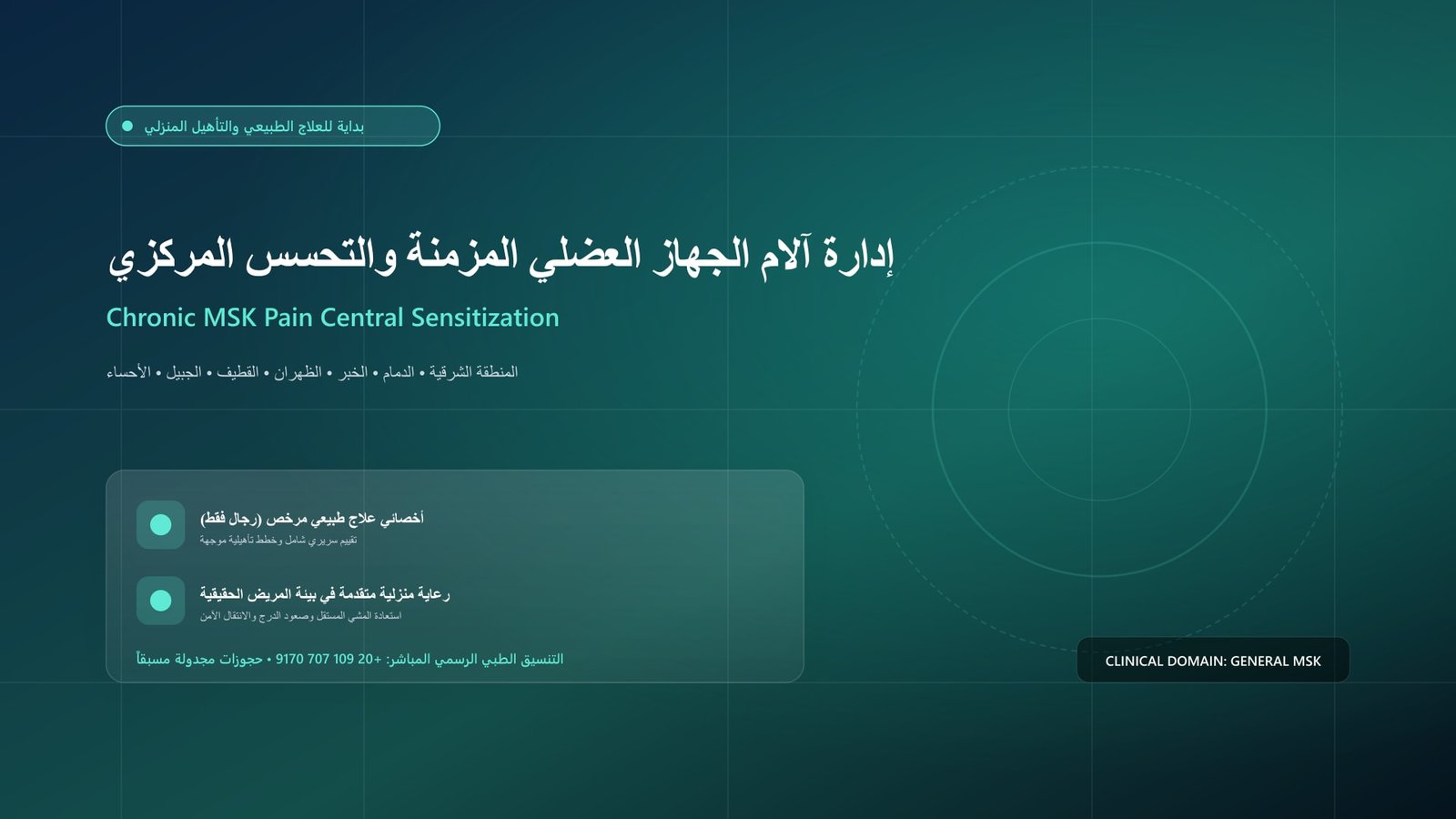
Advanced In-Home Physiotherapy for Chronic Musculoskeletal Pain & Central Sensitization
Evidence-based systemic musculoskeletal and arthritis rehabilitation delivered directly to your doorstep in Dammam, Khobar, and Eastern Province cities with maximum privacy and clinical rigor.
Comprehensive In-Home Clinical Evaluation (60-75 Mins)
Detailed functional & neuro examination, home safety audit, and custom protocol with portable equipment — no upfront package commitments.
Flexible appointments 7 days a week (8 AM - 10 PM) • Payment upon visit completion
1,500+ Successful Home Recoveries
Certified Clinical Physiotherapists
Assessment-First Protocol
Thorough physical evaluation before any treatment plan starts
Specialized Male Therapists
Professional licensed therapists visiting your residence
100% In-Home Rehabilitation
No clinic travel friction or waiting room discomfort
Targeted Functional Goals
Focused on daily stairs, walking endurance, and independence
Emergency Medical Red-Flags & Home Care Boundaries
In-home MSK therapy is strictly intended for stable conditions. If systemic fever co-exists with acute monoarticular warmth or rapid neurovascular collapse, seek emergency medical care immediately.
When musculoskeletal pain persists beyond normal physiological tissue healing timelines (typically exceeding 3-6 months), the central nervous system undergoes neuroplastic hyper-responsiveness termed central sensitization. Characterized by generalized hyperalgesia, allodynia, and movement-related fear-avoidance, managing persistent pain requires a modern biopsychosocial framework. Bidaya delivers home Pain Neuroscience Education (PNE) coupled with gentle graded exposure exercise via certified male physical therapists.
Clinical Biomechanics & Advanced Tissue Pathology for (Chronic MSK Pain & Central Sensitization)
Pathomechanical Analysis, Tissue Failure Mechanisms, and Kinetic Chain Compromise
In-home management of Chronic MSK Pain & Central Sensitization across Eastern Province provides a personalized clinical approach focusing on dorsal horn nociceptive neurons, ascending spinothalamic tracts, somatosensory cortex, and descending inhibitory pathways impaired by neuroplastic maladaptive hyperexcitability, central sensory amplification, expanded receptive fields, and allodynia. The resultant kinetic imbalance disrupts force transmission through fear-avoidance behavior, movement-related apprehension, generalized neuromuscular guarding, and secondary physical deconditioning, triggering discomfort during transitional movements and manual lifting tasks. Bidaya's visiting male specialists assess the interplay between domestic movement patterns and clinical presentation, formulating progressive exercises to decompress overloaded structures. Evidence-based home rehabilitation accelerates tissue remodeling while allowing patients to heal comfortably in their private living environment.
Targeted in-home mobilization stimulates natural synovial fluid production, lubricating sensitive cartilage surfaces and significantly alleviating troublesome morning joint stiffness. Restoring fluid joint kinematics enables smooth, comfortable transitions from bed to standing upon waking. Furthermore, supervised home clinical intervention establishes early neuromuscular control, systematically attenuating nociceptive input and optimizing functional mobility across all domestic environments.
Comprehensive Residential Clinical Evaluation & Diagnostic Battery for (Chronic MSK Pain & Central Sensitization)
Standardized Goniometry, Manual Muscle Testing, and Specialized Provocation Maneuvers
Bidaya's specialized residential evaluation in Eastern Province evaluates both open and closed kinetic chain performance: 1. Dynamic shock absorption analysis across lower extremity and spinal segments identifying kinematic compensations. 2. Goniometric measurement of functional movement angles during household tasks compared to normative clinical values. 3. Orthopedic stress maneuvers confirming ligamentous integrity and tendon tensile stability under directed load. 4. Neuromuscular recruitment profiling identifying muscular inhibition or protective guarding within the home setting.
This in-depth assessment isolates underlying biomechanical dysfunctions, enabling therapists to select the safest therapeutic exercises.
Observing patients within their home setting provides genuine insight into physical challenges, directing care toward meaningful functional goals.
Patients receive clear anatomical explanations of findings alongside an individualized plan for subsequent therapeutic phases.
Residential assessment captures authentic functional mechanics during daily living activities, providing realistic diagnostic insight rarely attainable in outpatient clinic settings. Evaluating actual floor-to-stand and chair transitions allows clinicians to formulate targeted mechanical corrections immediately. Recording granular clinical metrics during each home visit provides an objective benchmark for therapeutic progression, verifying steady functional recovery and patient physical resilience.
Precision Objective Documentation
Establishing quantified baseline metrics during the initial home visit enables precise outcome measurement, allowing clinicians to modulate load parameters in direct alignment with biological tissue healing rates.
| Clinical Assessment / Provocation Test | Diagnostic Target | Positive Clinical Indicator | Portable Clinical Instrumentation |
|---|---|---|---|
| Central Sensitization Inventory (CSI) | Quantify central neuroplastic hyper-responsiveness | Score exceeding 40/100 validating clinical presence of central sensory amplification | Validated clinical inventory |
| Pressure Pain Threshold (PPT) Remote Testing | Assess secondary hyperalgesia and spatial summation | Significantly depressed mechanical pain thresholds at remote unaffected anatomical sites | Clinical algometry |
| Tampa Scale for Kinesiophobia (TSK) | Quantify fear of movement and reinjury conviction | Score >37 indicating severe movement-related fear-avoidance requiring graded exposure therapy | Standardized psychological scale |
Evidence-Based Rehabilitation Protocol & Progressive Loading Phases for (Chronic MSK Pain & Central Sensitization)
Multi-Tiered Care Plan Combining Manual Therapy, Neuromuscular Stabilization, and Kinetic Chain Reconditioning
Bidaya's in-home rehabilitation protocol follows a structured biological remodeling model with four progressive phases: - Phase 1: Alleviating acute inflammatory irritation and decompressing dorsal horn nociceptive neurons, ascending spinothalamic tracts, somatosensory cortex, and descending inhibitory pathways through gentle manual therapy. - Phase 2: Restoring physiological range of motion and improving soft-tissue compliance via guided therapeutic stretches. - Phase 3: Progressive resistive conditioning and dynamic stabilization utilizing calibrated resistance bands and clinical gear. - Phase 4: Functional simulation of domestic tasks, religious worship, and independent community ambulation without restriction.
Clinicians reassess tissue tolerance after every session to calibrate exercise intensity to biological healing velocity. Continuous direct supervision prevents faulty movement substitutions, ensuring lasting protection against reinjury. Patients receive ongoing reassurance and clinical coaching that builds functional confidence and movement autonomy.
This methodical tier system establishes muscular stamina gradually, shielding sensitive mechanoreceptors from excessive shear forces and secondary irritation. Systematic reconditioning dampens peripheral sensitivity, restoring pain-free functional movement. Adherence to evidence-based mechanotransductive staging shields vulnerable articulations while steadily building functional physical endurance across everyday residential tasks.
Safe Therapeutic Loading Rules
Therapeutic exercise discomfort must remain at or below 3/10 during execution and must completely subside to baseline within 60 minutes post-session.
- Pain Neuroscience Education (PNE) reframing pain as a hypersensitive alarm system rather than structural harm
- Graded movement exposure methodically decoupling functional activities from perceived threat
- Diaphragmatic pacing and autonomic down-regulation reducing sympathetic hyper-arousal
- Rhythmic low-intensity aerobic conditioning stimulating descending endogenous opioid and serotonergic analgesia
Step-by-Step Prescribed Residential Exercise Protocol for (Chronic MSK Pain & Central Sensitization)
Detailed Guidance on Movement Execution, Biomechanical Form, Respiratory Timing, and Safe Progression Criteria
To optimize functional gains while safeguarding healing structures in (Chronic MSK Pain & Central Sensitization), our visiting clinician directly supervises the following home exercise protocol:
1. Restorative Tissue Decompression & Activation: Diaphragmatic nervous system pacing: supine with one hand on chest and one on abdomen, inhaling through nose for 4 seconds expanding belly, exhaling slowly through pursed lips for 6 seconds, 5 minutes.
2. Capsular Extensibility & Muscle Lengthening: Gentle rhythmic pelvic rocking: supine with knees flexed, gently tilting pelvis forward and backward within absolute pain-free limits, synchronizing movement with calm respiration, 12 reps, 3 sets.
3. Progressive Dynamic Stabilization & Neuromuscular Coordination: Time-contingent interval walking: ambulating indoors at a relaxed pace for 3 minutes strictly by time rather than pain, resting seated 1 minute, repeating for 3 cycles to rebuild movement tolerance.
Clinicians fine-tune body alignment, cue diaphragmatic breathing, and structure individualized rest intervals ensuring exercises stimulate remodeling without overload.
Movement precision and movement quality supersede repetition volume; patients are advised to stop immediately and alert their therapist should sharp atypical discomfort occur.
Therapeutic movements are systematically integrated into your domestic rhythm, ensuring each exercise directly facilitates easier bed transfers, smoother prayer transitions, and effortless household mobility.
Our visiting specialist regulates movement tempo to activate deep postural stabilizers, avoiding rapid rebounding motions that fatigue healing tissues. Controlled deceleration trains eccentric muscular capacity, providing vital joint protection during daily tasks. Disciplined independent execution under periodic clinical review reinforces positive biomechanical adaptations, permanently eliminating compensatory strain from daily physical routines.
- Avoid hazardous mechanical vectors, particularly: pushing through sharp escalating pain to exhaustion, total sedentary bedrest isolation, and chasing quick-fix passive modalities
- Execute all prescribed drills on a firm, supportive mat rather than excessively plush beds or sofas
- Maintain steady diaphragmatic respiration, strictly avoiding Valsalva breath-holding during exertion
- Log exercise tolerance and any transient symptoms for review during subsequent visits
Domestic Environmental Ergonomics & Joint Protection Strategies across Eastern Province
Actionable Adjustments for Prayer Postures, Majlis Seating, and Extended Eastern Province Commuting
Practical ergonomic recommendations provided by Bidaya in Eastern Province support comprehensive recovery from (Chronic MSK Pain & Central Sensitization): - Prayer Mechanics Progression: Reviewing prayer postures and guiding progressive transition back toward ground Sujud safely. - Majlis & Living Areas: Installing firm supportive foam cushions to optimize seat angles and facilitate gluteal-driven rising. - Expressway Travel Setup: Adjusting headrests and backrest incline to absorb vibrational shock during regional commutes. - Restful Sleeping Architecture: Arranging contoured pillows to maintain neutral cervical and lumbar alignment through the night.
These actionable adjustments preserve clinical gains between visits, providing continuous protection to recovering tissues. Clinical evidence demonstrates that domestic adaptation significantly shortens overall recovery time and enhances daily comfort.
Structuring restorative sleep environments with contoured orthopedic pillows relieves nocturnal joint pressure, ensuring you awake refreshed and free from morning gel. Maintaining neutral spinal contours overnight fosters deep, uninterrupted biological repair. Cultivating joint-sparing habits during daily domestic tasks protects healing periarticular tissues, ensuring functional improvements achieved during therapy remain durable across years.
- Recognize that symptom flare-ups reflect nervous system sensitivity rather than physical tissue damage
- Engage in daily time-contingent light home walking rather than activity governed by pain emergence
- Establish strict sleep hygiene, removing digital screens one hour before bedtime to quiet cortical arousal
- Deploy diaphragmatic breathing during flare-ups to avert reflexive secondary muscle splinting
Quantitative Clinical Discharge Criteria & Long-Term Joint Longevity for (Chronic MSK Pain & Central Sensitization)
Evidence-Based Benchmarks Confirming Restored Functional Independence and Lasting Musculoskeletal Health
Bidaya establishes transparent, quantifiable clinical discharge criteria in Eastern Province rooted in bilateral strength and functional symmetry: 1. Limb Symmetry Index (LSI): Achieving greater than 90% strength and stability symmetry between affected and healthy limbs. 2. Dynamic Joint Stability: Zero reactive swelling, tenderness, or pain flares following full daily physical activity. 3. Functional Independence: Confident resumption of prayer Sujud, multi-hour highway driving, and sustained walking without aids.
Graduating patients receive a customized home maintenance program to perform twice weekly to preserve musculoskeletal gains indefinitely.
Direct communication channels via official WhatsApp and coordination line (+20 109 707 9170) remain open for ongoing guidance.
Official communication channels via WhatsApp and phone (+20 109 707 9170) remain open for ongoing guidance, safeguarding lasting health for you and your family in Eastern Province. Expert clinical counsel is always available whenever new mobility questions arise. Achieving these standardized clinical discharge metrics validates that dynamic stabilization mechanisms operate effectively during all vocational, recreational, and spiritual activities.
Frequently Asked Questions about In-Home Physiotherapy
Your pain is 100% real and physiologically measurable; the volume dial of your central nervous system is simply set too high, which we recalibrate through therapy.
Related Clinical & Regional Pathways
Fibromyalgia Graded Functional Exercise→
Evidence-based systemic musculoskeletal and arthritis rehabilitation delivered directly to your doorstep in Dammam
Disuse Muscle Atrophy & Sarcopenia Rehabilitation→
Evidence-based systemic musculoskeletal and arthritis rehabilitation delivered directly to your doorstep in Dammam
Rheumatoid Arthritis Joint Protection→
Evidence-based systemic musculoskeletal and arthritis rehabilitation delivered directly to your doorstep in Dammam
Musculoskeletal Physiotherapy→
Evidence-based clinical rehabilitation for spinal disorders
Knee Osteoarthritis & Joint Care→
Advanced in-home rehabilitation across Al Hofuf led by licensed male clinicians
In-Home Physiotherapy in Al Mubarraz→
Comprehensive in-home physical therapy delivered across Al Mubarraz by licensed male clinicians for geriatric
Elderly Mobility & Balance Physiotherapy→
Advanced in-home rehabilitation across Al Mubarraz led by licensed male clinicians
Post-Op Orthopedic & Joint Rehab→
Advanced in-home rehabilitation across Al Mubarraz led by licensed male clinicians