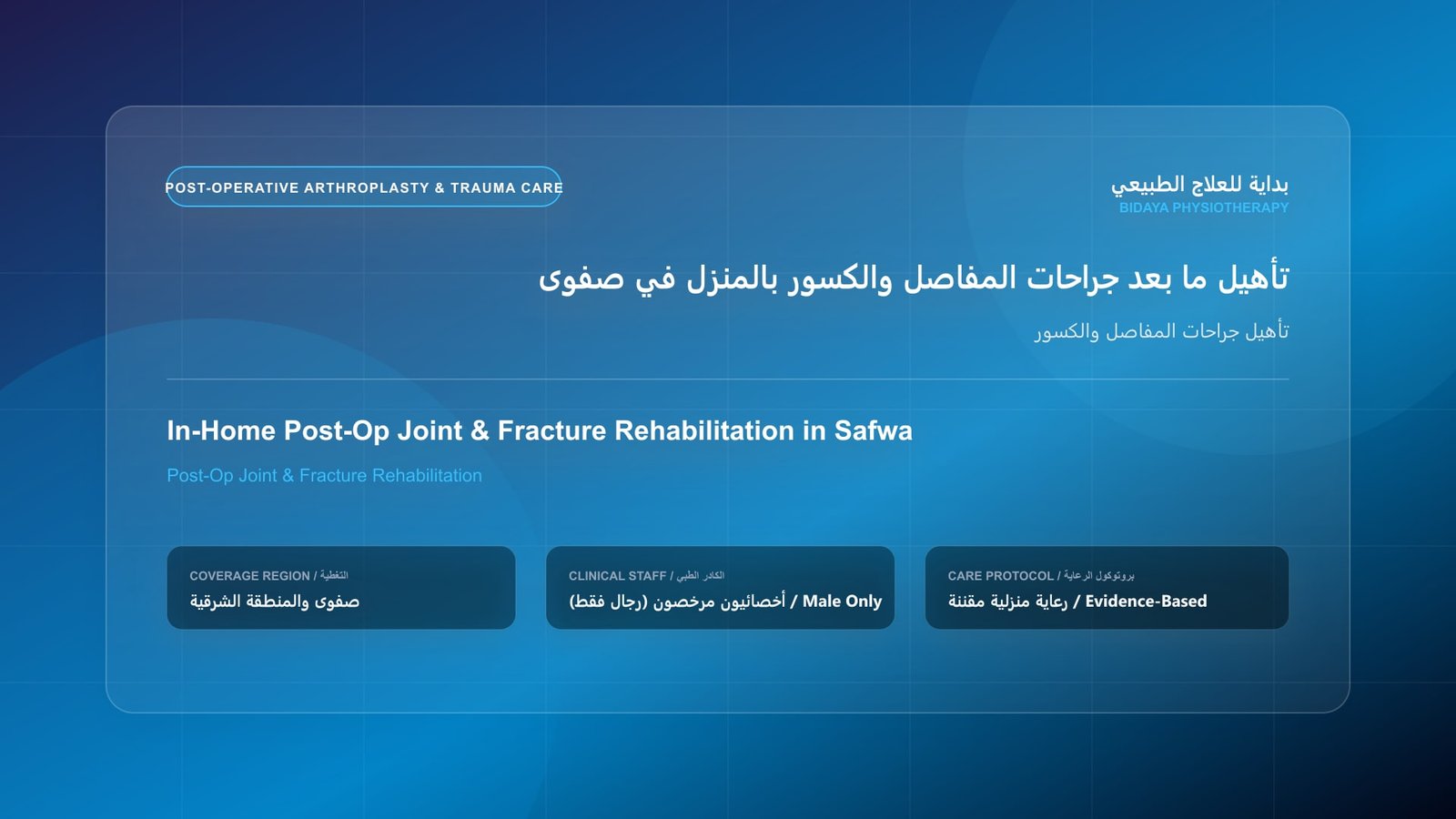
In-Home Post-Op Joint & Fracture Rehabilitation in Safwa
Advanced in-home rehabilitation across Safwa led by licensed male clinicians, restoring mobility and daily functional independence.
Comprehensive In-Home Clinical Evaluation (60-75 Mins)
Detailed functional & neuro examination, home safety audit, and custom protocol with portable equipment — no upfront package commitments.
Flexible appointments 7 days a week (8 AM - 10 PM) • Payment upon visit completion
1,500+ Successful Home Recoveries
Certified Clinical Physiotherapists
Assessment-First Protocol
Thorough physical evaluation before any treatment plan starts
Specialized Male Therapists
Professional licensed therapists visiting your residence
100% In-Home Rehabilitation
No clinic travel friction or waiting room discomfort
Targeted Functional Goals
Focused on daily stairs, walking endurance, and independence
Emergency Medical Red-Flags & Home Care Boundaries
Emergency Medical Boundary: Bidaya provides scheduled in-home therapeutic rehabilitation and is not an emergency medical dispatch service. For acute neurological deficits, unreduced fractures, severe respiratory distress, or sudden chest pain, contact the Saudi Red Crescent immediately at 997 or 911.
Integrating kinematic realignment for Post-Op Joint & Fracture Rehabilitation with domestic architectural hazard mitigation, Bidaya provides comprehensive in-home physiotherapy across Safwa. Our certified male physical therapists guide patients progressively toward sustainable pain-free living.
Post-Operative Orthopedic Monitoring in Safwa Homes
Wound Inspection, Range-of-Motion Restoration & Surgical Edema Control
The post-operative phase following arthroplasty or fracture osteosynthesis requires early in-home rehabilitation to protect surgical fixation and prevent joint arthrofibrosis.
Bidaya's visiting physical therapists review operative protocols, inspect incision healing, and deliver graded range-of-motion drills combined with cryo-elevation protocols.
Weight-Bearing Adherence
Strict compliance with surgeon-specified weight-bearing restrictions protects internal hardware from premature mechanical failure.
- Verify surgical weight-bearing guidelines documented on discharge records
- Inspect incision margins for primary closure and absence of erythema
- Quantify joint flexion and extension arcs against operative benchmarks
- Calibrate and instruct crutch or walker ambulation across domestic quarters
Progressive In-Home Muscular Restoration & Independent Ambulation
Isometric Reactivation, Stair Navigation Mastery & Gait Normalization
Therapy initiates with submaximal isometrics to overcome muscle inhibition, advancing to active-assisted loading and hip stabilizer strengthening.
Clinicians coach staircase ascent and descent within the patient's residence, resolving antalgic gait deviations to establish full independence.
Post-Exercise Swelling Control
Limb elevation above heart level combined with a 20-minute cold pack session post-exercise effectively minimizes dependent reactive edema.
- Execute ankle pumps and quadriceps sets in bed multiple times daily
- Apply cold packs for 20 minutes following exercise sessions
- Ascend stairs leading with the sound leg and descend leading with the operated leg
- Transition away from mobility aids only after achieving stable single-limb stance
Integrating Safwa Climatic Factors into Therapeutic Load Pacing
Indoor Microclimate Optimization, Hydration Maintenance & Preventing Exertional Fatigue
The climatic conditions of Safwa, marked by elevated summer ambient temperatures and humidity, impose unique physiological stresses on patients rehabilitating from Post-Op Joint & Fracture Rehabilitation, especially seniors and chronic patients.
Bidaya's licensed male clinicians optimize the domestic setting to safeguard patient vitality: 1. Ambient microclimate calibration: Mandating climate-controlled indoor rooms maintained between 21°C and 23°C with adequate hydration to thwart hypovolemia. 2. Exertional pacing and hemodynamic tracking: Scheduling sessions during optimal biological windows, pacing exercise intensity while monitoring vital signs. 3. Intermittent rest pauses: Structuring bedside ankle pump hemodynamics, static quadriceps sets, active-assisted heel slides, and locked-brace straight leg raises with scheduled recovery buffers to eliminate sudden autonomic spikes or thermoregulatory distress.
Exercising in a controlled home microclimate enables patients to achieve vital functional adaptations safely year-round in Safwa.
Thermal Hydration Metric in Safwa
Consuming 250ml of water prior to exertion and maintaining room temperature below 23°C mitigates orthostatic drops and premature neuromuscular fatigue.
- Pre-cool therapeutic room with active air conditioning 15 minutes prior to session
- Wear loose-fitting, breathable cotton attire facilitating unrestricted movement
- Record baseline blood pressure and resting heart rate in cardiac and frail patients
- Strictly restrict demanding physical drills to climate-controlled indoor quarters
Quantitative Arthrokinematic Measurement & Tissue Profiling for Post-Op Joint & Fracture Rehabilitation in Safwa
Calibrated Goniometry, Provocation Mapping & Structural Tissue Tolerance
Bidaya utilizes a rigorous quantitative diagnostic framework for Post-Op Joint & Fracture Rehabilitation across Safwa, combining manual palpation with portable, sanitized assessment instruments.
Core elements of the in-home clinical examination: 1. Targeted Diagnostic Battery: Executing surgical incision inspection, circumferential girth edema quantification, active/passive goniometry, and straight-leg raise extensor lag audit and recording angular arcs in degrees and linear limb girth in centimeters. 2. Pain Provocation Mapping: Identifying specific postures and loading directions that aggravate or alleviate symptoms to establish the directional preference. 3. Myofascial Extensibility Screening: Assessing muscle-tendon compliance and screening for active myofascial trigger points. 4. Domestic Functional Performance: Evaluating patient ability to execute bed transfers, independent rising, and hallway ambulation safely.
These objective findings provide baseline metrics tracked longitudinally via Lower Extremity Functional Scale (LEFS) and Oxford Joint Arthroplasty Score.
Quantitative Precision in Safwa
Recording motion metrics in exact degrees allows rigorous cross-session comparison, objectively confirming therapeutic response.
- Record joint ranges in standardized digital documentation charts
- Map symptom distribution and intensity during active and resting states
- Inspect soft-tissue elasticity and scar compliance across affected regions
- Identify domestic architectural barriers specific to the patient's residence
Clinical Discharge Benchmarks & Independent Functional Resumption for Post-Op Joint & Fracture Rehabilitation
Verifying Complete Functional Capacity and Transitioning to Autonomous Maintenance
Graduation from intensive in-home physical therapy for Post-Op Joint & Fracture Rehabilitation is governed by objective functional markers demonstrating independent mobility.
Discharge and functional criteria: 1. Functional Battery Mastery: Attaining achieving 90 degrees knee flexion by postoperative week 2, terminal 0-degree extension, and weaning from walker to single crutch upon reaching 4/5 quadriceps force with zero mechanical compensation. 2. Autonomous Home Conditioning: Independent, correct execution of bedside ankle pump hemodynamics, static quadriceps sets, active-assisted heel slides, and locked-brace straight leg raises. 3. Sustainable Symptom Relief: Maintaining pain scores below 2/10 across all standard daily domestic tasks.
The patient transitions seamlessly into a personalized longitudinal wellness framework to safeguard functional gains.
Graduation Milestone
Achieving functional autonomy and possessing the skills for independent joint protection represent true clinical success.
- Execute final functional assessment battery documenting quantitative gains
- Deliver comprehensive illustrated home maintenance portfolio to patient
- Schedule optional quarterly longitudinal check-ins with clinical desk
- Verify patient confidence in navigating domestic and community environments
Kinetic Safety Protocols & Bedside Transfer Retraining across Safwa
Protecting Joint Integrity During Daily Bed, Chair & Hallway Transit for Post-Op Joint & Fracture Rehabilitation
Bidaya delivers targeted instruction to help patients manage daily household transitions safely without aggravating Post-Op Joint & Fracture Rehabilitation across Safwa.
Core kinetic safety protocols: 1. Bedside log-roll transfer: Training side-lying roll mechanics, pushing the torso upright with both arms while lowering legs simultaneously over the bed edge. 2. Prohibited movement envelopes: Enforcing strict avoidance of strictly avoiding acute flexion past operative thresholds, avoiding limb adduction crossing, and utilizing raised toilet seating with a front-wheeled walker during routine domestic encounters. 3. Continuous restorative exercise: Consistent execution of bedside ankle pump hemodynamics, static quadriceps sets, active-assisted heel slides, and locked-brace straight leg raises to reinforce joint stabilization and muscular force. 4. Ergonomic caregiver coaching: Instructing family aides to guide patient pelvis without applying traction to vulnerable joints.
This training establishes complete domestic protection for the patient. Booking coordination: (+20 109 707 9170).
Bedside Transfer Rule in Safwa
Rising from a side-lying posture diminishes peak abdominal and lumbar intradiscal pressure by over 50% compared to straight sit-ups.
- Practice side-lying bed transfers daily until movement becomes second nature
- Keep the perimeter surrounding the bedside entirely clear of walking obstacles
- Adhere strictly to prescribed repetition and set targets in home charts
- Reach out to Bidaya (+20 109 707 9170) for personalized clinical guidance
Clinical Red Flags & Acute Emergency Medical Triage Thresholds
Differentiating Benign Exertional Discomfort from Critical Systemic Warning Signs in Safwa
Bidaya's visiting male physical therapists maintain strict diagnostic vigilance, distinguishing expected post-exercise muscular soreness from critical medical red flags demanding immediate cessation and acute emergency triage.
Critical warning indicators specific to Post-Op Joint & Fracture Rehabilitation: 1. Condition-Specific Warning Signs: Manifestation of acute unilateral calf tenderness with erythema (suspected deep vein thrombosis), purulent wound drainage, or sudden dyspnea. 2. Rapid Neurological Deficit Progression: Sudden bilateral lower extremity numbness, acute motor foot drop, or sudden loss of upright weight-bearing stability. 3. Cauda Equina Syndrome: Onset of perineal numbness (saddle anesthesia) coupled with sudden loss of bowel or bladder sphincter control, constituting a neurosurgical emergency. 4. Acute Cardiopulmonary Symptoms: Sudden substernal chest tightness radiating to jaw or shoulder, acute resting dyspnea, or cold diaphoresis with near-syncope.
Emergency Escalation Protocol: Encountering any red flag in Safwa triggers immediate cessation of physical therapy, positioning the patient safely, and activating the Saudi Red Crescent via 997 or unified emergency dispatch at 911 for immediate transit to Safwa General Hospital and accredited primary health networks. Bidaya provides scheduled in-home physical therapy, not acute emergency medical dispatch. Clinical desk: (+20 109 707 9170).
Uncompromising Medical Safety in Safwa
Clinical boundaries are absolute; therapeutic drills cease immediately upon detecting systemic danger signs to safeguard patient life.
- Contact Saudi Red Crescent immediately at 997 for acute progressive neurological or cardiac distress
- Notify your clinician instantly of any sudden bowel/bladder changes or groin numbness
- Halt exercise immediately if severe, unfamiliar visceral-type pain suddenly emerges
- Maintain emergency medical coordinates (997 and 911) readily visible within domestic quarters
Longitudinal Kinetic Surveillance & Joint Preservation Protocol for Post-Op Joint & Fracture Rehabilitation
Structured Self-Drills, Mobility Tracking & Periodic Consultations in ${cityEn}
Bidaya's long-term kinetic surveillance protocol cements functional milestones achieved during in-home sessions for Post-Op Joint & Fracture Rehabilitation across Safwa.
Core elements of kinetic surveillance: 1. Daily Restorative Routine: Performing gentle mobility exercises drawn from bedside ankle pump hemodynamics, static quadriceps sets, active-assisted heel slides, and locked-brace straight leg raises to stimulate synovial fluid circulation. 2. Self-Administered Motion Audits: Training patients to self-evaluate functional motion against achieving 90 degrees knee flexion by postoperative week 2, terminal 0-degree extension, and weaning from walker to single crutch upon reaching 4/5 quadriceps force. 3. Social Ergonomic Adaptation: Practical strategies for safe sitting and standing during community and family gatherings across Safwa. 4. Longitudinal Support Conduits: Ongoing clinical guidance available via Bidaya's telephone desk (+20 109 707 9170).
This continuous oversight provides long-term peace of mind and sustained functional vitality.
Joint Preservation Practice in Safwa
Cartilage nutrition relies on repetitive cyclic loading; gentle therapeutic movement represents the first defense against joint degeneration.
- Sustain prescribed autonomous exercise calisthenics at home regularly
- Identify early signs of focal joint irritation and modulate intensity
- Engage in structured walking along pleasant promenades like Safwa Health Walkway and municipal park ambulation paths
- Connect with Bidaya (+20 109 707 9170) to advance exercise programs periodically
Social Re-Engagement & Outdoor Community Resumption in Safwa
Resuming Family Life, Independent Errands & Pedestrian Ambulation across Safwa
Bidaya looks beyond domestic four-wall boundaries, empowering patients managing Post-Op Joint & Fracture Rehabilitation to resume active, meaningful roles across Safwa.
Field community reintegration steps: 1. Outdoor Terrain Adaptation: Coaching patients over ramps, concrete paths, and rubberized tracks along Safwa Health Walkway and municipal park ambulation paths. 2. Automotive Mobility Retraining: Mastering seat ingress/egress mechanics in personal vehicles for seamless travel across Al-Orouba, Al-Yarmouk, Al-Hizam, and Al-Madinah. 3. Spiritual Practice Fulfillment: Adapting prayer biomechanics to ensure full adherence to clinical joint precautions. 4. Domestic Familial Engagement: Restoring the physical capacity to sit and converse comfortably in traditional majlis living quarters.
This comprehensive community transition restores joy and social connection across Safwa. Booking desk: (+20 109 707 9170).
Community Participation in Safwa
Stepping into public spaces and participating in daily routines enhances psychological vitality, accelerating neuromuscular equilibrium.
- Practice vehicle transfer mechanics under trained caregiver oversight
- Stroll in accessible public parks during early morning or evening hours
- Deploy a lightweight supportive cane in crowded venues for baseline stability
- Coordinate with Bidaya (+20 109 707 9170) to advance community walking goals
Clinical Excellence Framework & Performance Indicators for Post-Op Joint & Fracture Rehabilitation in Safwa
Objective Arthrokinematic Benchmarking, Safety Audits & Home Care Integrity
Bidaya's clinical practice in Safwa is anchored in continuous excellence principles, ensuring patients managing Post-Op Joint & Fracture Rehabilitation achieve durable functional outcomes.
Pillars of the clinical excellence model: 1. Standardized Quantitative Testing: Measuring clinical outcomes using validated instruments (Lower Extremity Functional Scale (LEFS) and Oxford Joint Arthroplasty Score) to guide evidence-based decisions. 2. Multidisciplinary Case Review: Auditing complex clinical presentations under clinical supervisory oversight adhering to recent literature. 3. Encrypted Health Data Safeguards: Maintaining strict electronic documentation confidentiality conforming to privacy regulations. 4. Dynamic Quality Feedback Integration: Monitoring patient satisfaction through our clinical coordination desk (+20 109 707 9170) to optimize care delivery.
This dedication reflects Bidaya's standing as a leading mobile physiotherapy service across Safwa.
Evidence-Based Precision in Safwa
Anchoring therapy to quantitative metrics and contemporary science ensures accelerated, durable functional recovery.
- Administer standardized functional batteries at calibrated therapeutic milestones
- Protect patient medical records with encrypted digital storage protocols
- Calibrate treatment dosages dynamically based on physiological response
- Communicate with clinical management (+20 109 707 9170) for chart updates
Frequently Asked Questions about In-Home Physiotherapy
In-home care eliminates the stress of vehicular travel and traffic across Safwa, while enabling direct ergonomic inspection of the patient's actual domestic seating and sleeping setups.
Related Clinical & Regional Pathways
Post-Stroke Motor Recovery→
Advanced in-home rehabilitation across Safwa led by licensed male clinicians
Elderly Mobility & Walking Rehab→
Advanced in-home rehabilitation across Safwa led by licensed male clinicians
In-Home Physiotherapy in Ras Tanura→
Comprehensive in-home physical therapy delivered across Ras Tanura (Najmah & City) by licensed male clinicians...
In-Home Physiotherapy Eastern Province Therapy→
Comprehensive clinical rehabilitation delivered directly to your residence across Dammam
In-Home Low Back Pain & Sciatica Rehabilitation Therapy→
Evidence-based clinical rehabilitation engineered to resolve lumbar disc herniations
In-Home Knee Pain & Osteoarthritis Rehabilitation Therapy→
Evidence-based clinical rehabilitation engineered to arrest articular cartilage degeneration
In-Home Stroke Rehabilitation & Neurological Physiotherapy Therapy→
Evidence-based neurological rehabilitation engineered to stimulate corticomotor neuroplasticity
In-Home Post-Operative Physiotherapy Therapy→
Evidence-based surgical rehabilitation protocols engineered to restore joint range of motion