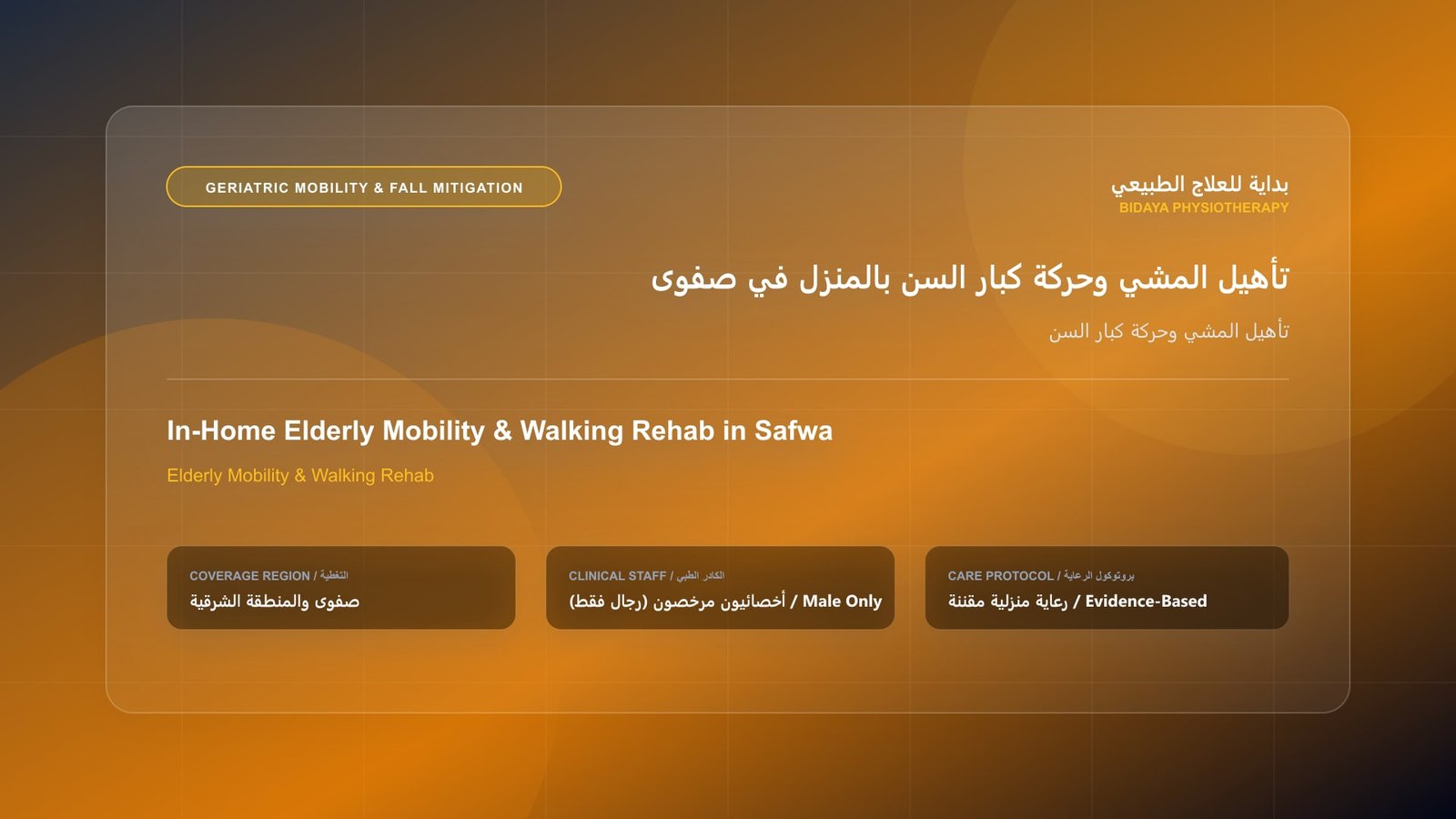
In-Home Elderly Mobility & Walking Rehab in Safwa
Advanced in-home rehabilitation across Safwa led by licensed male clinicians, restoring mobility and daily functional independence.
Comprehensive In-Home Clinical Evaluation (60-75 Mins)
Detailed functional & neuro examination, home safety audit, and custom protocol with portable equipment — no upfront package commitments.
Flexible appointments 7 days a week (8 AM - 10 PM) • Payment upon visit completion
1,500+ Successful Home Recoveries
Certified Clinical Physiotherapists
Assessment-First Protocol
Thorough physical evaluation before any treatment plan starts
Specialized Male Therapists
Professional licensed therapists visiting your residence
100% In-Home Rehabilitation
No clinic travel friction or waiting room discomfort
Targeted Functional Goals
Focused on daily stairs, walking endurance, and independence
Emergency Medical Red-Flags & Home Care Boundaries
Emergency Medical Boundary: Bidaya provides scheduled in-home therapeutic rehabilitation and is not an emergency medical dispatch service. For acute neurological deficits, unreduced fractures, severe respiratory distress, or sudden chest pain, contact the Saudi Red Crescent immediately at 997 or 911.
Integrating kinematic realignment for Elderly Mobility & Walking Rehab with domestic architectural hazard mitigation, Bidaya provides comprehensive in-home physiotherapy across Safwa. Our certified male physical therapists guide patients progressively toward sustainable pain-free living.
Clinical Gait Evaluation & Mobility Frailty in Safwa Seniors
Reduced Stride Length, Lower Limb Sarcopenia & Heightened Caregiver Reliance
Elderly residents across Safwa frequently experience insidious gait decline following acute illness or prolonged sitting, presenting short, hesitant shuffling strides and fear of falling.
Bidaya's visiting physical therapists quantify gait kinematics, stride velocity, and lower extremity strength, establishing whether mobility aids require recalibration.
Gait Velocity Benchmark
A gait speed below 0.8 m/s strongly correlates with future fall risks and functional decline; structured progressive training successfully restores cadence.
- Quantify active gait speed, step symmetry, and base of support width
- Grade quadriceps, gluteus medius, and plantarflexor motor strength
- Audit indoor footwear to ensure adequate traction on polished floors
- Train safe multi-step turning mechanics to avert lower extremity tripping
Progressive In-Home Gait Cadence Retraining & Corridor Ambulation
High-Step Cueing, Weight-Transfer Drills & Safe Domestic Corridor Pathways
Therapy introduces progressive indoor ambulation drills: emphasizing intentional knee elevation to clear floor thresholds, controlled weight shifting, and chair sit-to-stand power exercises.
Clinicians coach family caregivers on supportive contact guarding techniques, ensuring patient independence while maintaining safety.
Trip Prevention Pearl
Cueing exaggerated ankle dorsiflexion during initial swing phase prevents toe scuffing and reduces domestic trip incidents.
- Execute daily hallway walking intervals under supervision
- Perform 10 bilateral heel and toe raises daily to build ankle stability
- Eliminate unsecured scatter rugs along domestic corridors
- Adhere consistently to prescribed ambulatory aids during all household transfers
Seamless Hospital-to-Home Care Transition Across Safwa
Bridging the Gap Between Discharge from Safwa General Hospital and accredited primary health networks and Outpatient Clinics
The initial days following discharge from regional tertiary centers in Safwa (such as Safwa General Hospital and accredited primary health networks) represent the most precarious phase for Elderly Mobility & Walking Rehab; patients face difficult vehicular transfers, entrance steps, and unmonitored pain.
Bidaya's mobile physiotherapy service bridges this vulnerable window within 48 to 72 hours of hospital discharge: 1. Surgical and medical chart review: Aligning home therapy directly with physician discharge instructions, strictly observing weight-bearing limits and range-of-motion guidelines. 2. Early post-acute clinical assessment: Evaluating pain, edema, and mobility, initiating early circulatory exercises to prevent venous thromboembolism. 3. Functional domestic ambulation: Calibrating crutches or walker frames to domestic hallways and bathroom facilities safely.
Timely in-home intervention during the early post-acute phase dramatically diminishes 30-day hospital readmission rates.
Early Transition Metric in Safwa
Initiating active circulatory drills within 24 hours of returning home significantly mitigates venous thromboembolism and joint arthrofibrosis.
- Verify exact weight-bearing restrictions specified on hospital discharge summary
- Elevate affected limb periodically to manage dependent reactive edema
- Inspect surgical or injury perimeter daily for erythema, heat, or drainage
- Keep emergency contact coordinates (Red Crescent 997) accessible near bedside
Comprehensive Biomechanical & Kinematic Evaluation for Elderly Mobility & Walking Rehab
Objective Arthrokinematic Goniometry & Selective Tissue Tension Testing across Safwa
Every dedicated in-home physical therapy visit for Elderly Mobility & Walking Rehab in Safwa begins with an in-depth kinematic assessment conducted by a licensed male physical therapist. The clinical objective is to differentiate contractile tissue lesions from inert capsular dysfunctions.
Key diagnostic components include: 1. Objective Diagnostic Protocol: Implementing Berg Balance Scale (BBS), Timed Up and Go (TUG), and 30-Second Chair Stand muscular endurance battery to compare bilateral physiological and accessory motion arcs. 2. Cyriax Selective Tissue Tension Testing: Applying resisted isometric maneuvers to isolate tendinopathic strain from passive ligamentous insufficiency. 3. Manual Muscle Testing (MMT): Calibrating prime mover and stabilizer force production on a standardized 0-to-5 scale to reveal neuromuscular inhibition. 4. Focused Neurological Screening: Auditing deep tendon reflexes and dermatomal boundaries to verify neural integrity.
Baseline measurements are systematically documented, providing clear numerical metrics to benchmark progress using Activities-specific Balance Confidence (ABC) Scale and Fall Risk Assessment Index.
Diagnostic Specificity in Safwa
Isolating the precise mechanical pain generator allows targeted reconditioning, preventing wasted recovery time on non-specific exercise.
- Quantify active and passive joint arcs comparing bilateral symmetry
- Audit kinetic chain alignment across adjacent stabilizing articulations
- Rule out acute systemic inflammatory flags prior to mechanical loading
- Establish measurable functional milestones aligned with domestic goals
Mobility Aid Weaning Protocol & Gait Normalization for Elderly Mobility & Walking Rehab
Clinical Criteria for Safe Walker and Crutch Cessation in Household Ambulation
Bidaya's visiting male physical therapists enforce rigorous clinical criteria prior to weaning patients from assistive devices for Elderly Mobility & Walking Rehab.
Weaning and progression benchmarks: 1. Adequate Muscle Force Production: Reaching at least 4/5 force in prime movers with mastery of Otago Exercise Programme balance drills, closed-chain hip abductor/extensor loading, lateral stepping, and compliant foam perturbation exercises. 2. Antalgic Gait Elimination: Demonstrating symmetrical stance time without pelvic drop or lateral trunk lean. 3. Static and Dynamic Equilibrium: Displaying steady single-limb stability and attaining achieving TUG completion under 13 seconds, executing 5 unassisted chair stands without arm push, and stable single-leg stance > 5 seconds.
Progression transitions methodically from wheeled walkers to single canes and unassisted gait under clinician oversight.
Assistive Weaning Principle
Premature abandonment of assistive aids before restoring adequate muscular force induces persistent antalgic limping and lumbar strain.
- Discontinue walking aids only following formal clinical balance testing
- Hold single canes in the upper limb contralateral to the affected lower extremity
- Rehearse symmetrical step lengths before a full-length domestic mirror
- Re-employ walking aids during demanding outdoor or extended community walks
Autonomous Domestic Independence & Self-Care Protocols for Elderly Mobility & Walking Rehab
Daily Energy Conservation, Habitual Joint Protection & Exercise Adherence in Safwa
Bidaya empowers patients across Safwa to direct their daily self-care confidently without fear of symptom resurgence from Elderly Mobility & Walking Rehab.
Key pillars of domestic functional autonomy: 1. Energy conservation pacing: Performing personal grooming seated rather than standing whenever feasible to offload lower extremity joints. 2. Adherence to safety envelopes: Strictly observing documented movement limits: illuminating nocturnal transit pathways, eliminating floor thresholds, securing bathroom grab rails, and mandating non-slip rubber soles. 3. Daily restorative movement: Sustaining prescribed Otago Exercise Programme balance drills, closed-chain hip abductor/extensor loading, lateral stepping, and compliant foam perturbation exercises to build enduring musculoskeletal resilience. 4. Longitudinal clinical communication: Consulting your designated clinician to advance exercise dosages as milestones are attained.
This structured autonomy allows patients to resume fulfilling domestic lives across Safwa. Contact coordination: (+20 109 707 9170).
Joint Energy Conservation in Safwa
Executing light domestic chores seated diminishes cumulative compressive forces on lower limb joints by 35%.
- Utilize a sturdy high stool in food preparation areas to avoid prolonged stance
- Perform gentle morning extensibility drills to disperse joint stiffness
- Avoid hurried movements, incorporating calculated micro-pauses throughout the day
- Coordinate with your visiting clinician (+20 109 707 9170) for progression
Emergency Safety Protocol & Early Warning Stratification for Elderly Mobility & Walking Rehab in Safwa
Recognizing Systemic Danger Signs & Immediate Escalation to Saudi Red Crescent (997)
Bidaya's licensed male clinicians in Safwa coach family caregivers to identify early warning signs indicating acute medical emergencies rather than benign rehabilitation soreness.
Critical early warning markers: 1. Specific Pathology Red Flags: Documented emergence of traumatic domestic fall with inability to bear weight (suspected occult hip fracture), acute sudden delirium, or persistent vertigo. 2. Cerebrovascular Impairment: Acute cognitive disorientation, unilateral facial droop, or sudden arm drift. 3. Deep Vein Thrombosis: Unilateral calf swelling accompanied by acute warmth and severe tenderness on palpation. 4. Acute Respiratory Distress: Oxygen saturation desaturation beneath 88% refractory to rest with tachypnea.
Acute Transfer Protocol: Physical therapy is halted immediately, and the Saudi Red Crescent is dialed at 997 or emergency services at 911 for transport to Safwa General Hospital and accredited primary health networks. Bidaya provides scheduled in-home rehabilitation, not acute medical emergency dispatch. Inquiries: (+20 109 707 9170).
Early Warning Recognition in Safwa
Identifying emergent medical danger signs and contacting emergency response (997) saves lives and prevents chronic complications.
- Call emergency dispatch at 997 without hesitation upon acute red flags
- Record exact time of symptom onset to brief attending emergency physicians
- Maintain a calm, climate-controlled domestic environment pending ambulance arrival
- Notify Bidaya clinical desk (+20 109 707 9170) regarding hospital admission updates
Functional Durability Blueprint & Recurrence Prevention for Elderly Mobility & Walking Rehab
Managing Daily Physical Capacity, Muscular Balance & Continuity Care across ${cityEn}
Bidaya implements an extended rehabilitative strategy across Safwa shielding patients managing Elderly Mobility & Walking Rehab from long-term strength degradation or joint stiffness.
Pillars of functional durability: 1. Domestic Muscular Fortification: Executing Otago Exercise Programme balance drills, closed-chain hip abductor/extensor loading, lateral stepping, and compliant foam perturbation exercises consistently to sustain balanced vector forces surrounding target joints. 2. Avoiding Provocative Overload: Strictly observing movement boundaries: illuminating nocturnal transit pathways, eliminating floor thresholds, securing bathroom grab rails, and mandating non-slip rubber soles. 3. Standardized Metric Auditing: Periodically reassessing standardized scores via Activities-specific Balance Confidence (ABC) Scale and Fall Risk Assessment Index to detect subtle subclinical deficits. 4. Responsive Clinical Intake Desk: Maintaining direct communication with our licensed male physical therapists (+20 109 707 9170) to address questions.
This integrated approach ensures active, uncompromised daily living across Safwa.
Kinetic Fortification in Safwa
Retaining acquired muscular strength reduces symptom recurrence rates and re-injury potential by over 70%.
- Reserve dedicated daily time slots for restorative therapeutic calisthenics
- Wear supportive orthotic footwear during community strolls
- Engage in progressive low-impact exercise without acute fatigue
- Call Bidaya (+20 109 707 9170) to arrange review consultations when needed
Holistic Community Reintegration & Active Family Engagement across Safwa
Total Motor Autonomy, Fulfilling Social Roles & Enjoying Life in Safwa
Bidaya culminates its comprehensive physical therapy programs in Safwa by restoring the patient's full familial and social contributions with complete vigor.
Pillars of ultimate life reintegration: 1. Enjoying Multi-Generational Family Life: Participating actively in activities with children and grandchildren without limitations from Elderly Mobility & Walking Rehab. 2. Mosque Prayer Fulfillment: Enjoying independent walking to community mosques for congregation prayers with comfort and dignity. 3. Routine Walkway Fitness: Embedding low-impact ambulation along Safwa Health Walkway and municipal park ambulation paths into permanent weekly routines. 4. Spontaneous Regional Transit: Traveling comfortably across districts like Al-Orouba, Al-Yarmouk, Al-Hizam, and Al-Madinah to visit cultural and familial landmarks.
This tangible outcome represents our clinical mission for every individual served in Safwa. Scheduling desk: (+20 109 707 9170).
Complete Autonomy in Safwa
Autonomous functional mobility in daily life represents the true milestone of evidence-based, dedicated clinical rehabilitation.
- Celebrate functional mobility milestones and encourage ongoing physical activity
- Maintain outdoor corridor ambulation 2 to 3 times weekly as a lifestyle habit
- Stay connected with your clinical team for annual preventive wellness checks
- Call Bidaya (+20 109 707 9170) to coordinate any future rehabilitative needs
Comprehensive Clinical Governance & Evidence-Based Recovery for Elderly Mobility & Walking Rehab
International Protocol Adherence, Clinical Transparency & Quality Assurance in Safwa
Bidaya utilizes an advanced clinical governance framework in Safwa, harmonizing contemporary medical science with the values of Safwa households.
Pillars of comprehensive clinical governance: 1. Evidence-Based Interventions: Implementing established international clinical practice guidelines for Elderly Mobility & Walking Rehab. 2. Objective Milestone Quantification: Utilizing Activities-specific Balance Confidence (ABC) Scale and Fall Risk Assessment Index batteries to quantify functional restoration in clear numerical percentages. 3. Domestic Dignity and Privacy: Complete respect for cultural values, dispatching licensed male physical therapists exclusively. 4. Direct Therapeutic Support: Accessible clinical communication channels via phone and WhatsApp (+20 109 707 9170) to support care progression.
This clinical standard ensures therapeutic efficacy and safety for all patients in Safwa.
Clinical Transparency in Safwa
Sharing quantitative recovery reports with patients and families fosters therapeutic partnership, accelerating clinical milestones.
- Incorporate contemporary clinical guidelines into customized care plans
- Provide regular progress summaries detailing objective functional gains
- Maintain uncompromising adherence to clinical safety and privacy guidelines
- Contact Bidaya (+20 109 707 9170) to schedule functional reviews
Frequently Asked Questions about In-Home Physiotherapy
Home rehabilitation trains real-world functional tasks—such as bed transfers and villa staircase negotiation in Safwa—yielding faster and more sustainable functional autonomy.
Related Clinical & Regional Pathways
Post-Op Joint & Fracture Rehabilitation→
Advanced in-home rehabilitation across Safwa led by licensed male clinicians
In-Home Physiotherapy in Safwa→
Comprehensive in-home physical therapy delivered across Safwa by licensed male clinicians for geriatric
Post-Stroke Motor Recovery→
Advanced in-home rehabilitation across Safwa led by licensed male clinicians
In-Home Physiotherapy Eastern Province Therapy→
Comprehensive clinical rehabilitation delivered directly to your residence across Dammam
In-Home Low Back Pain & Sciatica Rehabilitation Therapy→
Evidence-based clinical rehabilitation engineered to resolve lumbar disc herniations
In-Home Knee Pain & Osteoarthritis Rehabilitation Therapy→
Evidence-based clinical rehabilitation engineered to arrest articular cartilage degeneration
In-Home Stroke Rehabilitation & Neurological Physiotherapy Therapy→
Evidence-based neurological rehabilitation engineered to stimulate corticomotor neuroplasticity
In-Home Post-Operative Physiotherapy Therapy→
Evidence-based surgical rehabilitation protocols engineered to restore joint range of motion