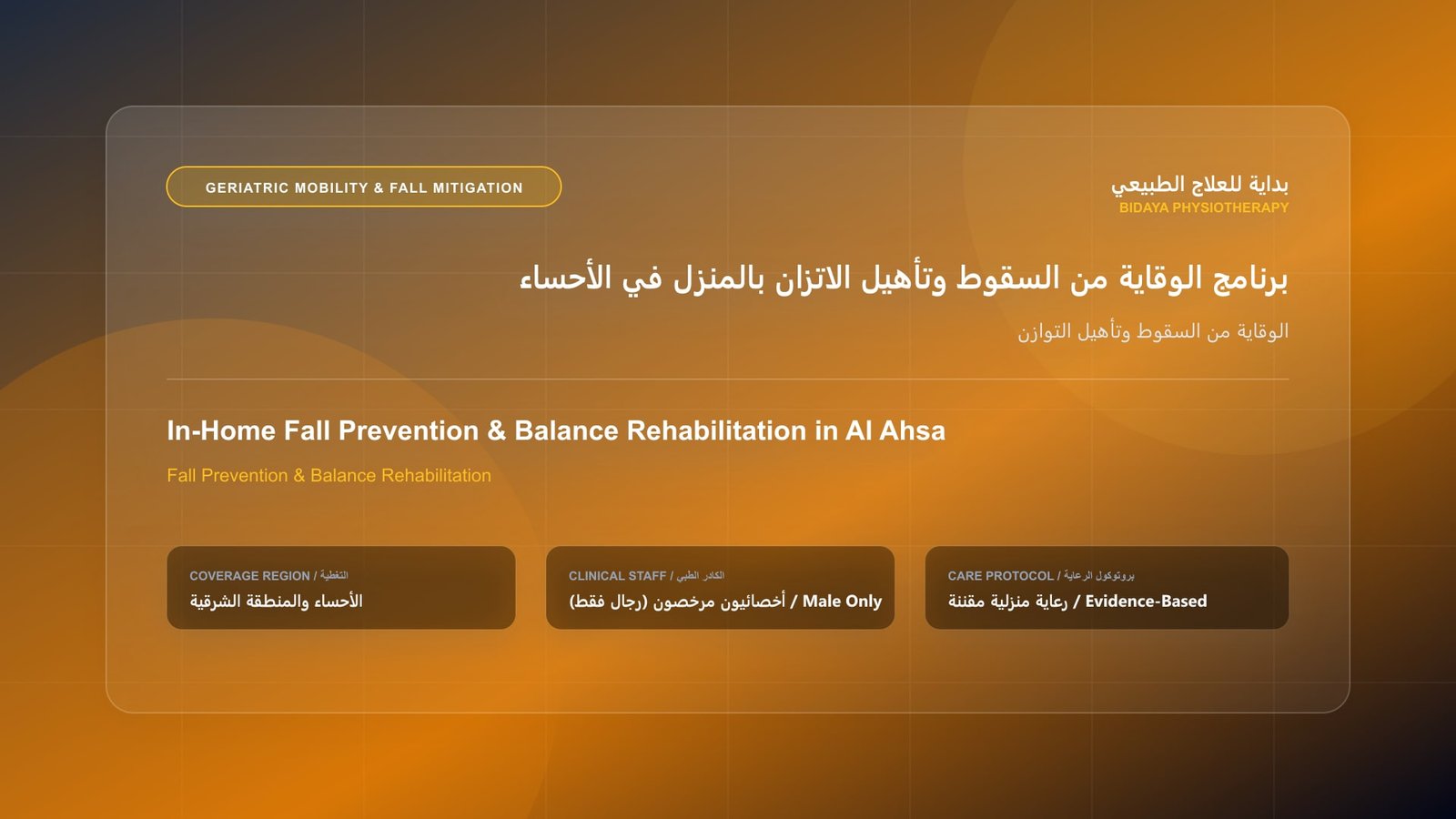
In-Home Fall Prevention & Balance Rehabilitation in Al Ahsa
Advanced in-home rehabilitation across Al Ahsa led by licensed male clinicians, restoring mobility and daily functional independence.
Comprehensive In-Home Clinical Evaluation (60-75 Mins)
Detailed functional & neuro examination, home safety audit, and custom protocol with portable equipment — no upfront package commitments.
Flexible appointments 7 days a week (8 AM - 10 PM) • Payment upon visit completion
1,500+ Successful Home Recoveries
Certified Clinical Physiotherapists
Assessment-First Protocol
Thorough physical evaluation before any treatment plan starts
Specialized Male Therapists
Professional licensed therapists visiting your residence
100% In-Home Rehabilitation
No clinic travel friction or waiting room discomfort
Targeted Functional Goals
Focused on daily stairs, walking endurance, and independence
Emergency Medical Red-Flags & Home Care Boundaries
Emergency Medical Boundary: Bidaya provides scheduled in-home therapeutic rehabilitation and is not an emergency medical dispatch service. For acute neurological deficits, unreduced fractures, severe respiratory distress, or sudden chest pain, contact the Saudi Red Crescent immediately at 997 or 911.
Integrating kinematic realignment for Fall Prevention & Balance Rehabilitation with domestic architectural hazard mitigation, Bidaya provides comprehensive in-home physiotherapy across Al Ahsa. Our certified male physical therapists guide patients progressively toward sustainable pain-free living.
Clinical Fall Risk Profiling & Postural Stability in Al Ahsa Homes
Standardized TUG Protocols, Plantar Somatosensory Mapping & Marble Floor Audits
Unintentional falls among elderly family members in Al Ahsa frequently result in debilitating fractures, driven by low-friction marble flooring, unlevel thresholds, and dim lighting.
Bidaya's visiting physical therapists administer standardized screening protocols: Timed Up and Go (TUG), sensory monofilament testing, and comprehensive domestic audits of living quarters.
Fear of Falling Cycle
Post-fall anxiety provokes self-imposed activity restriction, exacerbating muscular atrophy and accelerating secondary fall risks; home retraining breaks this cycle.
- Administer static and dynamic balance assessments in domestic quarters
- Evaluate ankle and hip postural recovery strategies under perturbed stance
- Map plantar somatosensory thresholds to screen for diabetic sensory loss
- Identify household trip hazards including loose rugs and trailing cables
In-Home Postural Synergy Retraining & Environmental Adaptation
Ankle and Hip Balance Synergies, Stepping Drills & Bathroom Safety Optimization
Therapy trains intrinsic postural strategies (ankle and hip synergies) that enable seniors to rapidly recover equilibrium when subjected to unexpected domestic perturbations.
Clinicians coach high-stepping cadence ambulation to overcome carpet thresholds, while advising families on essential safety installations such as shower grab bars and nightlights.
Bathroom Fall Mitigation Pearl
Installing heavy-duty grab bars adjacent to the toilet and shower provides essential upper extremity stability, averting slip injuries.
- Practice daily standing balance drills adjacent to sturdy domestic counters
- Execute high-stepping ambulation to eliminate carpet scuffing
- Ensure pathway lighting is illuminated between bedroom and bathroom at night
- Wear supportive indoor shoes featuring non-skid rubber outsoles
Adapting Home Physiotherapy to Al Ahsa Residential Villa Architecture
Safely Navigating multi-generational family villas with traditional floor-level seating (majlis) requiring specialized transfer biomechanics and Domestic Ambulation Corridors
Residential villas across Al Ahsa characteristically feature expansive open layouts and multi-generational family villas with traditional floor-level seating (majlis) requiring specialized transfer biomechanics. For patients rehabilitating from Fall Prevention & Balance Rehabilitation, this domestic architecture presents distinct clinical hazards; low-friction flooring elevates slip risks, while multi-level staircases demand high joint torque.
During the initial domestic consultation, Bidaya's visiting male physical therapist conducts a comprehensive architectural audit: 1. Screening flooring across bedrooms, primary corridors, and washroom thresholds, securing loose scatter rugs with industrial non-slip backing. 2. Coaching safe gait pacing over polished marble surfaces, prescribing broad-based high-traction indoor footwear to maximize floor contact area. 3. Structuring step-by-step staircase navigation using bilateral handrails, enforcing the gold-standard principle of leading with the uninvolved limb during ascent and the involved limb during descent.
Rehabilitating within the actual home environment in Al Ahsa establishes functional confidence and autonomy far surpassing artificial clinic gymnasiums.
Immediate Home Safety Pearl in Al Ahsa
Securing rug perimeters with double-sided anti-slip backing and leveling thresholds reduces domestic slip incidents by over 60% on marble surfaces.
- Clear loose accent rugs along key domestic ambulation corridors
- Install motion-activated pathway lighting between bed and bathroom
- Train full single-limb weight capture before initiating swing phase
- Mandate supportive rubber-soled enclosed indoor footwear
Differential Musculoskeletal & Mechanical Triage for Fall Prevention & Balance Rehabilitation in Al Ahsa
Isolating Mechanical Etiologies, Excluding Red Flags & Calibrating Therapeutic Windows
Successful clinical rehabilitation delivered by Bidaya across Al Ahsa begins with rigorous differential triage for Fall Prevention & Balance Rehabilitation, ensuring presentations reside within safe therapeutic boundaries.
Differential diagnostic pillars: 1. Focused Examination Battery: Conducting Berg Balance Scale (BBS), Timed Up and Go (TUG), and 30-Second Chair Stand muscular endurance battery to isolate the primary structural lesion. 2. Passive Capsular & Ligamentous Stress Testing: Verifying end-feel integrity to exclude gross structural tears requiring urgent surgical repair. 3. Kinetic Antagonist Compliance: Assessing opposing muscle flexibility to identify myofascial tension vectors. 4. Self-Reported Functional Disability: Quantifying patient-reported daily functional limitations utilizing standardized Activities-specific Balance Confidence (ABC) Scale and Fall Risk Assessment Index.
This methodical triage protects patient safety, establishing a customized home physical therapy program.
Safe Differential Screening in Al Ahsa
Meticulous clinical screening ensures appropriate physical therapy intervention while rapidly escalating unstable pathologies.
- Exclude conditions requiring advanced hospital-based neuro-imaging
- Establish pain-free movement corridors for initial therapeutic loading
- Document baseline scores for all muscle groups and motion planes
- Formulate and communicate comprehensive evaluation report with family
Biomechanically Governed Tissue Loading & Progressive Phase Transitions
Advancing from Submaximal Isometrics to Dynamic Eccentric Strengthening for Fall Prevention & Balance Rehabilitation
Rehabilitation progression at Bidaya is governed by physiological tissue healing timelines, ensuring collagen remodeling occurs safely for Fall Prevention & Balance Rehabilitation.
Phased progression criteria: 1. Symptom Modulation & Stabilization: Initiating Otago Exercise Programme balance drills, closed-chain hip abductor/extensor loading, lateral stepping, and compliant foam perturbation exercises within safe arcs to reverse arthrogenic muscle inhibition. 2. Dynamic Isotonic Resisted Loading: Advancing to progressive concentric and eccentric resistance using graded bands once resting pain subsides. 3. Closed Kinetic Chain Integration: Incorporating multi-joint functional loading replicating stair descent and chair transfers.
Target Milestones: Prioritizing achieving TUG completion under 13 seconds, executing 5 unassisted chair stands without arm push, and stable single-leg stance > 5 seconds, strictly requiring exercise discomfort to remain beneath 3/10 without reactive next-day joint effusion.
Tissue Adaptation Milestone
Progressive mechanical tension promotes parallel collagen remodeling; calibrated loading builds resilience, whereas premature strain precipitates recurrent inflammation.
- Respect designated inter-set rest intervals to avoid acute neuromuscular fatigue
- Audit tissue response precisely 24 hours after introducing higher resistances
- Limit temporary mobility aids strictly as directed by the visiting clinician
- Conduct serial weekly strength tests to dynamically calibrate resistance dosages
Domestic Environmental Hazard Auditing & Pathway Clearance for Fall Prevention & Balance Rehabilitation
Securing Ambulation Corridors, Bathroom Retrofits & Fall Prevention across Al Ahsa
Bidaya's licensed male physical therapists transform the patient's residence in Al Ahsa into an engineered recovery environment supporting autonomy for Fall Prevention & Balance Rehabilitation.
Core environmental hazard adaptations: 1. Washroom and shower retrofitting: Securing structural wall grab bars adjacent to toilets and showers, deploying rubberized suction mats to abort slips. 2. Living room and bedroom reconfiguration: Replacing deep, low sofas with ergonomic firm chairs, avoiding illuminating nocturnal transit pathways, eliminating floor thresholds, securing bathroom grab rails, and mandating non-slip rubber soles. 3. Daily conditioning integration: Implementing calibrated Otago Exercise Programme balance drills, closed-chain hip abductor/extensor loading, lateral stepping, and compliant foam perturbation exercises at structured daily times while tracking exertion. 4. Stable equilibrium support: Ensuring a sturdy support anchor remains within arm's reach during standing balance drills.
These adjustments establish a supportive living space promoting durable recovery. Contact intake: (+20 109 707 9170).
Safe Home Space in Al Ahsa
Illuminating transit corridors and securing wall anchors reduces domestic slip-and-trip incidents by over 75% on polished surfaces.
- Mount wall-anchored safety grab bars at high-risk transfer locations
- Refrain from performing unassisted standing drills over low-friction tiling
- Exercise under direct caregiver contact-guarding if balance is compromised
- Contact Bidaya directly to modify home exercise intensity as symptoms evolve
Rigorous Safety Standards & Emergency Triage Pathways for Fall Prevention & Balance Rehabilitation
Immediate Session Cessation, Stabilization & Direct Red Crescent (997) Referral
All home physical therapy encounters delivered by Bidaya's licensed male clinicians in Al Ahsa adhere to strict safety protocols prioritizing medical stability above functional exercise.
Situations necessitating immediate therapeutic cessation: 1. Acute Clinical Crisis Indicators: Emergence of traumatic domestic fall with inability to bear weight (suspected occult hip fracture), acute sudden delirium, or persistent vertigo. 2. Hemodynamic Instability: Palpitations coupled with profound dizziness or anginal discomfort. 3. Surgical or Vascular Breakdown: Sudden wound dehiscence or active bleeding refractory to light direct pressure. 4. Acute Cauda Equina or Sudden Paresis: Loss of sensation in the perineum or acute bilateral lower limb weakness.
Emergency Care Workflow: The clinician terminates drills immediately, reassures the family, and coordinates immediate ambulance dispatch via the Saudi Red Crescent at 997 or 911. Bidaya is a scheduled restorative therapy service, not an emergency ambulance service. Clinical desk: (+20 109 707 9170).
Maximal Clinical Safety in Al Ahsa
Strict adherence to medical safety boundaries protects patients, ensuring acute care is administered at the appropriate facility.
- Dial Saudi Red Crescent (997) instantly upon suspecting clinical red flags
- Avoid moving patients following severe domestic falls with suspected pelvic fractures
- Assemble hospital discharge summaries and medication lists for paramedics
- Follow up with patient and clinical desk following hospital stabilization
Secondary Prevention & Long-Term Articular Fortification for Fall Prevention & Balance Rehabilitation in Al Ahsa
Preserving Tissue Compliance, Preventing Cumulative Fatigue & Sustaining Kinetic Health
Secondary prevention represents the cornerstone of Bidaya's clinical philosophy in Al Ahsa, ensuring functional relapse is avoided following recovery from Fall Prevention & Balance Rehabilitation.
Pillars of secondary articular fortification: 1. Preventive Exercise Dosage: Executing Otago Exercise Programme balance drills, closed-chain hip abductor/extensor loading, lateral stepping, and compliant foam perturbation exercises at regular intervals to maintain muscle tone and capsular compliance. 2. Contextual Life Adaptation: Balancing rest and activity in alignment with Al Ahsa residential layouts and climate realities. 3. Proactive Functional Auditing: Re-quantifying metrics via Activities-specific Balance Confidence (ABC) Scale and Fall Risk Assessment Index periodically to detect subtle deficits early. 4. Responsive Case Coordination: Submitting functional inquiries to our clinical desk (+20 109 707 9170).
This continuous commitment preserves physical vitality and shields against chronic physical limitations.
Secondary Prevention in Al Ahsa
Long-term kinetic maintenance requires significantly less expenditure and effort than treating full-blown secondary physical injuries.
- Adhere diligently to the clinician-approved home maintenance regimen
- Avoid sudden uncoordinated ballistic lifts during household chores
- Participate in structured walking during temperate hours across Al Ahsa
- Reach Bidaya's team (+20 109 707 9170) for personalized exercise adjustments
Community Reintegration & Social Lifestyle Resumption Across Al Ahsa
Safe Return to Mosque Prayers, Public Strolling & Domestic Family Engagements
The ultimate measure of successful in-home rehabilitation delivered by Bidaya across Al Ahsa for Fall Prevention & Balance Rehabilitation is restoring the patient's full participation in cultural, familial, and spiritual routines without apprehension.
Key pillars of domestic and social reintegration: 1. Mosque Prayer Functional Mobility: Retraining safe transitions between upright stance, bowing (ruku), and kneeling/prostration (sujud), or mastering ergonomic prayer chair transfers. 2. Community Strolling & Walkway Navigation: Conditioning ambulation over diverse outdoor terrains along shaded date-palm oasis pathways, Jabal Al-Qarah trails, and Ain Najm public park with paced breathing cadence. 3. Vehicular Transfers & Family Visits: Practicing automotive ingress/egress and negotiating multi-height domestic thresholds to enjoy family gatherings across central Hofuf, Al Mubarraz, Eastern and Northern oasis districts. 4. Psychological Empowerment & Autonomy: Dispelling fear-avoidance beliefs and overcoming domestic isolation, which dramatically elevates systemic well-being and quality of life.
We accompany each patient step by step until complete functional vitality is restored within their community in Al Ahsa. Clinical intake desk: (+20 109 707 9170).
Community Independence in Al Ahsa
Restoring the capacity to walk to local mosques and attend family gatherings represents the true milestone of functional recovery.
- Rehearse vehicle ingress and egress mechanics under clinician guidance
- Select temperate diurnal windows for outdoor community strolling
- Wear biomechanically supportive footwear suited to variable outdoor terrains
- Contact Bidaya (+20 109 707 9170) to coordinate guided community mobility progression
Clinical Excellence Framework & Performance Indicators for Fall Prevention & Balance Rehabilitation in Al Ahsa
Objective Arthrokinematic Benchmarking, Safety Audits & Home Care Integrity
Bidaya's clinical practice in Al Ahsa is anchored in continuous excellence principles, ensuring patients managing Fall Prevention & Balance Rehabilitation achieve durable functional outcomes.
Pillars of the clinical excellence model: 1. Standardized Quantitative Testing: Measuring clinical outcomes using validated instruments (Activities-specific Balance Confidence (ABC) Scale and Fall Risk Assessment Index) to guide evidence-based decisions. 2. Multidisciplinary Case Review: Auditing complex clinical presentations under clinical supervisory oversight adhering to recent literature. 3. Encrypted Health Data Safeguards: Maintaining strict electronic documentation confidentiality conforming to privacy regulations. 4. Dynamic Quality Feedback Integration: Monitoring patient satisfaction through our clinical coordination desk (+20 109 707 9170) to optimize care delivery.
This dedication reflects Bidaya's standing as a leading mobile physiotherapy service across Al Ahsa.
Evidence-Based Precision in Al Ahsa
Anchoring therapy to quantitative metrics and contemporary science ensures accelerated, durable functional recovery.
- Administer standardized functional batteries at calibrated therapeutic milestones
- Protect patient medical records with encrypted digital storage protocols
- Calibrate treatment dosages dynamically based on physiological response
- Communicate with clinical management (+20 109 707 9170) for chart updates
Frequently Asked Questions about In-Home Physiotherapy
Home rehabilitation trains real-world functional tasks—such as bed transfers and villa staircase negotiation in Al Ahsa—yielding faster and more sustainable functional autonomy.
Related Clinical & Regional Pathways
Bedridden & Immobility Patient Care→
Advanced in-home rehabilitation across Al Ahsa led by licensed male clinicians
Elderly Sarcopenia & Muscle Frailty→
Advanced in-home rehabilitation across Al Ahsa led by licensed male clinicians
Stroke & Hemiplegia Neurological Rehab→
Advanced in-home rehabilitation across Al Ahsa led by licensed male clinicians
In-Home Physiotherapy Eastern Province Therapy→
Comprehensive clinical rehabilitation delivered directly to your residence across Dammam
In-Home Low Back Pain & Sciatica Rehabilitation Therapy→
Evidence-based clinical rehabilitation engineered to resolve lumbar disc herniations
In-Home Knee Pain & Osteoarthritis Rehabilitation Therapy→
Evidence-based clinical rehabilitation engineered to arrest articular cartilage degeneration
In-Home Stroke Rehabilitation & Neurological Physiotherapy Therapy→
Evidence-based neurological rehabilitation engineered to stimulate corticomotor neuroplasticity
In-Home Post-Operative Physiotherapy Therapy→
Evidence-based surgical rehabilitation protocols engineered to restore joint range of motion