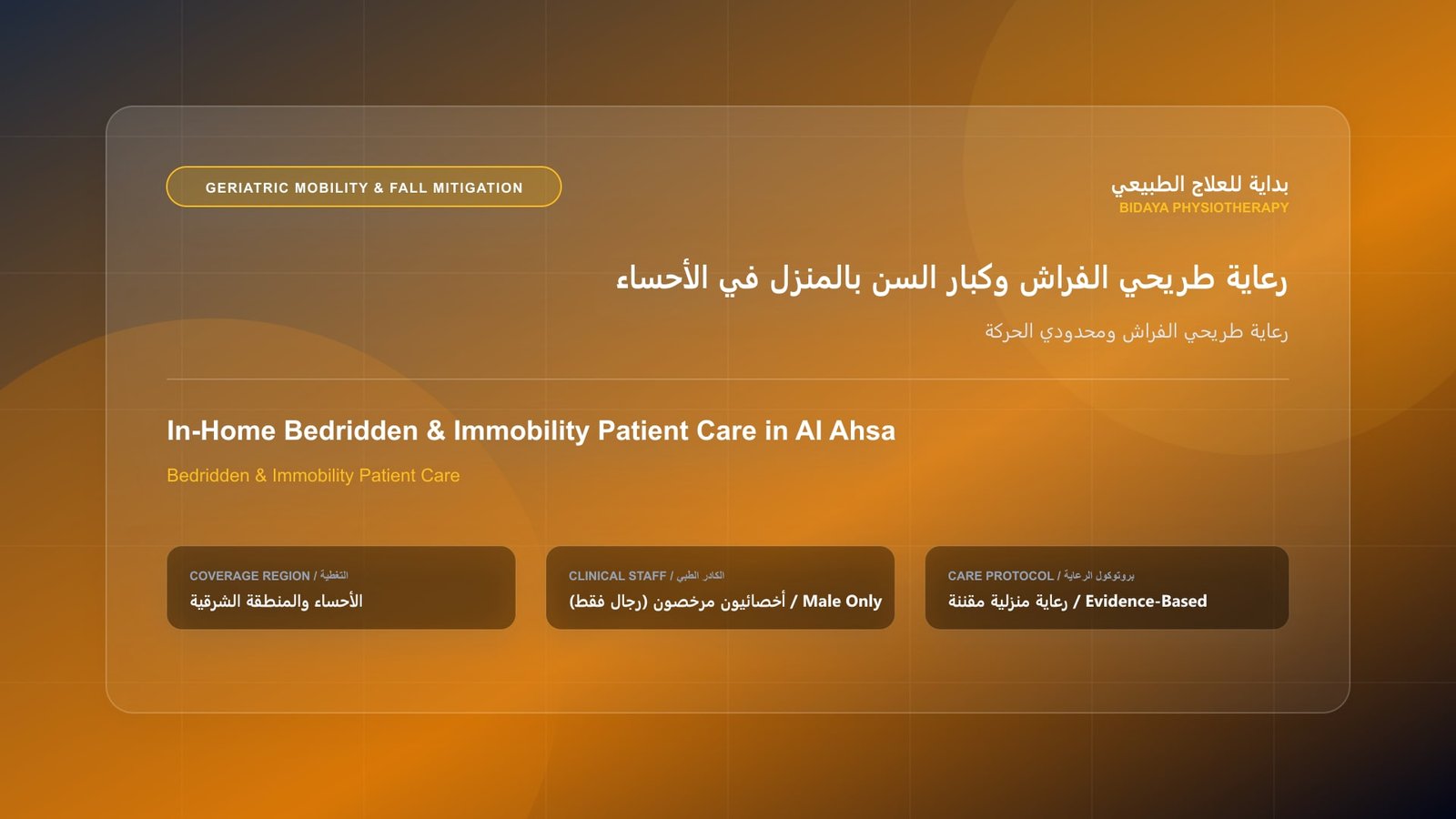
In-Home Bedridden & Immobility Patient Care in Al Ahsa
Advanced in-home rehabilitation across Al Ahsa led by licensed male clinicians, restoring mobility and daily functional independence.
Comprehensive In-Home Clinical Evaluation (60-75 Mins)
Detailed functional & neuro examination, home safety audit, and custom protocol with portable equipment — no upfront package commitments.
Flexible appointments 7 days a week (8 AM - 10 PM) • Payment upon visit completion
1,500+ Successful Home Recoveries
Certified Clinical Physiotherapists
Assessment-First Protocol
Thorough physical evaluation before any treatment plan starts
Specialized Male Therapists
Professional licensed therapists visiting your residence
100% In-Home Rehabilitation
No clinic travel friction or waiting room discomfort
Targeted Functional Goals
Focused on daily stairs, walking endurance, and independence
Emergency Medical Red-Flags & Home Care Boundaries
Emergency Medical Boundary: Bidaya provides scheduled in-home therapeutic rehabilitation and is not an emergency medical dispatch service. For acute neurological deficits, unreduced fractures, severe respiratory distress, or sudden chest pain, contact the Saudi Red Crescent immediately at 997 or 911.
Bidaya's home rehabilitation program for Bedridden & Immobility Patient Care across Al Ahsa bridges the vulnerable interval between hospital discharge and full daily function. Our licensed male clinicians implement phased recovery benchmarks focusing on achieving TUG completion under 13 seconds, executing 5 unassisted chair stands without arm push, and stable single-leg stance > 5 seconds to secure enduring functional gains.
Comprehensive Clinical Assessment of Bedridden Patients in Al Ahsa
Decubitus Ulcer Prevention, Joint Contracture Staging & Pulmonary Aeration
Prolonged recumbency due to advanced illness or extreme frailty demands rigorous in-home therapeutic surveillance to thwart pressure ulcers, fixed joint contractures, and hypostatic lung congestion.
Bidaya's visiting physical therapists inspect integumentary integrity over bony prominences, quantify passive range resistance across all extremities, and auscultate pulmonary fields.
Two-Hour Repositioning Imperative
Alternating recumbent postures every two hours while offloading heels and sacrum with supportive foam forms the cornerstone of pressure sore prophylaxis.
- Inspect sacral, trochanteric, and calcaneal skin for stage-1 non-blanchable erythema
- Assess passive range of motion across bilateral shoulders, hips, knees, and ankles
- Perform pulmonary auscultation to detect bronchial secretion accumulation
- Evaluate alternating-pressure mattress settings and bed positioning parameters
In-Home Passive Mobilization, Respiratory Clearance & Transfer Coaching
Full-Body Joint Mobilization, Incentive Chest Clearance & Wheelchair Transfers
Therapy incorporates full-body passive and active-assisted range calisthenics to sustain vascular flow and avert tendon shortening, combined with manual chest physiotherapy techniques.
Clinicians train family caregivers in biomechanically sound bed-to-wheelchair transfers, enabling the patient to spend meaningful upright intervals within family living spaces.
Caregiver Transfer Ergonomics
Utilizing a sturdy transfer belt and keeping the patient close to your center of gravity protects the caregiver's lumbar spine during wheelchair transfers.
- Execute gentle full-body passive range drills twice daily to avert contractures
- Facilitate supported upright wheelchair seating for at least 60 minutes daily as tolerated
- Prompt regular diaphragmatic breathing intervals to maintain lung aeration
- Place protective foam wedges beneath lower extremities to float heels off mattress
Overcoming Residential Staircase & Entryway Step Barriers in Al Ahsa
Practical Strategies for Internal Multi-Tier Stairs, Thresholds & Family Transit
Patients managing Bedridden & Immobility Patient Care across Al Ahsa frequently encounter mobility barriers rooted in residential design, where exterior entrances require ascending concrete steps and living spaces span multiple stories.
Bidaya's structured in-home clinical approach includes: 1. Progressive stair navigation retraining: Utilizing handrail support and coaching bodyweight distribution while strictly respecting illuminating nocturnal transit pathways, eliminating floor thresholds, securing bathroom grab rails, and mandating non-slip rubber soles. 2. Entryway threshold clearance: Training safe swing-phase foot clearance to negotiate raised door thresholds typical of Al Ahsa villas. 3. Interval pacing strategies: Instructing scheduled micro-pauses during domestic transit to prevent cumulative muscular fatigue.
All drills are directed by credentialed male physical therapists who blend clinical rigor with complete respect for domestic privacy.
Stair Navigation Rule in Al Ahsa
Ascending leading with the sound leg recruits healthy musculature to hoist bodyweight, while descending leading with the affected leg protects healing tissues.
- Practice daily staircase negotiation under clinician or trained caregiver supervision
- Confirm rigid anchoring of all domestic staircase handrails
- Avoid staircase navigation under extreme fatigue or subdued illumination
- Deploy a single supportive cane for inter-floor domestic transits when recommended
Quantitative Arthrokinematic Measurement & Tissue Profiling for Bedridden & Immobility Patient Care in Al Ahsa
Calibrated Goniometry, Provocation Mapping & Structural Tissue Tolerance
Bidaya utilizes a rigorous quantitative diagnostic framework for Bedridden & Immobility Patient Care across Al Ahsa, combining manual palpation with portable, sanitized assessment instruments.
Core elements of the in-home clinical examination: 1. Targeted Diagnostic Battery: Executing Berg Balance Scale (BBS), Timed Up and Go (TUG), and 30-Second Chair Stand muscular endurance battery and recording angular arcs in degrees and linear limb girth in centimeters. 2. Pain Provocation Mapping: Identifying specific postures and loading directions that aggravate or alleviate symptoms to establish the directional preference. 3. Myofascial Extensibility Screening: Assessing muscle-tendon compliance and screening for active myofascial trigger points. 4. Domestic Functional Performance: Evaluating patient ability to execute bed transfers, independent rising, and hallway ambulation safely.
These objective findings provide baseline metrics tracked longitudinally via Activities-specific Balance Confidence (ABC) Scale and Fall Risk Assessment Index.
Quantitative Precision in Al Ahsa
Recording motion metrics in exact degrees allows rigorous cross-session comparison, objectively confirming therapeutic response.
- Record joint ranges in standardized digital documentation charts
- Map symptom distribution and intensity during active and resting states
- Inspect soft-tissue elasticity and scar compliance across affected regions
- Identify domestic architectural barriers specific to the patient's residence
Mobility Aid Weaning Protocol & Gait Normalization for Bedridden & Immobility Patient Care
Clinical Criteria for Safe Walker and Crutch Cessation in Household Ambulation
Bidaya's visiting male physical therapists enforce rigorous clinical criteria prior to weaning patients from assistive devices for Bedridden & Immobility Patient Care.
Weaning and progression benchmarks: 1. Adequate Muscle Force Production: Reaching at least 4/5 force in prime movers with mastery of Otago Exercise Programme balance drills, closed-chain hip abductor/extensor loading, lateral stepping, and compliant foam perturbation exercises. 2. Antalgic Gait Elimination: Demonstrating symmetrical stance time without pelvic drop or lateral trunk lean. 3. Static and Dynamic Equilibrium: Displaying steady single-limb stability and attaining achieving TUG completion under 13 seconds, executing 5 unassisted chair stands without arm push, and stable single-leg stance > 5 seconds.
Progression transitions methodically from wheeled walkers to single canes and unassisted gait under clinician oversight.
Assistive Weaning Principle
Premature abandonment of assistive aids before restoring adequate muscular force induces persistent antalgic limping and lumbar strain.
- Discontinue walking aids only following formal clinical balance testing
- Hold single canes in the upper limb contralateral to the affected lower extremity
- Rehearse symmetrical step lengths before a full-length domestic mirror
- Re-employ walking aids during demanding outdoor or extended community walks
Self-Directed Domestic Conditioning & Environmental Safeguards for Bedridden & Immobility Patient Care
Optimizing Seating Geometry, Independent Calisthenics & Joint Protection across Al Ahsa
Autonomous inter-visit conditioning provides the cumulative stimulus required to rehabilitate Bedridden & Immobility Patient Care. Bidaya's visiting male physical therapist crafts an illustrated home program tailored to your domestic surroundings in Al Ahsa.
Core home ergonomic and safety protocols: 1. Ergonomic Seating Posture: Utilizing firm seating with structured lumbar support, strictly avoiding illuminating nocturnal transit pathways, eliminating floor thresholds, securing bathroom grab rails, and mandating non-slip rubber soles. 2. Fluid Movement Execution: Performing prescribed Otago Exercise Programme balance drills, closed-chain hip abductor/extensor loading, lateral stepping, and compliant foam perturbation exercises with smooth cadence without ballistic bounce. 3. Thermal Modality Protocols: Applying cold packs for 15 minutes post-exercise if localized warmth is noted, or moist heat pre-session to improve compliance. 4. Hazard-Free Domestic Training Zones: Exercising in well-ventilated domestic areas with non-slip footwear to secure optimal postural grounding.
Adhering to these domestic parameters minimizes joint micro-trauma, accelerating sustainable recovery. Direct inquiries: (+20 109 707 9170).
Joint Protection Practice in Al Ahsa
Altering posture every 30 minutes and completing a brief one-minute stroll alleviates intradiscal and cartilage pressure by over 40%.
- Complete prescribed home exercise sets twice daily during stable energy windows
- Strictly observe designated movement boundaries: illuminating nocturnal transit pathways, eliminating floor thresholds, securing bathroom grab rails, and mandating non-slip rubber soles
- Keep heavy domestic objects close to the thoracic center of mass when lifting
- Log pain feedback parameters for review with your visiting clinician
Clinical Red Flags & Acute Emergency Medical Triage Thresholds
Differentiating Benign Exertional Discomfort from Critical Systemic Warning Signs in Al Ahsa
Bidaya's visiting male physical therapists maintain strict diagnostic vigilance, distinguishing expected post-exercise muscular soreness from critical medical red flags demanding immediate cessation and acute emergency triage.
Critical warning indicators specific to Bedridden & Immobility Patient Care: 1. Condition-Specific Warning Signs: Manifestation of traumatic domestic fall with inability to bear weight (suspected occult hip fracture), acute sudden delirium, or persistent vertigo. 2. Rapid Neurological Deficit Progression: Sudden bilateral lower extremity numbness, acute motor foot drop, or sudden loss of upright weight-bearing stability. 3. Cauda Equina Syndrome: Onset of perineal numbness (saddle anesthesia) coupled with sudden loss of bowel or bladder sphincter control, constituting a neurosurgical emergency. 4. Acute Cardiopulmonary Symptoms: Sudden substernal chest tightness radiating to jaw or shoulder, acute resting dyspnea, or cold diaphoresis with near-syncope.
Emergency Escalation Protocol: Encountering any red flag in Al Ahsa triggers immediate cessation of physical therapy, positioning the patient safely, and activating the Saudi Red Crescent via 997 or unified emergency dispatch at 911 for immediate transit to King Fahd Hospital in Al-Hofuf, Prince Saud bin Jalawi Hospital, and Almoosa Specialist Hospital. Bidaya provides scheduled in-home physical therapy, not acute emergency medical dispatch. Clinical desk: (+20 109 707 9170).
Uncompromising Medical Safety in Al Ahsa
Clinical boundaries are absolute; therapeutic drills cease immediately upon detecting systemic danger signs to safeguard patient life.
- Contact Saudi Red Crescent immediately at 997 for acute progressive neurological or cardiac distress
- Notify your clinician instantly of any sudden bowel/bladder changes or groin numbness
- Halt exercise immediately if severe, unfamiliar visceral-type pain suddenly emerges
- Maintain emergency medical coordinates (997 and 911) readily visible within domestic quarters
Secondary Prevention & Long-Term Articular Fortification for Bedridden & Immobility Patient Care in Al Ahsa
Preserving Tissue Compliance, Preventing Cumulative Fatigue & Sustaining Kinetic Health
Secondary prevention represents the cornerstone of Bidaya's clinical philosophy in Al Ahsa, ensuring functional relapse is avoided following recovery from Bedridden & Immobility Patient Care.
Pillars of secondary articular fortification: 1. Preventive Exercise Dosage: Executing Otago Exercise Programme balance drills, closed-chain hip abductor/extensor loading, lateral stepping, and compliant foam perturbation exercises at regular intervals to maintain muscle tone and capsular compliance. 2. Contextual Life Adaptation: Balancing rest and activity in alignment with Al Ahsa residential layouts and climate realities. 3. Proactive Functional Auditing: Re-quantifying metrics via Activities-specific Balance Confidence (ABC) Scale and Fall Risk Assessment Index periodically to detect subtle deficits early. 4. Responsive Case Coordination: Submitting functional inquiries to our clinical desk (+20 109 707 9170).
This continuous commitment preserves physical vitality and shields against chronic physical limitations.
Secondary Prevention in Al Ahsa
Long-term kinetic maintenance requires significantly less expenditure and effort than treating full-blown secondary physical injuries.
- Adhere diligently to the clinician-approved home maintenance regimen
- Avoid sudden uncoordinated ballistic lifts during household chores
- Participate in structured walking during temperate hours across Al Ahsa
- Reach Bidaya's team (+20 109 707 9170) for personalized exercise adjustments
Restoring Vitality & Complete Community Participation for Bedridden & Immobility Patient Care in Al Ahsa
Safe Return to Spiritual Rites, Outdoor Walking & Social Engagements
Bidaya's licensed male clinicians deliver advanced functional training designed to return patients to their active community roles in Al Ahsa.
Pillars of community vitality restoration: 1. Spiritual Worship Mobility: Retraining kneeling, prostration, or elevated prayer chair ergonomics to safeguard healing joints. 2. Outdoor Aerobic Conditioning: Encouraging routine walking along scenic seafronts and parks like shaded date-palm oasis pathways, Jabal Al-Qarah trails, and Ain Najm public park during temperate hours. 3. Family Transit Mastery: Negotiating exterior steps and entrance thresholds when visiting relatives across central Hofuf, Al Mubarraz, Eastern and Northern oasis districts. 4. Independent Functional Living: Eradicating learned dependency on family members during basic daily errands.
We work alongside each patient until recovery translates into daily reality across Al Ahsa. Inquiries: (+20 109 707 9170).
Daily Vitality in Al Ahsa
Gradually resuming outdoor walking resets circadian rhythms, substantially enhancing sleep quality and restorative recovery.
- Arrange supportive accompaniment during initial outings to public venues
- Perform gentle warm-up mobility drills prior to leaving the domestic residence
- Avoid outdoor walking during extreme midday heat or severe humidity windows
- Consult your visiting clinician (+20 109 707 9170) regarding outdoor assistive aids
Medical Governance & Clinical Accountability Standards in Al Ahsa
Field Auditing, Sanitization Protocols & High-Standard Patient Experience for ${topicEn}
Bidaya enforces thorough clinical accountability across Al Ahsa, ensuring patients with Bedridden & Immobility Patient Care receive safe, standardized in-home rehabilitation.
Pillars of medical governance and accountability: 1. Routine Clinical Chart Auditing: Periodically evaluating clinical documentation, comparing motor gains against achieving TUG completion under 13 seconds, executing 5 unassisted chair stands without arm push, and stable single-leg stance > 5 seconds. 2. Hospital-Grade Equipment Hygiene: Disinfecting portable evaluation instruments and modalities with approved solutions between every domestic visit. 3. Patient-Centered Feedback Loops: Gathering structured family feedback across neighborhoods in central Hofuf, Al Mubarraz, Eastern and Northern oasis districts to enhance the care encounter. 4. Direct Clinical Triage Conduit: Providing ongoing access to clinical coordinators via telephone at (+20 109 707 9170).
We provide dependable in-home rehabilitation commanding community trust across Al Ahsa.
Clinical Accountability in Al Ahsa
Rigorous supervisory case auditing elevates clinical effectiveness, securing peak safety and functional outcomes.
- Conduct weekly supervisory audits on active patient rehabilitation charts
- Enforce dual-cycle sanitization for all mobile clinical assessment apparatus
- Track functional performance scores and share progress metrics with families
- Reach Bidaya management (+20 109 707 9170) for clinical compliance reviews
Frequently Asked Questions about In-Home Physiotherapy
Your visiting therapist conducts serial re-evaluations measuring joint arcs and force production, benchmarking gains against achieving TUG completion under 13 seconds, executing 5 unassisted chair stands without arm push, and stable single-leg stance > 5 seconds.
Related Clinical & Regional Pathways
Stroke & Hemiplegia Neurological Rehab→
Advanced in-home rehabilitation across Al Ahsa led by licensed male clinicians
Fall Prevention & Balance Rehabilitation→
Advanced in-home rehabilitation across Al Ahsa led by licensed male clinicians
Parkinson's Disease Movement Therapy→
Advanced in-home rehabilitation across Al Ahsa led by licensed male clinicians
In-Home Physiotherapy Eastern Province Therapy→
Comprehensive clinical rehabilitation delivered directly to your residence across Dammam
In-Home Low Back Pain & Sciatica Rehabilitation Therapy→
Evidence-based clinical rehabilitation engineered to resolve lumbar disc herniations
In-Home Knee Pain & Osteoarthritis Rehabilitation Therapy→
Evidence-based clinical rehabilitation engineered to arrest articular cartilage degeneration
In-Home Stroke Rehabilitation & Neurological Physiotherapy Therapy→
Evidence-based neurological rehabilitation engineered to stimulate corticomotor neuroplasticity
In-Home Post-Operative Physiotherapy Therapy→
Evidence-based surgical rehabilitation protocols engineered to restore joint range of motion