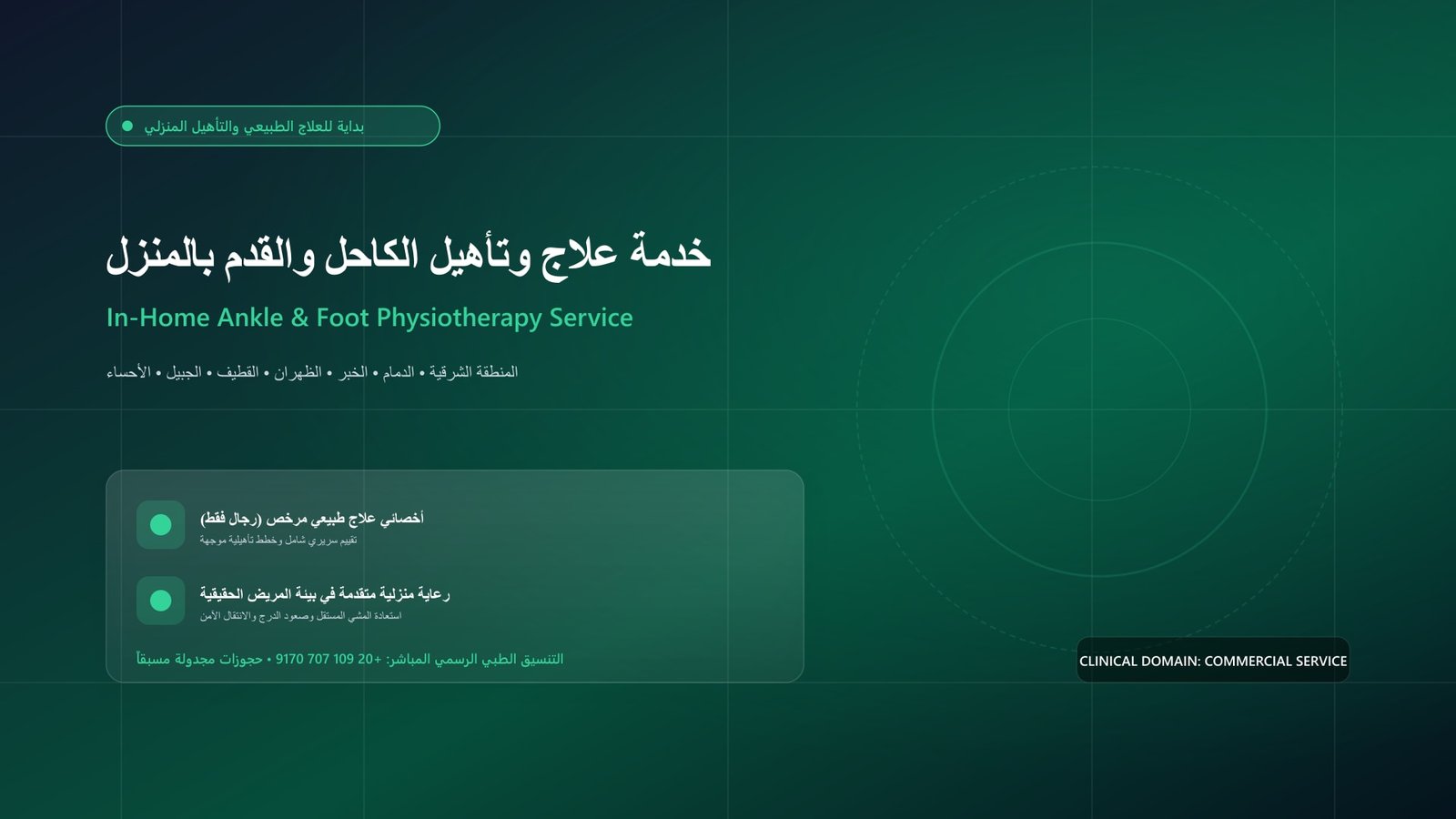
Specialized In-Home Ankle, Foot & Balance Rehabilitation Service
Evidence-based clinical rehabilitation delivered directly to your residence across Dammam, Khobar, Dhahran, and Eastern Province cities with maximum privacy and comfort.
Comprehensive In-Home Clinical Evaluation (60-75 Mins)
Detailed functional & neuro examination, home safety audit, and custom protocol with portable equipment — no upfront package commitments.
Flexible appointments 7 days a week (8 AM - 10 PM) • Payment upon visit completion
1,500+ Successful Home Recoveries
Certified Clinical Physiotherapists
Assessment-First Protocol
Thorough physical evaluation before any treatment plan starts
Specialized Male Therapists
Professional licensed therapists visiting your residence
100% In-Home Rehabilitation
No clinic travel friction or waiting room discomfort
Targeted Functional Goals
Focused on daily stairs, walking endurance, and independence
Emergency Medical Red-Flags & Home Care Boundaries
In-home physiotherapy is intended strictly for medically stable recovery. In the presence of acute emergency symptoms, immediately call 997 or proceed to hospital emergency.
Ankle sprains, plantar fasciitis, and post-fracture joint stiffness compromise ground weight-bearing and stability with every step. Bidaya delivers specialized in-home ankle and foot rehabilitation across Eastern Province residences, treating ligament tears, heel pain, and post-cast immobility through structured clinical protocols by certified male clinicians.
Clinical Biomechanics & Advanced Tissue Pathology for (In-Home Ankle and Foot Pain Physiotherapy)
Pathomechanical Analysis, Tissue Failure Mechanisms, and Kinetic Chain Compromise
Addressing the complex functional impacts of In-Home Ankle and Foot Pain Physiotherapy represents a key specialty of Bidaya's in-home clinical practice in Eastern Province. The underlying lesion impacts talocrural and subtalar joints, anterior talofibular ligament, Achilles tendon, and plantar fascia, characterized pathologically by chronic ankle instability, plantar fasciitis, Achilles tendinopathy, and post-immobilization stiffness.
This impairment alters kinematic load distribution across related kinetic linkages, notably calf muscular weakness, restricted talar posterior glide, and ascending kinetic knee/hip instability. Left untreated, compensatory muscle hypertonicity and joint stiffness escalate, interfering with comfortable driving, stair navigation, and prolonged sitting.
Residential habits in the Eastern Province, including plush majlis seating and extended vehicle travel in hot climates, frequently exacerbate these symptoms. Our certified male physical therapists deploy customized home treatment plans integrating gentle joint glides, stabilizing drills, and postural re-education to restore unrestricted motion.
By prioritizing patient comfort and rigorous clinical science, Bidaya ensures rapid symptom relief and lasting musculoskeletal resilience without clinic travel burdens.
Our therapeutic intervention activates endogenous biological healing cascades by optimizing capsular compliance and tendon resilience, facilitating unrestricted, fluid joint articulation. Restoring normal physiological excursion permanently eliminates compensatory guarding and secondary myofascial trigger points. Furthermore, supervised home clinical intervention establishes early neuromuscular control, systematically attenuating nociceptive input and optimizing functional mobility across all domestic environments.
Comprehensive Residential Clinical Evaluation & Diagnostic Battery for (In-Home Ankle and Foot Pain Physiotherapy)
Standardized Goniometry, Manual Muscle Testing, and Specialized Provocation Maneuvers
Bidaya's licensed male physical therapist conducts an exhaustive 60-minute diagnostic examination within your residence in Eastern Province to evaluate every clinical nuance: 1. Sensorimotor and neurodynamic screening to rule out red flags and ensure absolute home rehabilitation safety. 2. High-precision digital goniometric tracking logging active and passive range-of-motion restrictions in degrees compared to the unaffected contralateral side. 3. Targeted orthopedic provocation testing isolating the exact anatomical tissue generating painful impulses. 4. Observational gait and movement synergy analysis identifying abnormal compensatory kinematics that overload adjacent segments.
Conducting this objective assessment within your domestic environment captures actual movement mechanics across hallways, stairs, and living room furniture—providing realistic diagnostic insight unavailable in clinical outpatient facilities, and shaping tangible recovery goals that mirror everyday living.
Our visiting specialist carries a comprehensive portable diagnostic kit featuring digital goniometers, sensory monofilaments, neuromuscular stimulators, and dynamometers, delivering an uncompromising hospital-grade evaluation in the comfort and privacy of your home.
All baseline findings and diagnostic metrics are immediately logged into the patient's encrypted digital clinical profile. This structured documentation provides objective weekly progress reports shared directly with your consulting orthopedic physician, establishing clinical transparency and seamless multidisciplinary coordination across your entire rehabilitation journey.
Evaluating movement patterns within your actual home environment allows our visiting clinician to observe genuine kinematic challenges across stairs, hallways, and residential seating. Identifying these authentic environmental demands ensures therapeutic exercises target the precise movement patterns needed for daily domestic autonomy. Recording granular clinical metrics during each home visit provides an objective benchmark for therapeutic progression, verifying steady functional recovery and patient physical resilience.
Precision Objective Documentation
Establishing quantified baseline metrics during the initial home visit enables precise outcome measurement, allowing clinicians to modulate load parameters in direct alignment with biological tissue healing rates.
| Clinical Assessment / Provocation Test | Diagnostic Target | Positive Clinical Indicator | Portable Clinical Instrumentation |
|---|---|---|---|
| Ankle Anterior Drawer Ligamentous Test | Evaluate mechanical integrity of the anterior talofibular ligament | Excessive anterior talar translation without a firm ligamentous end-feel | Manual orthopedic test |
| Windlass Plantar Fascia Provocation Test | Confirm plantar fasciitis and heel spur irritation | Sharp focal calcaneal pain upon passive great toe dorsiflexion during weight bearing | Standardized clinical test |
| Weight-Bearing Ankle Lunge (WBLT) | Quantify talar posterior glide and gastrocnemius-soleus flexibility | Deficit below 10 cm distance from knee to wall without heel lift | Standard clinical ruler |
Evidence-Based Rehabilitation Protocol & Progressive Loading Phases for (In-Home Ankle and Foot Pain Physiotherapy)
Multi-Tiered Care Plan Combining Manual Therapy, Neuromuscular Stabilization, and Kinetic Chain Reconditioning
Bidaya's home rehabilitation protocol for (In-Home Ankle and Foot Pain Physiotherapy) utilizes a systematic neuromuscular re-education model structured across four tiers: - Phase 1: Calming irritated tissues around talocrural and subtalar joints, anterior talofibular ligament, Achilles tendon, and plantar fascia and reducing protective hypertonicity using gentle manual therapy. - Phase 2: Sensorimotor retraining re-establishing balanced co-contraction between prime movers and deep stabilizing sleeves. - Phase 3: Antigravity kinetic chain strengthening expanding load-bearing capacity during sustained upright standing and walking. - Phase 4: Ecological task simulation preparing the patient for full family, professional, and recreational engagement.
Advancing between phases requires fulfilling strict objective criteria, ensuring previous gains are cemented before increasing intensity.
This methodical framework shields patients from reinjury, providing lasting, dependable recovery in the comfort of home.
Every stage is governed by quantified functional benchmarks, ensuring previous biomechanical gains are consolidated before advancing to higher physical demands. This structured methodology establishes a durable physical foundation supporting long-term musculoskeletal wellness. Adherence to evidence-based mechanotransductive staging shields vulnerable articulations while steadily building functional physical endurance across everyday residential tasks.
Safe Therapeutic Loading Rules
Therapeutic exercise discomfort must remain at or below 3/10 during execution and must completely subside to baseline within 60 minutes post-session.
- Talar mobilization with movement restoring functional dorsiflexion excursion
- Heavy slow resistance eccentric loading rebuilding Achilles tendon tensile resilience
- Dynamic balance retraining on unstable surfaces restoring ankle proprioceptive reflexes
- Plantar fascia stretching and roller massage easing first-step morning heel pain
Step-by-Step Prescribed Residential Exercise Protocol for (In-Home Ankle and Foot Pain Physiotherapy)
Detailed Guidance on Movement Execution, Biomechanical Form, Respiratory Timing, and Safe Progression Criteria
Therapeutic home exercises for (In-Home Ankle and Foot Pain Physiotherapy) are designed to rebuild natural movement and safeguard joints within your home:
1. Targeted Symptom Modulation & Offloading: Calf gastrocnemius stretch against wall: placing affected leg behind with heel grounded while leaning forward, holding 20 seconds, 3 reps.
2. Tissue Flexibility & Excursion Restoration: Plantar fascia roller massage: rolling tennis ball or firm cylinder under sole of foot back and forth, 2 minutes each morning.
3. Progressive Stabilizer Strengthening & Balance: Heel raise and slow eccentric lower on step: elevating onto balls of feet and slowly descending below step level, 12 reps, 3 sets.
Clinicians highlight the importance of smooth movement transitions, allowing adequate rest intervals between consecutive sets. Patients receive an illustrated guide detailing step-by-step technique to facilitate confident independent practice. This targeted program establishes enduring joint resilience, preventing recurrences and revitalizing daily mobility.
Our therapist reviews exercise technique at the start of every visit, making fine kinematic corrections to maximize therapeutic efficacy and joint safety. Continuous technique reinforcement prevents the emergence of subtle compensatory movement errors. Disciplined independent execution under periodic clinical review reinforces positive biomechanical adaptations, permanently eliminating compensatory strain from daily physical routines.
- Avoid hazardous mechanical vectors, particularly: walking barefoot across hard ceramic tiles and sudden running prior to ligamentous stability
- Execute all prescribed drills on a firm, supportive mat rather than excessively plush beds or sofas
- Maintain steady diaphragmatic respiration, strictly avoiding Valsalva breath-holding during exertion
- Log exercise tolerance and any transient symptoms for review during subsequent visits
Domestic Environmental Ergonomics & Joint Protection Strategies across Eastern Province
Actionable Adjustments for Prayer Postures, Majlis Seating, and Extended Eastern Province Commuting
Bidaya provides practical domestic guidelines optimizing residential environments in Eastern Province to accelerate healing for (In-Home Ankle and Foot Pain Physiotherapy): - Worship Posture Adaptation: Teaching safe prayer mechanics to avoid concentrating mechanical loads on irritated structures. - Home & Office Seating: Deploying ergonomic chairs with supportive armrests and appropriate heights to support independent rising. - Highway Travel Ergonomics: Structuring 5-minute movement breaks during long expressway commutes across the Eastern Province. - Sleep Hygiene: Utilizing supportive bedding that maintains natural musculoskeletal contours for restorative, pain-free sleep.
Implementing these straightforward adjustments shields healing tissues during rest and work, preventing repetitive daily strain. Patients notice immediate improvements in domestic comfort upon adapting basic movement habits within their home.
Our therapist demonstrates how to position ergonomic lumbar supports during extended highway commutes across the Eastern Province to eliminate spinal compression. Proper vehicular posture dissipates road vibrations, ensuring you arrive at your destination refreshed and comfortable. Cultivating joint-sparing habits during daily domestic tasks protects healing periarticular tissues, ensuring functional improvements achieved during therapy remain durable across years.
- Wear cushioned indoor footwear with arch support, avoiding barefoot contact with hard tile
- Perform gentle plantar fascia stretches in bed before taking your initial morning steps
- Place an anti-fatigue gel mat in the kitchen to buffer prolonged standing forces
- Utilize supportive ankle strapping or elastic braces during community walking
Quantitative Clinical Discharge Criteria & Long-Term Joint Longevity for (In-Home Ankle and Foot Pain Physiotherapy)
Evidence-Based Benchmarks Confirming Restored Functional Independence and Lasting Musculoskeletal Health
Bidaya enforces objective discharge standards confirming tissues absorb routine mechanical shock before therapy concludes: 1. Eccentric Braking Mastery: Controlled, silent descent into chairs and fluid stair descent without reliant handrail gripping. 2. Bilateral Muscular Symmetry: Symmetrical manual muscle testing scores and total elimination of compensatory limping. 3. Restful Sleep Architecture: Uninterrupted nocturnal sleep free from pain, waking refreshed without morning joint gel.
Patients receive clear ergonomic guidance for managing work exertion, leisure activities, and long-distance road trips.
Direct support channels remain accessible to address any functional inquiries and support your ongoing physical wellness.
Graduating patients receive clear guidelines for managing physical exertion and scheduling rest intervals during extended highway commutes across the region. Proactive movement pacing preserves musculoskeletal vitality during travel, work, and family commitments. Achieving these standardized clinical discharge metrics validates that dynamic stabilization mechanisms operate effectively during all vocational, recreational, and spiritual activities.
Frequently Asked Questions about In-Home Physiotherapy
The plantar fascia tightens in shortened positions overnight; abrupt morning weight-bearing induces painful micro-tearing. Pre-step stretching prevents this.
Related Clinical & Regional Pathways
In-Home Arthritis & Joint Stiffness Service→
Evidence-based clinical rehabilitation delivered directly to your residence across Dammam
In-Home Hip Rehabilitation Service→
Evidence-based clinical rehabilitation delivered directly to your residence across Dammam
In-Home Post-Surgical Orthopedic Rehabilitation→
Evidence-based clinical rehabilitation delivered directly to your residence across Dammam
In-Home Physiotherapy Services→
An integrated clinical care system delivering evidence-based physical therapy disciplines directly to your res...
In-Home Neurological & Stroke Rehabilitation in Jubail Industrial & City→
Advanced in-home physical therapy restoring functional mobility
ACL Reconstruction Post-Op→
Advanced in-home rehabilitation across Dammam led by licensed male clinicians
Meniscus Tear Rehabilitation→
Advanced in-home rehabilitation across Dammam led by licensed male clinicians
Rotator Cuff Rehabilitation→
Advanced in-home rehabilitation across Dammam led by licensed male clinicians