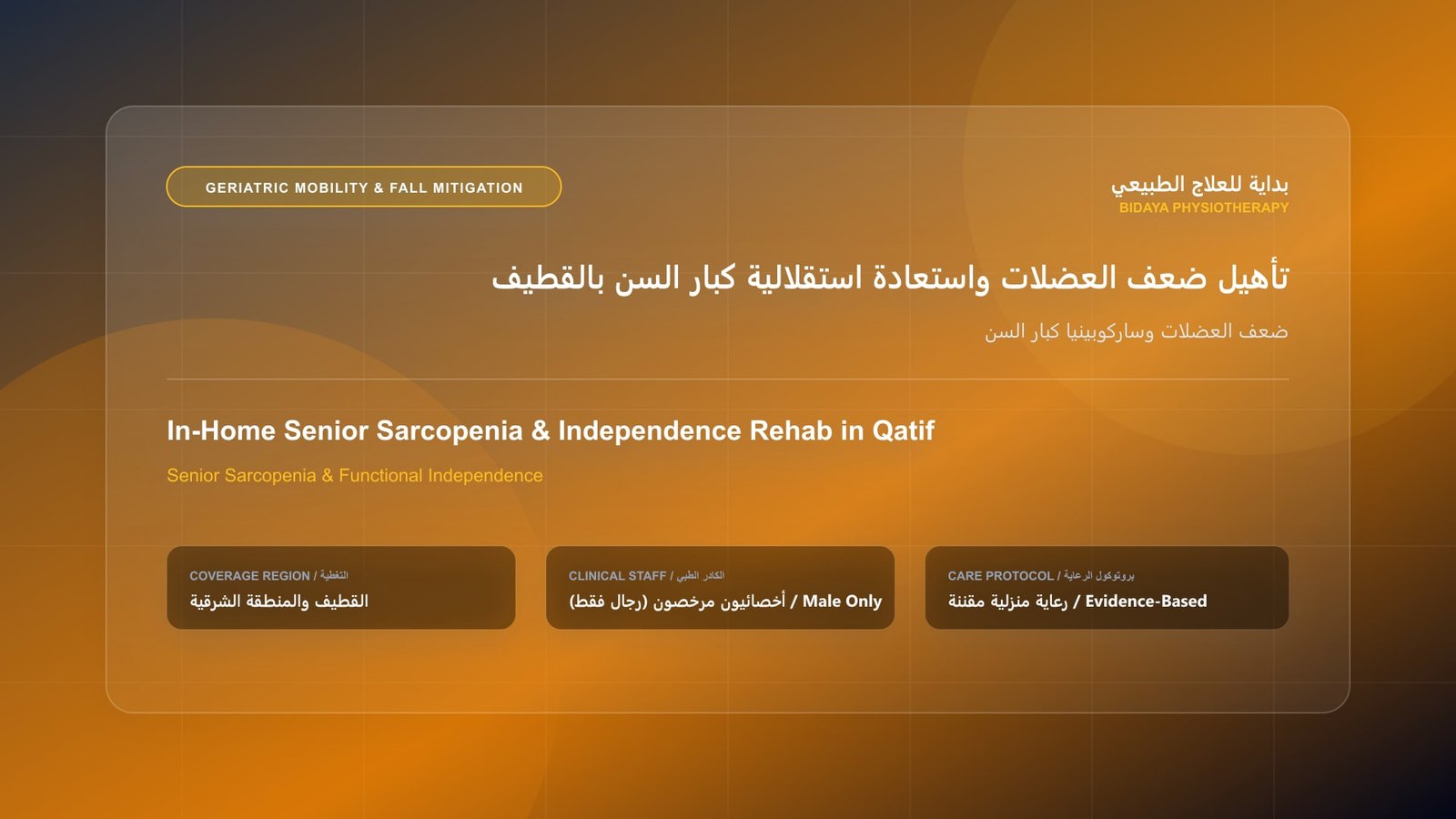
In-Home Senior Sarcopenia & Independence Rehab in Qatif
Advanced in-home rehabilitation across Qatif led by licensed male clinicians, restoring mobility and daily functional independence.
Comprehensive In-Home Clinical Evaluation (60-75 Mins)
Detailed functional & neuro examination, home safety audit, and custom protocol with portable equipment — no upfront package commitments.
Flexible appointments 7 days a week (8 AM - 10 PM) • Payment upon visit completion
1,500+ Successful Home Recoveries
Certified Clinical Physiotherapists
Assessment-First Protocol
Thorough physical evaluation before any treatment plan starts
Specialized Male Therapists
Professional licensed therapists visiting your residence
100% In-Home Rehabilitation
No clinic travel friction or waiting room discomfort
Targeted Functional Goals
Focused on daily stairs, walking endurance, and independence
Emergency Medical Red-Flags & Home Care Boundaries
Emergency Medical Boundary: Bidaya provides scheduled in-home therapeutic rehabilitation and is not an emergency medical dispatch service. For acute neurological deficits, unreduced fractures, severe respiratory distress, or sudden chest pain, contact the Saudi Red Crescent immediately at 997 or 911.
Delivering private, individualized therapeutic care across Qatif, Bidaya tailors in-home physical therapy protocols for Senior Sarcopenia & Functional Independence led exclusively by licensed male physical therapists. We focus on restoring functional autonomy within the domestic environment without mechanical discomfort.
Clinical Diagnosis of Sarcopenic Decline in Qatif Seniors
Gait Velocity Metrics, Grip Dynamometry & Chair-Rise Transfer Failure
Progressive age-related skeletal muscle wasting (Sarcopenia) significantly impairs mobility among seniors residing in multi-generational family homes across Qatif, precipitating prolonged chair-rest and loss of autonomy.
Bidaya's visiting physical therapists quantify functional deficits: benchmark 4-meter gait velocity, evaluate isometric grip dynamometry, and time Five-Times Sit-to-Stand (5XSTS) transfer performance.
Functional Mobility Cut-Off
Quadriceps weakness represents the premier biomechanical barrier to independent chair transfers; conditioning extensor power restores transfer autonomy in over 80% of patients.
- Benchmark baseline gait velocity over standard domestic distances
- Quantify appendicular muscle strength across knee extensors and hip abductors
- Evaluate sit-to-stand kinematics from typical domestic living room seating
- Coordinate dietary protein intake adequacy with family caregivers
Progressive Resistance Training (PRT) & Functional Conditioning in Home Care
Soft Ankle Weights, Elastic Resistance Bands & Transfer Independence
Therapy administers evidence-based Progressive Resistance Training (PRT) using calibrated soft ankle weights and elastic bands, stimulating motor unit recruitment across lower extremity prime movers.
Every exercise directly maps to essential domestic milestones: chair transfers, hallway ambulation, and villa stair navigation, restoring self-efficacy across Qatif households.
Daily Chair-Rise Training Rule
Executing 10 controlled sit-to-stand repetitions from a sturdy armchair daily preserves functional quadriceps reserve and prevents mobility decline.
- Execute supervised chair-rise repetitions twice daily with tactile cues
- Condition lower extremity extensors utilizing progressive soft ankle cuff weights
- Engage in structured corridor ambulation maintaining steady step rhythms
- Encourage senior participation in safe daily self-care activities to build confidence
Adapting Home Physiotherapy to Qatif Residential Villa Architecture
Safely Navigating extended family residences with shaded domestic courtyards, durable terrazzo flooring, and traditional stairwells and Domestic Ambulation Corridors
Residential villas across Qatif characteristically feature expansive open layouts and extended family residences with shaded domestic courtyards, durable terrazzo flooring, and traditional stairwells. For patients rehabilitating from Senior Sarcopenia & Functional Independence, this domestic architecture presents distinct clinical hazards; low-friction flooring elevates slip risks, while multi-level staircases demand high joint torque.
During the initial domestic consultation, Bidaya's visiting male physical therapist conducts a comprehensive architectural audit: 1. Screening flooring across bedrooms, primary corridors, and washroom thresholds, securing loose scatter rugs with industrial non-slip backing. 2. Coaching safe gait pacing over polished marble surfaces, prescribing broad-based high-traction indoor footwear to maximize floor contact area. 3. Structuring step-by-step staircase navigation using bilateral handrails, enforcing the gold-standard principle of leading with the uninvolved limb during ascent and the involved limb during descent.
Rehabilitating within the actual home environment in Qatif establishes functional confidence and autonomy far surpassing artificial clinic gymnasiums.
Immediate Home Safety Pearl in Qatif
Securing rug perimeters with double-sided anti-slip backing and leveling thresholds reduces domestic slip incidents by over 60% on marble surfaces.
- Clear loose accent rugs along key domestic ambulation corridors
- Install motion-activated pathway lighting between bed and bathroom
- Train full single-limb weight capture before initiating swing phase
- Mandate supportive rubber-soled enclosed indoor footwear
Quantitative Arthrokinematic Measurement & Tissue Profiling for Senior Sarcopenia & Functional Independence in Qatif
Calibrated Goniometry, Provocation Mapping & Structural Tissue Tolerance
Bidaya utilizes a rigorous quantitative diagnostic framework for Senior Sarcopenia & Functional Independence across Qatif, combining manual palpation with portable, sanitized assessment instruments.
Core elements of the in-home clinical examination: 1. Targeted Diagnostic Battery: Executing Berg Balance Scale (BBS), Timed Up and Go (TUG), and 30-Second Chair Stand muscular endurance battery and recording angular arcs in degrees and linear limb girth in centimeters. 2. Pain Provocation Mapping: Identifying specific postures and loading directions that aggravate or alleviate symptoms to establish the directional preference. 3. Myofascial Extensibility Screening: Assessing muscle-tendon compliance and screening for active myofascial trigger points. 4. Domestic Functional Performance: Evaluating patient ability to execute bed transfers, independent rising, and hallway ambulation safely.
These objective findings provide baseline metrics tracked longitudinally via Activities-specific Balance Confidence (ABC) Scale and Fall Risk Assessment Index.
Quantitative Precision in Qatif
Recording motion metrics in exact degrees allows rigorous cross-session comparison, objectively confirming therapeutic response.
- Record joint ranges in standardized digital documentation charts
- Map symptom distribution and intensity during active and resting states
- Inspect soft-tissue elasticity and scar compliance across affected regions
- Identify domestic architectural barriers specific to the patient's residence
Functional Motor Recovery Roadmap & Progressive Kinetic Milestones for Senior Sarcopenia & Functional Independence
Structured Transition from Assisted Movement to Independent Loading and Endurance
Bidaya implements a calibrated clinical roadmap ensuring progressive muscular endurance and full motion restoration for Senior Sarcopenia & Functional Independence.
Functional progression trajectory: 1. Phase I (Neuromuscular Activation): Administering Otago Exercise Programme balance drills, closed-chain hip abductor/extensor loading, lateral stepping, and compliant foam perturbation exercises to engage motor units and resolve joint stiffness. 2. Phase II (Active Functional Arcs): Advancing toward full active range of motion reinforced by stabilizing muscle loading. 3. Phase III (Autonomy & Functional Capacity): Achieving achieving TUG completion under 13 seconds, executing 5 unassisted chair stands without arm push, and stable single-leg stance > 5 seconds, training independent corridor ambulation and reciprocal stair navigation.
Phase transitions rely on objective testing substantiating tissue load tolerance.
Safe Transition Benchmark
Progressing to higher-demand drills strictly requires executing current protocols across 3 consecutive sessions with zero reactive soreness.
- Log repetitions and completed sets during each clinical session
- Temporarily halt exercise if sharp, unfamiliar pain suddenly manifests
- Perform exercises with slow, deliberate tempo to maximize target muscle recruitment
- Verify balance stability prior to weaning from crutches or walkers
Preventive Home Ergonomics & Recovery Microclimate Design for Senior Sarcopenia & Functional Independence
Optimizing Room Clearance, Lighting & Safe Conditioning in Qatif
Long-term rehabilitative success for Senior Sarcopenia & Functional Independence depends on engineering an obstacle-free residential environment across Qatif.
Preventive domestic adaptation steps: 1. Transit corridor clearance: Repositioning redundant furniture away from main domestic hallways to accommodate mobility aids without hindrance. 2. Specific motion precautions: Strictly respecting documented clinical instructions: illuminating nocturnal transit pathways, eliminating floor thresholds, securing bathroom grab rails, and mandating non-slip rubber soles. 3. Daily exercise execution: Diligently performing Otago Exercise Programme balance drills, closed-chain hip abductor/extensor loading, lateral stepping, and compliant foam perturbation exercises interspersed with structured recovery breaks. 4. Restful sleep mechanics: Deploying a contour mattress supporting physiological spinal lordosis and neutral joint alignment.
These structural adjustments enable patients to regain functional independence safely. Direct line: (+20 109 707 9170).
Restful Sleep Alignment in Qatif
Positioning an ergonomic contour pillow between knees in side-lying posture aligns pelvic symmetry, arresting morning stiffness.
- Place a firm supportive pillow between knees when resting in side-lying
- Ensure adequate illumination across primary corridors day and night
- Execute home exercises during periods of peak physiological energy
- Share functional recovery updates via WhatsApp (+20 109 707 9170)
Emergency Safety Protocol & Early Warning Stratification for Senior Sarcopenia & Functional Independence in Qatif
Recognizing Systemic Danger Signs & Immediate Escalation to Saudi Red Crescent (997)
Bidaya's licensed male clinicians in Qatif coach family caregivers to identify early warning signs indicating acute medical emergencies rather than benign rehabilitation soreness.
Critical early warning markers: 1. Specific Pathology Red Flags: Documented emergence of traumatic domestic fall with inability to bear weight (suspected occult hip fracture), acute sudden delirium, or persistent vertigo. 2. Cerebrovascular Impairment: Acute cognitive disorientation, unilateral facial droop, or sudden arm drift. 3. Deep Vein Thrombosis: Unilateral calf swelling accompanied by acute warmth and severe tenderness on palpation. 4. Acute Respiratory Distress: Oxygen saturation desaturation beneath 88% refractory to rest with tachypnea.
Acute Transfer Protocol: Physical therapy is halted immediately, and the Saudi Red Crescent is dialed at 997 or emergency services at 911 for transport to Qatif Central Hospital, Al-Zahra General Hospital, and Anak Hospital. Bidaya provides scheduled in-home rehabilitation, not acute medical emergency dispatch. Inquiries: (+20 109 707 9170).
Early Warning Recognition in Qatif
Identifying emergent medical danger signs and contacting emergency response (997) saves lives and prevents chronic complications.
- Call emergency dispatch at 997 without hesitation upon acute red flags
- Record exact time of symptom onset to brief attending emergency physicians
- Maintain a calm, climate-controlled domestic environment pending ambulance arrival
- Notify Bidaya clinical desk (+20 109 707 9170) regarding hospital admission updates
Longitudinal Kinetic Surveillance & Joint Preservation Protocol for Senior Sarcopenia & Functional Independence
Structured Self-Drills, Mobility Tracking & Periodic Consultations in ${cityEn}
Bidaya's long-term kinetic surveillance protocol cements functional milestones achieved during in-home sessions for Senior Sarcopenia & Functional Independence across Qatif.
Core elements of kinetic surveillance: 1. Daily Restorative Routine: Performing gentle mobility exercises drawn from Otago Exercise Programme balance drills, closed-chain hip abductor/extensor loading, lateral stepping, and compliant foam perturbation exercises to stimulate synovial fluid circulation. 2. Self-Administered Motion Audits: Training patients to self-evaluate functional motion against achieving TUG completion under 13 seconds, executing 5 unassisted chair stands without arm push, and stable single-leg stance > 5 seconds. 3. Social Ergonomic Adaptation: Practical strategies for safe sitting and standing during community and family gatherings across Qatif. 4. Longitudinal Support Conduits: Ongoing clinical guidance available via Bidaya's telephone desk (+20 109 707 9170).
This continuous oversight provides long-term peace of mind and sustained functional vitality.
Joint Preservation Practice in Qatif
Cartilage nutrition relies on repetitive cyclic loading; gentle therapeutic movement represents the first defense against joint degeneration.
- Sustain prescribed autonomous exercise calisthenics at home regularly
- Identify early signs of focal joint irritation and modulate intensity
- Engage in structured walking along pleasant promenades like Qatif Seafront promenade, Al-Majeedah walkway, and Sanabis coastal path
- Connect with Bidaya (+20 109 707 9170) to advance exercise programs periodically
Holistic Community Reintegration & Active Family Engagement across Qatif
Total Motor Autonomy, Fulfilling Social Roles & Enjoying Life in Qatif
Bidaya culminates its comprehensive physical therapy programs in Qatif by restoring the patient's full familial and social contributions with complete vigor.
Pillars of ultimate life reintegration: 1. Enjoying Multi-Generational Family Life: Participating actively in activities with children and grandchildren without limitations from Senior Sarcopenia & Functional Independence. 2. Mosque Prayer Fulfillment: Enjoying independent walking to community mosques for congregation prayers with comfort and dignity. 3. Routine Walkway Fitness: Embedding low-impact ambulation along Qatif Seafront promenade, Al-Majeedah walkway, and Sanabis coastal path into permanent weekly routines. 4. Spontaneous Regional Transit: Traveling comfortably across districts like Al-Majeedah, Al-Shati, Danat Al-Rames, Al-Awamiyah, and Tarout to visit cultural and familial landmarks.
This tangible outcome represents our clinical mission for every individual served in Qatif. Scheduling desk: (+20 109 707 9170).
Complete Autonomy in Qatif
Autonomous functional mobility in daily life represents the true milestone of evidence-based, dedicated clinical rehabilitation.
- Celebrate functional mobility milestones and encourage ongoing physical activity
- Maintain outdoor corridor ambulation 2 to 3 times weekly as a lifestyle habit
- Stay connected with your clinical team for annual preventive wellness checks
- Call Bidaya (+20 109 707 9170) to coordinate any future rehabilitative needs
Clinical Governance, Quality Assurance & Standardized Functional Metrics in Qatif
Rigorous Clinical Documentation, Objective Outcome Quantification & Safety Standards
All home physiotherapy interventions delivered by Bidaya across Qatif for Senior Sarcopenia & Functional Independence operate under a structured clinical governance framework, guaranteeing quality and clinical efficacy equivalent to premium tertiary institutions.
Pillars of clinical quality assurance and objective monitoring: 1. Standardized Patient-Reported Outcome Measures (PROMs): Deploying internationally validated metrics—including Activities-specific Balance Confidence (ABC) Scale and Fall Risk Assessment Index—at baseline, interim, and graduation intervals to quantify recovery progress objectively. 2. Peer Review and Clinical Case Auditing: Conducting multidisciplinary chart reviews to confirm therapeutic trajectories align with evidence-based rehabilitative milestones and recommendations from Qatif Central Hospital, Al-Zahra General Hospital, and Anak Hospital. 3. Stringent Mobile Infection Control: Enforcing hospital-grade sanitization protocols for all mobile therapy apparatus prior to domestic deployment and immediately post-session. 4. Patient and Caregiver Experience Governance: Gathering continuous feedback through our clinical coordination desk (+20 109 707 9170) to adapt care pacing and enhance domestic engagement.
This uncompromising standard establishes Bidaya as the dependable in-home physical therapy provider across Qatif.
Clinical Excellence Metric in Qatif
Quantifying rehabilitation milestones with standardized objective scales ensures full transparency and predictable functional restoration.
- Maintain encrypted electronic functional tracking throughout the episode of care
- Adhere to hospital-grade disinfection for all portable assessment instruments
- Conduct periodic functional score re-evaluations to substantiate discharge criteria
- Reach clinical coordination desk (+20 109 707 9170) for medical chart summaries
Frequently Asked Questions about In-Home Physiotherapy
In-home care eliminates the stress of vehicular travel and traffic across Qatif, while enabling direct ergonomic inspection of the patient's actual domestic seating and sleeping setups.
Related Clinical & Regional Pathways
Bedridden Senior Positioning & Mobility→
Advanced in-home rehabilitation across Qatif led by licensed male clinicians
Hip Fracture Post-Surgical Rehab→
Advanced in-home rehabilitation across Qatif led by licensed male clinicians
Sit-to-Stand & Walking Endurance Training→
Advanced in-home rehabilitation across Qatif led by licensed male clinicians
In-Home Physiotherapy in Dammam→
Evidence-based clinical rehabilitation delivered directly to your doorstep across Dammam metropolitan districts
In-Home Low Back Pain & Sciatica Rehabilitation Therapy→
Evidence-based clinical rehabilitation engineered to resolve lumbar disc herniations
In-Home Knee Pain & Osteoarthritis Rehabilitation Therapy→
Evidence-based clinical rehabilitation engineered to arrest articular cartilage degeneration
In-Home Stroke Rehabilitation & Neurological Physiotherapy Therapy→
Evidence-based neurological rehabilitation engineered to stimulate corticomotor neuroplasticity
In-Home Post-Operative Physiotherapy Therapy→
Evidence-based surgical rehabilitation protocols engineered to restore joint range of motion