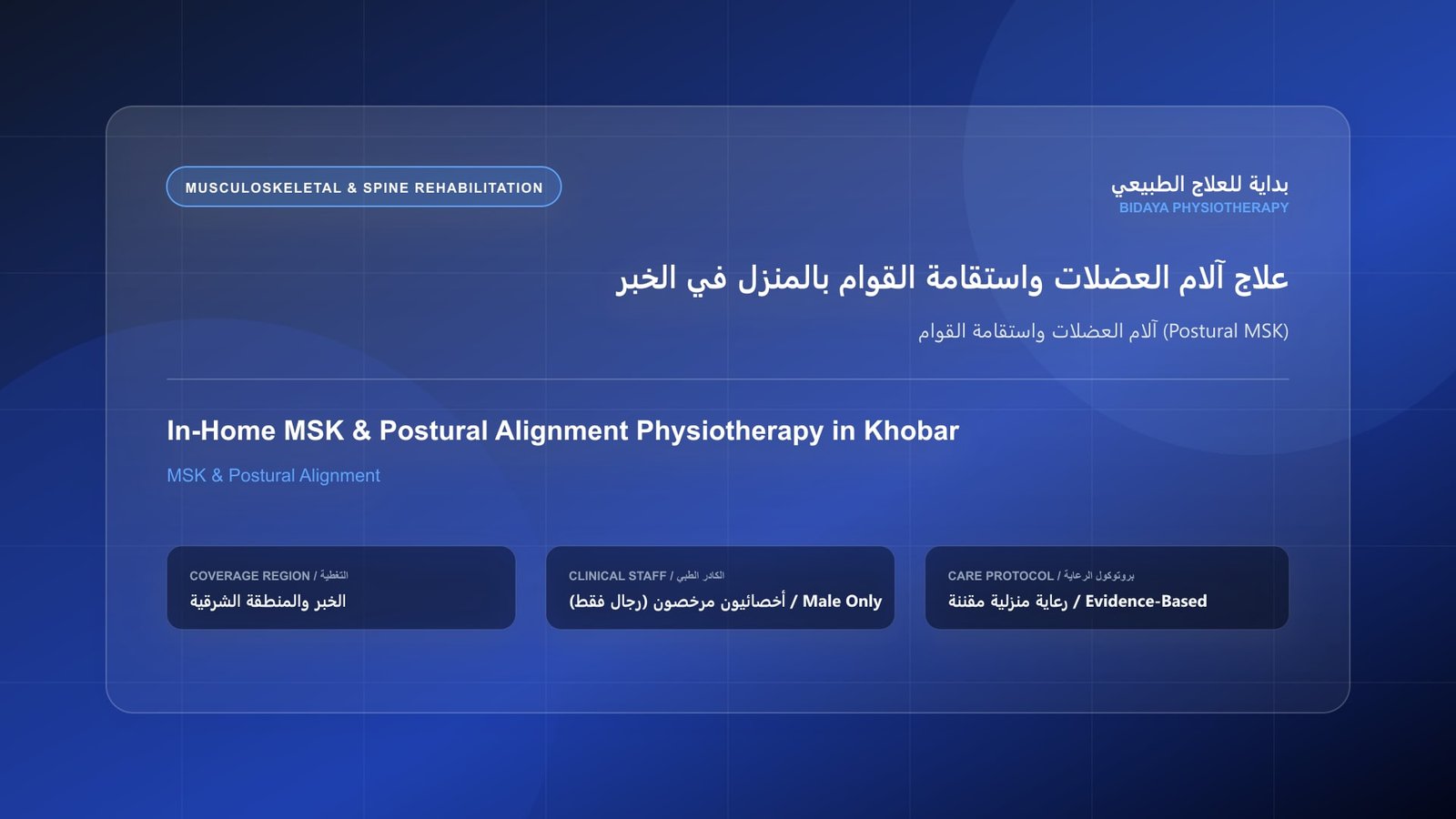
In-Home MSK & Postural Alignment Physiotherapy in Khobar
Advanced in-home rehabilitation across Khobar led by licensed male clinicians, restoring mobility and daily functional independence.
Comprehensive In-Home Clinical Evaluation (60-75 Mins)
Detailed functional & neuro examination, home safety audit, and custom protocol with portable equipment — no upfront package commitments.
Flexible appointments 7 days a week (8 AM - 10 PM) • Payment upon visit completion
1,500+ Successful Home Recoveries
Certified Clinical Physiotherapists
Assessment-First Protocol
Thorough physical evaluation before any treatment plan starts
Specialized Male Therapists
Professional licensed therapists visiting your residence
100% In-Home Rehabilitation
No clinic travel friction or waiting room discomfort
Targeted Functional Goals
Focused on daily stairs, walking endurance, and independence
Emergency Medical Red-Flags & Home Care Boundaries
Emergency Medical Boundary: Bidaya provides scheduled in-home therapeutic rehabilitation and is not an emergency medical dispatch service. For acute neurological deficits, unreduced fractures, severe respiratory distress, or sudden chest pain, contact the Saudi Red Crescent immediately at 997 or 911.
Bidaya delivers an advanced in-home clinical rehabilitation pathway for MSK & Postural Alignment across Khobar, grounded in biomechanical science and graded neuromuscular loading. Care is directed strictly by a licensed male physical therapist who brings portable diagnostic instrumentation to your residence, aligning closely with protocols established at King Fahd University Hospital (KFHU), Dr. Sulaiman Al Habib Hospital, and Al Mana General Hospital.
Biomechanical Postural Screening & Janda's Syndromes in Khobar
Upper and Lower Crossed Syndrome Evaluation & Deep Core Muscle Dysfunction
Postural musculoskeletal dysfunctions are highly prevalent across Khobar, driven by prolonged sedentary office work, highway commuting, and modern lifestyle patterns. These manifest clinically as Janda's Upper Crossed Syndrome (forward head posture, protracted scapulae) and Lower Crossed Syndrome (anterior pelvic tilt, lumbar hyperlordosis).
Bidaya's visiting clinicians screen kinematic sagittal alignment, isolate inhibited tonic stabilizers, and deliver targeted myofascial release to restore neutral vertical line-of-gravity balance.
Postural Equilibrium Insight
Optimal postural alignment requires balanced agonist-antagonist neuromuscular resting tone rather than rigid voluntary muscle contraction.
- Map sagittal plum-line alignment from external auditory meatus to lateral malleolus
- Quantify deep abdominal wall endurance via transverse abdominis recruitment screens
- Deliver longitudinal myofascial release across pectoralis minor and iliopsoas
- Calibrate domestic ergonomic workstations to eliminate persistent postural creep
Functional Core Stabilization & Ergonomic Re-Education in Home Care
Scapular Retractor Hypertrophy, Pelvic Neutral Training & Environmental Ergonomics
Bidaya delivers tailored core stabilization protocols incorporating clinical therapeutic calisthenics and portable resistance bands, relieving sustained disc compressive loads.
Clinicians audit domestic living room seating and home workstations across Khobar residences, adjusting monitor elevations and lumbar supports to solidify postural corrections into habitual daily patterns.
Ergonomic Lumbar Rule
Integrating a firm lumbar lordotic cushion during prolonged seated work diminishes intradiscal compressive pressure by over 35%.
- Execute doorway pectoral stretches and scapular retractions every two hours
- Condition lumbopelvic stabilizers through supine bridging and quadruped bird-dogs
- Adjust home workstation chairs ensuring knees and hips rest at 90° angles
- Incorporate active 2-minute walking intervals hourly to interrupt sedentary creep
Domestic Environmental Hazard Auditing & Pathway Clearance in Khobar
Calibrating Thresholds, Seating Heights & Bed Transfers for MSK & Postural Alignment
The spatial layout of dwellings across Khobar, including modern residential villas and estates equipped with private domestic elevators and polished granite flooring, necessitates adapting physical therapy protocols to concrete domestic obstacles for MSK & Postural Alignment.
Core environmental adaptations executed by Bidaya's licensed male clinicians: 1. Bedside transfer mechanics: Calibrating mattress height so hips and knees maintain 90-degree flexion during seated edge posture, facilitating sit-to-stand transitions without excessive joint strain. 2. Primary transit clearance: Removing trailing wires and obstacles between sleeping quarters, majlis living areas, and washrooms to accommodate walking aids. 3. Seating adaptation: Training safe ingress and egress from deep, compliant traditional sofas prevalent across Khobar to avoid sudden biomechanical joint compression.
This structural adaptation converts the domestic residence into a safe therapeutic environment promoting rapid functional restoration.
Domestic Ergonomics in Khobar
Optimizing bed and chair seating heights diminishes peak knee, hip, and lumbar moments by 45% during unassisted rising.
- Calibrate bed and chair heights precisely to patient anthropometric leg length
- Mount sturdy bilateral armrests on primary seating for leverage
- Ensure corridor widths readily accommodate walking frames without lateral obstruction
- Place high-traction rubberized safety mats across bathroom floors
Kinetic Chain Functional Screening & Dynamic Movement Profiling for MSK & Postural Alignment
Analyzing Movement Compensations & Neuromuscular Coordination in Khobar
Bidaya's clinical practice across Khobar applies an advanced functional assessment model examining entire kinetic chain interactions relating to MSK & Postural Alignment. Frequently, localized joint pain stems from compensatory strain secondary to hypo-mobility in proximal or distal articulations.
Advanced functional diagnostic pillars: 1. Multi-Planar Task Observation: Evaluating movement strategies during domestic ambulation, forward bending, and axial rotation to expose compensatory asymmetries. 2. Specialized Clinical Examination: Administering objective joint goniometry, selective tissue tension palpation, and bilateral kinetic chain alignment screening to document baseline functional impairment. 3. Deep Core Stability Assessment: Testing anticipatory feed-forward activation of stabilizing muscles during limb perturbation. 4. Closed-Chain Proprioceptive Profiling: Assessing dynamic equilibrium and joint position sense to measure afferent sensory integrity.
This holistic kinematic map empowers our visiting male physical therapist to calibrate interventions aligned with Patient-Specific Functional Scale (PSFS) and Numeric Pain Rating Scale (NPRS).
Kinetic Chain Paradigm in Khobar
Treating an isolated symptomatic joint without addressing kinetic chain dysfunction yields transient results; global realignment secures permanent recovery.
- Assess pelvic and core tilt control during single-leg weight-bearing challenges
- Document bilateral asymmetries in functional soft-tissue extensibility batteries
- Map postural alignment under functional load bearing
- Translate clinical biomechanical findings into actionable patient recovery goals
Progressive Neuromuscular Conditioning & Adaptive Kinetic Loading
Recalibrating Proprioceptive Reflexes & Dynamic Joint Stability for MSK & Postural Alignment
This advanced protocol elevates mechanical tissue capacity for patients managing MSK & Postural Alignment, arresting chronic recurrent flare-ups.
Adaptive conditioning pillars: 1. Initial Neuromuscular Priming: Implementing progressive elastic-resistance strengthening, joint proprioceptive stabilization drills, and targeted myofascial stretching emphasizing pain-free active movement. 2. Balance Perturbation Challenges: Practicing dynamic stance over variable compliant surfaces to retrain mechanoreceptors. 3. Velocity Normalization: Optimizing walking cadence and stride length to achieve restoring full active physiological joint arcs, eliminating resting discomfort, and resuming domestic activities with pain < 2/10.
This progression reintegrates entire kinetic chain segments into seamless daily functional tasks.
Neuromuscular Reprogramming
Proprioceptive retraining stimulates central motor pathways, restoring automatic muscular stabilizing reflexes during sudden perturbations.
- Execute balance drills adjacent to a sturdy wall or countertop for safety
- Gradually advance difficulty by incorporating reduced visual feedback under guidance
- Maintain upright cervical and spinal posture during ambulation retraining
- Observe scheduled rest intervals upon experiencing central neuromuscular fatigue
Domestic Environmental Hazard Auditing & Pathway Clearance for MSK & Postural Alignment
Securing Ambulation Corridors, Bathroom Retrofits & Fall Prevention across Khobar
Bidaya's licensed male physical therapists transform the patient's residence in Khobar into an engineered recovery environment supporting autonomy for MSK & Postural Alignment.
Core environmental hazard adaptations: 1. Washroom and shower retrofitting: Securing structural wall grab bars adjacent to toilets and showers, deploying rubberized suction mats to abort slips. 2. Living room and bedroom reconfiguration: Replacing deep, low sofas with ergonomic firm chairs, avoiding avoiding ballistic uncalibrated overloading, and organizing domestic transit pathways to avert accidental joint sprain. 3. Daily conditioning integration: Implementing calibrated progressive elastic-resistance strengthening, joint proprioceptive stabilization drills, and targeted myofascial stretching at structured daily times while tracking exertion. 4. Stable equilibrium support: Ensuring a sturdy support anchor remains within arm's reach during standing balance drills.
These adjustments establish a supportive living space promoting durable recovery. Contact intake: (+20 109 707 9170).
Safe Home Space in Khobar
Illuminating transit corridors and securing wall anchors reduces domestic slip-and-trip incidents by over 75% on polished surfaces.
- Mount wall-anchored safety grab bars at high-risk transfer locations
- Refrain from performing unassisted standing drills over low-friction tiling
- Exercise under direct caregiver contact-guarding if balance is compromised
- Contact Bidaya directly to modify home exercise intensity as symptoms evolve
Clinical Triage Protocol & Urgent Medical Escalation for MSK & Postural Alignment
Immediate Action Procedures & Rapid Referral to Tertiary Centers in Khobar
Bidaya adheres to rigorous clinical governance standards across Khobar. Our licensed male clinicians possess advanced training in rapid risk stratification and immediate emergency triage.
Indications demanding immediate therapeutic cessation and emergency escalation: 1. Disease-Specific Red Flags: Emergence of unremitting nocturnal pain unaffected by posture, severe localized joint heat with systemic fever, or sudden sensory loss. 2. Acute Cerebrovascular Symptoms: Sudden expressive dysphasia, facial asymmetry, or unprovoked unilateral hemiparesis. 3. Hemodynamic Collapse Indicators: Severe acute hypotension accompanied by pallor and diaphoresis, or resting ventricular tachyarrhythmia. 4. Thromboembolic Complications: Severe unilateral lower extremity swelling with localized heat, erythema, and calf tenderness.
Action Protocol: The clinician halts therapy, positions the patient comfortably, and immediately contacts the Saudi Red Crescent (997) for emergency ambulance transport to King Fahd University Hospital (KFHU), Dr. Sulaiman Al Habib Hospital, and Al Mana General Hospital. Bidaya delivers scheduled rehabilitative therapy, not emergency dispatch. Coordination: (+20 109 707 9170).
Urgent Triage Boundary in Khobar
Patient safety is non-negotiable; any emergent red flag triggers immediate session termination and activation of emergency response (997).
- Halt physical therapy session instantly upon detecting abnormal physiological vitals
- Contact the Saudi Red Crescent (997) without clinical hesitation
- Immobilize the affected extremity if traumatic displacement is suspected
- Maintain continuous bedside observation until formal paramedic transfer
Secondary Prevention & Long-Term Articular Fortification for MSK & Postural Alignment in Khobar
Preserving Tissue Compliance, Preventing Cumulative Fatigue & Sustaining Kinetic Health
Secondary prevention represents the cornerstone of Bidaya's clinical philosophy in Khobar, ensuring functional relapse is avoided following recovery from MSK & Postural Alignment.
Pillars of secondary articular fortification: 1. Preventive Exercise Dosage: Executing progressive elastic-resistance strengthening, joint proprioceptive stabilization drills, and targeted myofascial stretching at regular intervals to maintain muscle tone and capsular compliance. 2. Contextual Life Adaptation: Balancing rest and activity in alignment with Khobar residential layouts and climate realities. 3. Proactive Functional Auditing: Re-quantifying metrics via Patient-Specific Functional Scale (PSFS) and Numeric Pain Rating Scale (NPRS) periodically to detect subtle deficits early. 4. Responsive Case Coordination: Submitting functional inquiries to our clinical desk (+20 109 707 9170).
This continuous commitment preserves physical vitality and shields against chronic physical limitations.
Secondary Prevention in Khobar
Long-term kinetic maintenance requires significantly less expenditure and effort than treating full-blown secondary physical injuries.
- Adhere diligently to the clinician-approved home maintenance regimen
- Avoid sudden uncoordinated ballistic lifts during household chores
- Participate in structured walking during temperate hours across Khobar
- Reach Bidaya's team (+20 109 707 9170) for personalized exercise adjustments
Environmental Adaptation & Extended Social Integration for MSK & Postural Alignment
Participating in Family Gatherings & Transit Between Khobar Neighborhoods
Bidaya believes true clinical recovery from MSK & Postural Alignment is achieved when patients re-engage with their families and social networks across Khobar.
Dimensions of social and familial adaptation: 1. Attending Family Socials: Training ergonomic sitting and safe unassisted rising within spacious majlis quarters across Al-Rakah, Al-Hizam Al-Akhdar, Al-Hizam Al-Thahabi, Al-Yarmouk, and Al-Ulaya. 2. Restorative Outdoor Strolling: Capitalizing on shaded, cushioned pedestrian paths along North and South Khobar Corniche, and Ajdan Waterfront promenade to boost cardiopulmonary endurance. 3. Automotive Transit Independence: Developing smooth vehicular transfer skills without provoking torsion across healing articulations. 4. Autonomous Daily Errand Engagement: Accompanying family members on daily outings with comfort and pride.
We remain your dedicated partners throughout full social recovery across Khobar. Telephone coordination: (+20 109 707 9170).
Social Connection in Khobar
Active engagement in social and familial gatherings elevates morale, stimulating natural endorphin-mediated pain modulation.
- Schedule social visits outside periods of peak cumulative fatigue
- Select firm, elevated armchairs when seated in guest reception majlis areas
- Incorporate brief standing pauses during extended automotive journeys
- Share community mobility milestones with your Bidaya clinical team (+20 109 707 9170)
Clinical Excellence Framework & Performance Indicators for MSK & Postural Alignment in Khobar
Objective Arthrokinematic Benchmarking, Safety Audits & Home Care Integrity
Bidaya's clinical practice in Khobar is anchored in continuous excellence principles, ensuring patients managing MSK & Postural Alignment achieve durable functional outcomes.
Pillars of the clinical excellence model: 1. Standardized Quantitative Testing: Measuring clinical outcomes using validated instruments (Patient-Specific Functional Scale (PSFS) and Numeric Pain Rating Scale (NPRS)) to guide evidence-based decisions. 2. Multidisciplinary Case Review: Auditing complex clinical presentations under clinical supervisory oversight adhering to recent literature. 3. Encrypted Health Data Safeguards: Maintaining strict electronic documentation confidentiality conforming to privacy regulations. 4. Dynamic Quality Feedback Integration: Monitoring patient satisfaction through our clinical coordination desk (+20 109 707 9170) to optimize care delivery.
This dedication reflects Bidaya's standing as a leading mobile physiotherapy service across Khobar.
Evidence-Based Precision in Khobar
Anchoring therapy to quantitative metrics and contemporary science ensures accelerated, durable functional recovery.
- Administer standardized functional batteries at calibrated therapeutic milestones
- Protect patient medical records with encrypted digital storage protocols
- Calibrate treatment dosages dynamically based on physiological response
- Communicate with clinical management (+20 109 707 9170) for chart updates
Frequently Asked Questions about In-Home Physiotherapy
Bidaya's licensed male clinicians deliver focused care combining kinematic evaluation, manual joint mobilization, and targeted neuromuscular strengthening in your home in Khobar.
Related Clinical & Regional Pathways
Neck Pain & Desk Posture Rehab→
Advanced in-home rehabilitation across Khobar led by licensed male clinicians
Cardiopulmonary Sternal Care & Safe Walking→
Advanced in-home rehabilitation across Khobar led by licensed male clinicians
Sciatica & Lumbar Radiculopathy→
Advanced in-home rehabilitation across Khobar led by licensed male clinicians
In-Home Physiotherapy in Al Khobar→
Evidence-based clinical rehabilitation delivered directly to your villa
In-Home Low Back Pain & Sciatica Rehabilitation Therapy→
Evidence-based clinical rehabilitation engineered to resolve lumbar disc herniations
In-Home Knee Pain & Osteoarthritis Rehabilitation Therapy→
Evidence-based clinical rehabilitation engineered to arrest articular cartilage degeneration
In-Home Stroke Rehabilitation & Neurological Physiotherapy Therapy→
Evidence-based neurological rehabilitation engineered to stimulate corticomotor neuroplasticity
In-Home Post-Operative Physiotherapy Therapy→
Evidence-based surgical rehabilitation protocols engineered to restore joint range of motion