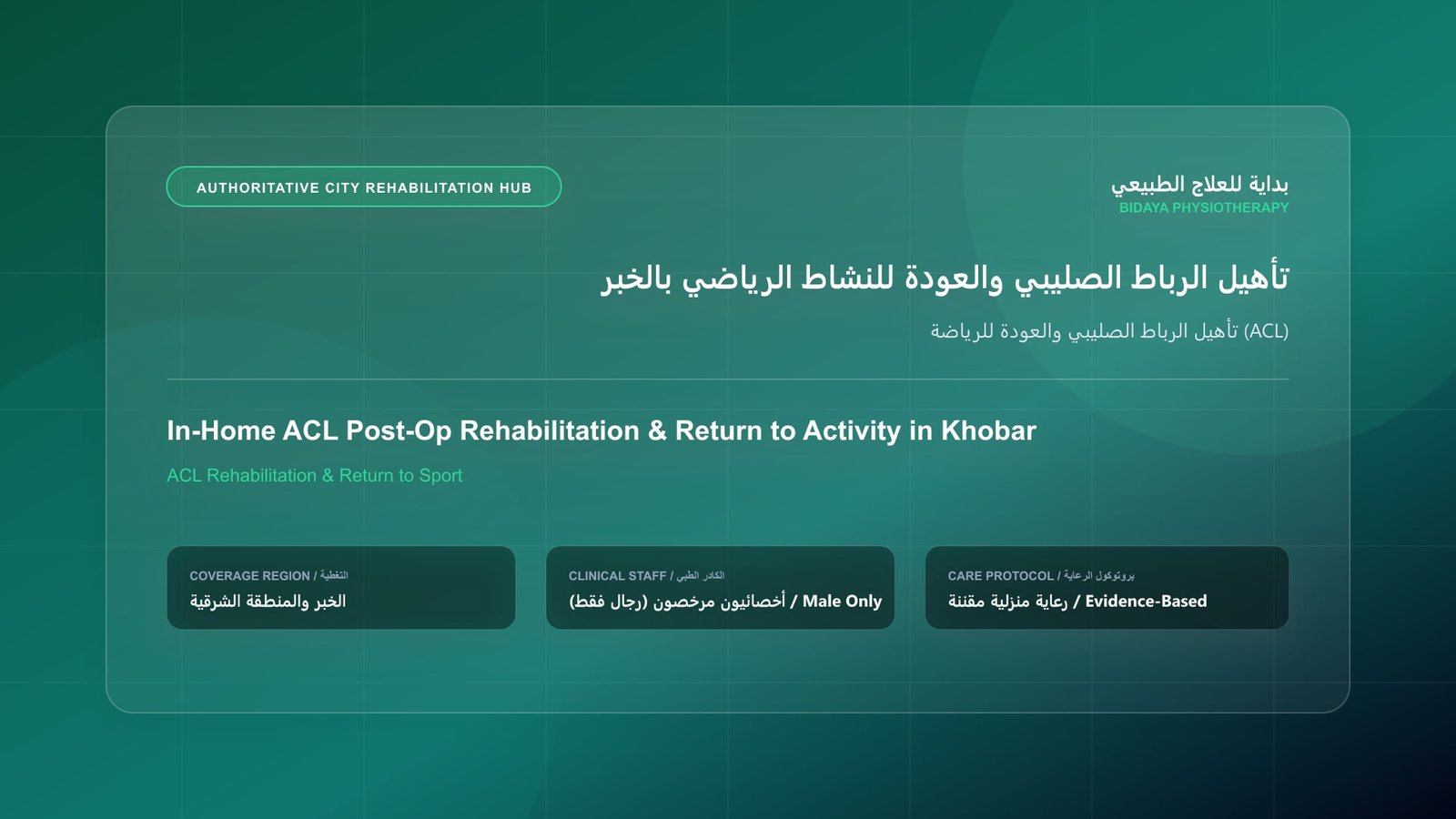
In-Home ACL Post-Op Rehabilitation & Return to Activity in Khobar
Advanced in-home rehabilitation across Khobar led by licensed male clinicians, restoring mobility and daily functional independence.
Comprehensive In-Home Clinical Evaluation (60-75 Mins)
Detailed functional & neuro examination, home safety audit, and custom protocol with portable equipment — no upfront package commitments.
Flexible appointments 7 days a week (8 AM - 10 PM) • Payment upon visit completion
1,500+ Successful Home Recoveries
Certified Clinical Physiotherapists
Assessment-First Protocol
Thorough physical evaluation before any treatment plan starts
Specialized Male Therapists
Professional licensed therapists visiting your residence
100% In-Home Rehabilitation
No clinic travel friction or waiting room discomfort
Targeted Functional Goals
Focused on daily stairs, walking endurance, and independence
Emergency Medical Red-Flags & Home Care Boundaries
Emergency Medical Boundary: Bidaya provides scheduled in-home therapeutic rehabilitation and is not an emergency medical dispatch service. For acute neurological deficits, unreduced fractures, severe respiratory distress, or sudden chest pain, contact the Saudi Red Crescent immediately at 997 or 911.
Bidaya's home rehabilitation program for ACL Rehabilitation & Return to Sport across Khobar bridges the vulnerable interval between hospital discharge and full daily function. Our licensed male clinicians implement phased recovery benchmarks focusing on restoring full active physiological joint arcs, eliminating resting discomfort, and resuming domestic activities with pain < 2/10 to secure enduring functional gains.
Objective Return-to-Sport (RTS) Criteria Post-ACL in Khobar
Limb Symmetry Index (LSI > 90%), Functional Hop Batteries & Psychological Readiness (ACL-RSI)
Returning safely to athletic conditioning and running along the Khobar Corniche post-ACL reconstruction requires strict objective milestone clearance rather than arbitrary temporal milestones (6 to 9 months).
Bidaya's visiting physical therapists quantify Limb Symmetry Index (LSI) requiring >90% quadriceps and hamstring torque symmetry, administer single-leg hop test batteries, and screen kinesiophobia using the ACL-RSI scale.
RTS Safety Threshold
Returning to cutting and pivoting athletics before achieving >90% quadriceps limb symmetry elevates secondary graft rupture rates by fourfold.
- Quantify isometric quadriceps and hamstring force output symmetry
- Administer single-leg hop test batteries (single, triple, crossover, timed)
- Benchmark psychological confidence using the validated ACL-RSI questionnaire
- Screen dynamic knee valgus collapse during landing phases
Plyometric Mechanics & Neuromuscular Deceleration in Home Environments
Graded Impact Attenuation, Multi-Planar Agility & Corniche Running Progression
Therapy trains eccentric deceleration mechanics across spacious home halls or villa courtyards in Khobar, emphasizing deep knee and hip flexion to dissipate ground reaction forces away from the graft.
Progression advances through progressive linear and multi-directional agility drills, smoothly bridging patients toward outdoor track interval running along Khobar recreational circuits.
Quiet Landing Kinematics
Inaudible, quiet landings utilizing deep knee flexion absorb impact forces through muscular deceleration, protecting intra-articular graft biology.
- Master box drop-lands emphasizing symmetrical knee flexion angles
- Advance multi-planar ladder agility drills under therapist supervision
- Condition gluteus medius and maximus to eradicate dynamic valgus collapse
- Execute structured progressive running intervals along flat outdoor surfaces
Seamless Hospital-to-Home Care Transition Across Khobar
Bridging the Gap Between Discharge from King Fahd University Hospital (KFHU), Dr. Sulaiman Al Habib Hospital, and Al Mana General Hospital and Outpatient Clinics
The initial days following discharge from regional tertiary centers in Khobar (such as King Fahd University Hospital (KFHU), Dr. Sulaiman Al Habib Hospital, and Al Mana General Hospital) represent the most precarious phase for ACL Rehabilitation & Return to Sport; patients face difficult vehicular transfers, entrance steps, and unmonitored pain.
Bidaya's mobile physiotherapy service bridges this vulnerable window within 48 to 72 hours of hospital discharge: 1. Surgical and medical chart review: Aligning home therapy directly with physician discharge instructions, strictly observing weight-bearing limits and range-of-motion guidelines. 2. Early post-acute clinical assessment: Evaluating pain, edema, and mobility, initiating early circulatory exercises to prevent venous thromboembolism. 3. Functional domestic ambulation: Calibrating crutches or walker frames to domestic hallways and bathroom facilities safely.
Timely in-home intervention during the early post-acute phase dramatically diminishes 30-day hospital readmission rates.
Early Transition Metric in Khobar
Initiating active circulatory drills within 24 hours of returning home significantly mitigates venous thromboembolism and joint arthrofibrosis.
- Verify exact weight-bearing restrictions specified on hospital discharge summary
- Elevate affected limb periodically to manage dependent reactive edema
- Inspect surgical or injury perimeter daily for erythema, heat, or drainage
- Keep emergency contact coordinates (Red Crescent 997) accessible near bedside
Kinetic Chain Functional Screening & Dynamic Movement Profiling for ACL Rehabilitation & Return to Sport
Analyzing Movement Compensations & Neuromuscular Coordination in Khobar
Bidaya's clinical practice across Khobar applies an advanced functional assessment model examining entire kinetic chain interactions relating to ACL Rehabilitation & Return to Sport. Frequently, localized joint pain stems from compensatory strain secondary to hypo-mobility in proximal or distal articulations.
Advanced functional diagnostic pillars: 1. Multi-Planar Task Observation: Evaluating movement strategies during domestic ambulation, forward bending, and axial rotation to expose compensatory asymmetries. 2. Specialized Clinical Examination: Administering objective joint goniometry, selective tissue tension palpation, and bilateral kinetic chain alignment screening to document baseline functional impairment. 3. Deep Core Stability Assessment: Testing anticipatory feed-forward activation of stabilizing muscles during limb perturbation. 4. Closed-Chain Proprioceptive Profiling: Assessing dynamic equilibrium and joint position sense to measure afferent sensory integrity.
This holistic kinematic map empowers our visiting male physical therapist to calibrate interventions aligned with Patient-Specific Functional Scale (PSFS) and Numeric Pain Rating Scale (NPRS).
Kinetic Chain Paradigm in Khobar
Treating an isolated symptomatic joint without addressing kinetic chain dysfunction yields transient results; global realignment secures permanent recovery.
- Assess pelvic and core tilt control during single-leg weight-bearing challenges
- Document bilateral asymmetries in functional soft-tissue extensibility batteries
- Map postural alignment under functional load bearing
- Translate clinical biomechanical findings into actionable patient recovery goals
Arthrokinematic Loading & Eccentric Deceleration Training for ACL Rehabilitation & Return to Sport
Developing Dynamic Motor Control & Myofascial Remodeling in Domestic Setting
Bidaya's structured protocol emphasizes dynamic motor control and tissue adaptation for patients with ACL Rehabilitation & Return to Sport via progressive mechanical dosing.
Arthrokinematic progression phases: 1. Multi-Angle Isometrics: Initiating progressive elastic-resistance strengthening, joint proprioceptive stabilization drills, and targeted myofascial stretching to build force output without provocative articular displacement. 2. Controlled Eccentric Loading: Training muscle-tendon units to decelerate loads during elongation, stimulating tensile remodeling. 3. Functional Multi-Planar Drills: Progressing to domestic chair transfers and ground-level rising mechanics.
The central clinical goal is attaining restoring full active physiological joint arcs, eliminating resting discomfort, and resuming domestic activities with pain < 2/10 with uncompromising biomechanical safety.
Significance of Eccentric Conditioning
Eccentric training enhances tendon tensile modulus and energy absorption, safeguarding articulations against domestic shear forces.
- Execute the eccentric lowering phase at twice the duration of concentric lifting
- Maintain regular diaphragmatic respiration avoiding the Valsalva maneuver
- Monitor joint alignment throughout multi-joint functional drills
- Document functional milestone progression in domestic clinical logs
Preventive Home Ergonomics & Recovery Microclimate Design for ACL Rehabilitation & Return to Sport
Optimizing Room Clearance, Lighting & Safe Conditioning in Khobar
Long-term rehabilitative success for ACL Rehabilitation & Return to Sport depends on engineering an obstacle-free residential environment across Khobar.
Preventive domestic adaptation steps: 1. Transit corridor clearance: Repositioning redundant furniture away from main domestic hallways to accommodate mobility aids without hindrance. 2. Specific motion precautions: Strictly respecting documented clinical instructions: avoiding ballistic uncalibrated overloading, and organizing domestic transit pathways to avert accidental joint sprain. 3. Daily exercise execution: Diligently performing progressive elastic-resistance strengthening, joint proprioceptive stabilization drills, and targeted myofascial stretching interspersed with structured recovery breaks. 4. Restful sleep mechanics: Deploying a contour mattress supporting physiological spinal lordosis and neutral joint alignment.
These structural adjustments enable patients to regain functional independence safely. Direct line: (+20 109 707 9170).
Restful Sleep Alignment in Khobar
Positioning an ergonomic contour pillow between knees in side-lying posture aligns pelvic symmetry, arresting morning stiffness.
- Place a firm supportive pillow between knees when resting in side-lying
- Ensure adequate illumination across primary corridors day and night
- Execute home exercises during periods of peak physiological energy
- Share functional recovery updates via WhatsApp (+20 109 707 9170)
Clinical Safety Thresholds & Emergency Healthcare Interfacing across Khobar
Decisive Red Flag Management & Coordination with Emergency Services at King Fahd University Hospital (KFHU), Dr. Sulaiman Al Habib Hospital, and Al Mana General Hospital
Bidaya's visiting physical therapists enforce uncompromising clinical safety parameters to ensure home care never compromises patient vitality.
Clinical indicators mandating acute emergency hospital referral: 1. Condition Red Flags for ACL Rehabilitation & Return to Sport: Documented emergence of unremitting nocturnal pain unaffected by posture, severe localized joint heat with systemic fever, or sudden sensory loss. 2. Severe Non-Mechanical Pain: Relentless nocturnal burning or deep thoracic pain unalleviated by positional changes, accompanied by diaphoresis. 3. Sudden Vertigo with Cranial Neuropathy: Acute severe spinning sensation coupled with diplopia, dysarthria, or dysphagia. 4. Acute Systemic Infection Signs: Spiking pyrexia accompanied by rigors and localized incision drainage.
Emergency Referral Workflow: Direct instruction is issued to activate the Saudi Red Crescent via 997 or emergency dispatch at 911 for transport to King Fahd University Hospital (KFHU), Dr. Sulaiman Al Habib Hospital, and Al Mana General Hospital. Bidaya provides scheduled rehabilitative therapy, not acute medical emergency services. Inquiries: (+20 109 707 9170).
Accredited Clinical Safety in Khobar
Advanced training of our male clinical personnel guarantees swift, professional execution of emergency referral pathways.
- Keep Saudi Red Crescent dispatch (997) programmed into primary mobile devices
- Inform attending medical specialist or orthopedic surgeon of critical changes
- Refrain from administering oral analgesics or fluids if surgical triage is possible
- Utilize unified emergency numbers (997 and 911) as primary acute care conduits
Extended Kinetic Care Continuum & Physical Life Quality for ACL Rehabilitation & Return to Sport
Sustaining Functional Fitness, Preserving Mobility & Long-Term Clinical Governance in ${cityEn}
Bidaya's extended care continuum ensures patients managing ACL Rehabilitation & Return to Sport experience the highest levels of functional quality of life across Khobar.
Pillars of extended kinetic wellness: 1. Sustainable Routine Design: Embedding progressive elastic-resistance strengthening, joint proprioceptive stabilization drills, and targeted myofascial stretching into weekly habits to support articular compliance. 2. Protective Behavioral Mechanics: Adhering to movement safeguards: avoiding ballistic uncalibrated overloading, and organizing domestic transit pathways to avert accidental joint sprain. 3. Longitudinal Stability Verification: Auditing recovery trajectories through validated Patient-Specific Functional Scale (PSFS) and Numeric Pain Rating Scale (NPRS). 4. Direct Clinical Access: Maintaining continuous contact with Bidaya intake desk (+20 109 707 9170) to schedule periodic reviews.
This structure ensures patients maintain independent, fulfilling domestic and social routines across Khobar.
Physical Life Quality in Khobar
Sustained physical activity elevates mood, enhances systemic vitality, and protects against the complications of sedentary lifestyles.
- Execute autonomous home drills according to your illustrated clinical portfolio
- Maintain a balanced physical lifestyle supporting hydration and tissue repair
- Enjoy outdoor ambulation across scenic routes like North and South Khobar Corniche, and Ajdan Waterfront promenade
- Contact Bidaya (+20 109 707 9170) to arrange periodic clinical check-ins
Community Reintegration & Social Lifestyle Resumption Across Khobar
Safe Return to Mosque Prayers, Public Strolling & Domestic Family Engagements
The ultimate measure of successful in-home rehabilitation delivered by Bidaya across Khobar for ACL Rehabilitation & Return to Sport is restoring the patient's full participation in cultural, familial, and spiritual routines without apprehension.
Key pillars of domestic and social reintegration: 1. Mosque Prayer Functional Mobility: Retraining safe transitions between upright stance, bowing (ruku), and kneeling/prostration (sujud), or mastering ergonomic prayer chair transfers. 2. Community Strolling & Walkway Navigation: Conditioning ambulation over diverse outdoor terrains along North and South Khobar Corniche, and Ajdan Waterfront promenade with paced breathing cadence. 3. Vehicular Transfers & Family Visits: Practicing automotive ingress/egress and negotiating multi-height domestic thresholds to enjoy family gatherings across Al-Rakah, Al-Hizam Al-Akhdar, Al-Hizam Al-Thahabi, Al-Yarmouk, and Al-Ulaya. 4. Psychological Empowerment & Autonomy: Dispelling fear-avoidance beliefs and overcoming domestic isolation, which dramatically elevates systemic well-being and quality of life.
We accompany each patient step by step until complete functional vitality is restored within their community in Khobar. Clinical intake desk: (+20 109 707 9170).
Community Independence in Khobar
Restoring the capacity to walk to local mosques and attend family gatherings represents the true milestone of functional recovery.
- Rehearse vehicle ingress and egress mechanics under clinician guidance
- Select temperate diurnal windows for outdoor community strolling
- Wear biomechanically supportive footwear suited to variable outdoor terrains
- Contact Bidaya (+20 109 707 9170) to coordinate guided community mobility progression
Clinical Governance, Quality Assurance & Standardized Functional Metrics in Khobar
Rigorous Clinical Documentation, Objective Outcome Quantification & Safety Standards
All home physiotherapy interventions delivered by Bidaya across Khobar for ACL Rehabilitation & Return to Sport operate under a structured clinical governance framework, guaranteeing quality and clinical efficacy equivalent to premium tertiary institutions.
Pillars of clinical quality assurance and objective monitoring: 1. Standardized Patient-Reported Outcome Measures (PROMs): Deploying internationally validated metrics—including Patient-Specific Functional Scale (PSFS) and Numeric Pain Rating Scale (NPRS)—at baseline, interim, and graduation intervals to quantify recovery progress objectively. 2. Peer Review and Clinical Case Auditing: Conducting multidisciplinary chart reviews to confirm therapeutic trajectories align with evidence-based rehabilitative milestones and recommendations from King Fahd University Hospital (KFHU), Dr. Sulaiman Al Habib Hospital, and Al Mana General Hospital. 3. Stringent Mobile Infection Control: Enforcing hospital-grade sanitization protocols for all mobile therapy apparatus prior to domestic deployment and immediately post-session. 4. Patient and Caregiver Experience Governance: Gathering continuous feedback through our clinical coordination desk (+20 109 707 9170) to adapt care pacing and enhance domestic engagement.
This uncompromising standard establishes Bidaya as the dependable in-home physical therapy provider across Khobar.
Clinical Excellence Metric in Khobar
Quantifying rehabilitation milestones with standardized objective scales ensures full transparency and predictable functional restoration.
- Maintain encrypted electronic functional tracking throughout the episode of care
- Adhere to hospital-grade disinfection for all portable assessment instruments
- Conduct periodic functional score re-evaluations to substantiate discharge criteria
- Reach clinical coordination desk (+20 109 707 9170) for medical chart summaries
Frequently Asked Questions about In-Home Physiotherapy
Clinicians deploy retrograde lymphatic drainage, cryo-elevation protocols, and gentle circulatory pumps to decongest tissues without stressing healing structures.
Related Clinical & Regional Pathways
Runner's Knee & Patellofemoral Rehab→
Advanced in-home rehabilitation across Khobar led by licensed male clinicians
Hip Pain & Joint Mobility→
Advanced in-home rehabilitation across Khobar led by licensed male clinicians
Frozen Shoulder Capsular Mobilization→
Advanced in-home rehabilitation across Khobar led by licensed male clinicians
In-Home Physiotherapy in Al Khobar→
Evidence-based clinical rehabilitation delivered directly to your villa
In-Home Low Back Pain & Sciatica Rehabilitation Therapy→
Evidence-based clinical rehabilitation engineered to resolve lumbar disc herniations
In-Home Knee Pain & Osteoarthritis Rehabilitation Therapy→
Evidence-based clinical rehabilitation engineered to arrest articular cartilage degeneration
In-Home Stroke Rehabilitation & Neurological Physiotherapy Therapy→
Evidence-based neurological rehabilitation engineered to stimulate corticomotor neuroplasticity
In-Home Post-Operative Physiotherapy Therapy→
Evidence-based surgical rehabilitation protocols engineered to restore joint range of motion