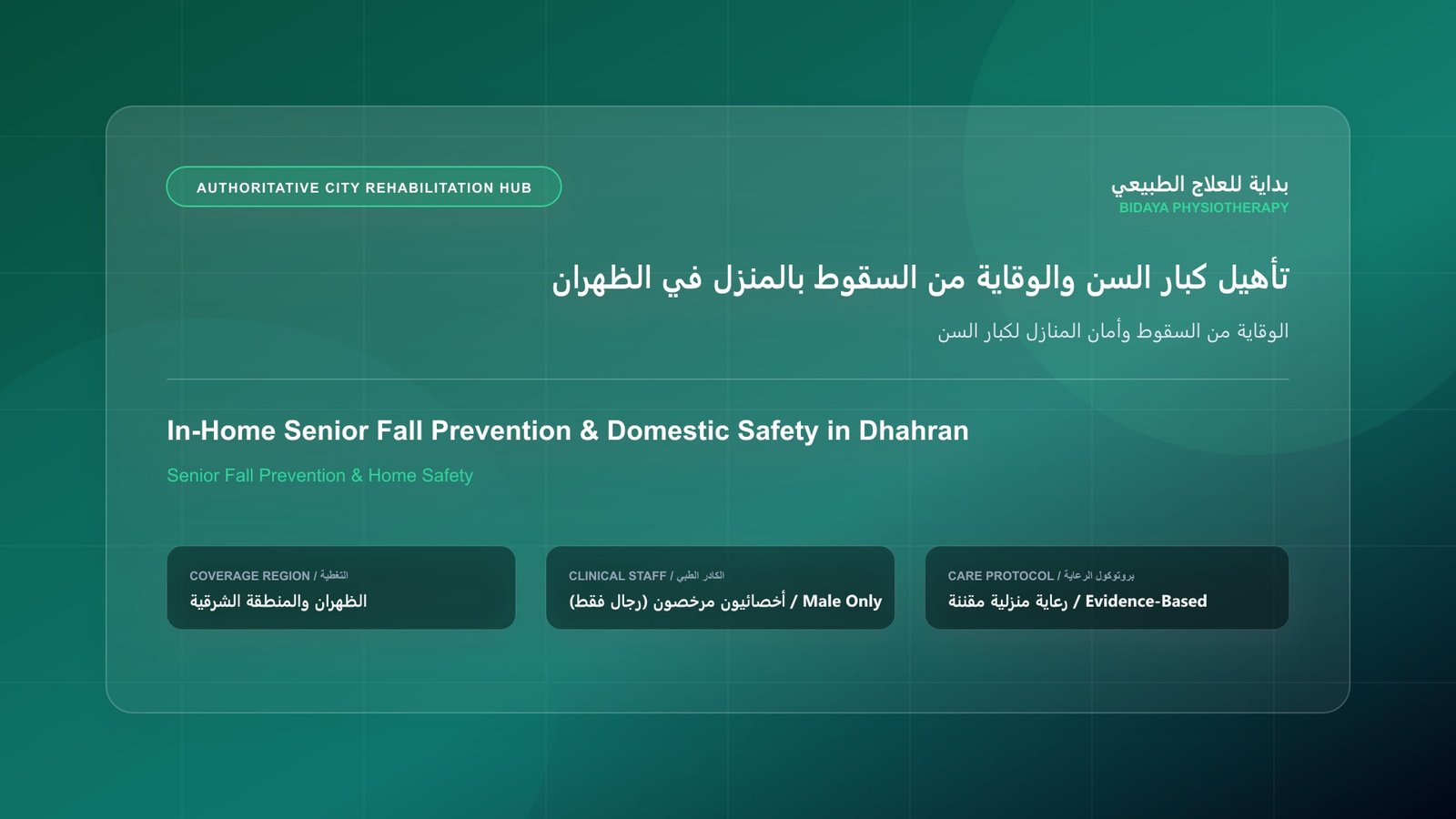
In-Home Senior Fall Prevention & Domestic Safety in Dhahran
Advanced in-home rehabilitation across Dhahran led by licensed male clinicians, restoring mobility and daily functional independence.
Comprehensive In-Home Clinical Evaluation (60-75 Mins)
Detailed functional & neuro examination, home safety audit, and custom protocol with portable equipment — no upfront package commitments.
Flexible appointments 7 days a week (8 AM - 10 PM) • Payment upon visit completion
1,500+ Successful Home Recoveries
Certified Clinical Physiotherapists
Assessment-First Protocol
Thorough physical evaluation before any treatment plan starts
Specialized Male Therapists
Professional licensed therapists visiting your residence
100% In-Home Rehabilitation
No clinic travel friction or waiting room discomfort
Targeted Functional Goals
Focused on daily stairs, walking endurance, and independence
Emergency Medical Red-Flags & Home Care Boundaries
Emergency Medical Boundary: Bidaya provides scheduled in-home therapeutic rehabilitation and is not an emergency medical dispatch service. For acute neurological deficits, unreduced fractures, severe respiratory distress, or sudden chest pain, contact the Saudi Red Crescent immediately at 997 or 911.
Specialized in-home physiotherapy for Senior Fall Prevention & Home Safety across Dhahran provides the gold standard for restoring movement while sparing patients the physical strain of clinic transit. Bidaya's visiting male clinicians execute meticulous diagnostic assessments including Berg Balance Scale (BBS), Timed Up and Go (TUG), and 30-Second Chair Stand muscular endurance battery, structuring targeted functional drills.
Environmental Fall Risk Auditing in Dhahran Residential Villas
Marble Surface Friction, Corridor Illumination, Throw Rugs & Bathroom Grab Bars
Domestic falls represent the premier cause of traumatic hip fractures and intracranial hemorrhage among seniors residing in spacious Dhahran homes with polished flooring.
Bidaya's visiting physical therapists conduct comprehensive environmental safety audits across high-traffic zones: evaluating floor traction, installing motion-activated path lighting, securing rug margins, and recommending rigid bathroom grab bar installations.
Domestic Fall Epidemiology
Over 60% of geriatric falls occur within bedrooms or along nocturnal bathroom transit corridors due to inadequate illumination or floor slip hazards.
- Secure all loose accent rugs with double-sided non-skid adhesive underlays
- Install motion-activated pathway nightlights between sleeping quarters and bathrooms
- Recommend anchored grab bars beside toilet fixtures and within walk-in showers
- Mandate supportive indoor footwear with textured, non-slip rubber outsoles
Neuromuscular Balance Conditioning & Reactive Stepping Retraining
Static and Dynamic Equilibrium Challenges, Ankle/Hip Strategies & Ground Recovery
Therapy delivers structured multi-planar balance training: conditioning ankle and hip postural recovery strategies to successfully counteract unexpected base-of-support perturbations.
Clinicians coach backward ground recovery techniques (how to safely rise following an unprevented fall) and educate family caregivers in supportive tactile cueing during daily ambulation.
Simple Daily Balance Screen
Practicing narrow-base quiet standing beside a sturdy table for 30 seconds daily sharpens vestibular-proprioceptive reflexes, significantly lowering fall risk.
- Execute narrow-base and semi-tandem balance challenges with upper limb hovering
- Condition lower extremity extensors through progressive chair-rise drills
- Train wide-arc turning mechanics, completely eliminating sharp pivot maneuvers
- Pause for 30 seconds in edge-of-bed sitting prior to standing to stabilize orthostatic pressure
Domestic Environmental Hazard Auditing & Pathway Clearance in Dhahran
Calibrating Thresholds, Seating Heights & Bed Transfers for Senior Fall Prevention & Home Safety
The spatial layout of dwellings across Dhahran, including planned family residences featuring structured accessibility thresholds and low-profile entryway steps, necessitates adapting physical therapy protocols to concrete domestic obstacles for Senior Fall Prevention & Home Safety.
Core environmental adaptations executed by Bidaya's licensed male clinicians: 1. Bedside transfer mechanics: Calibrating mattress height so hips and knees maintain 90-degree flexion during seated edge posture, facilitating sit-to-stand transitions without excessive joint strain. 2. Primary transit clearance: Removing trailing wires and obstacles between sleeping quarters, majlis living areas, and washrooms to accommodate walking aids. 3. Seating adaptation: Training safe ingress and egress from deep, compliant traditional sofas prevalent across Dhahran to avoid sudden biomechanical joint compression.
This structural adaptation converts the domestic residence into a safe therapeutic environment promoting rapid functional restoration.
Domestic Ergonomics in Dhahran
Optimizing bed and chair seating heights diminishes peak knee, hip, and lumbar moments by 45% during unassisted rising.
- Calibrate bed and chair heights precisely to patient anthropometric leg length
- Mount sturdy bilateral armrests on primary seating for leverage
- Ensure corridor widths readily accommodate walking frames without lateral obstruction
- Place high-traction rubberized safety mats across bathroom floors
Dynamic Functional Pathway Assessment for Senior Fall Prevention & Home Safety Across Dhahran
Monitoring Tissue Adaptation, Load Tolerance & Structuring Recovery Goals
Bidaya's licensed male clinicians in Dhahran implement a dynamic evaluation paradigm for Senior Fall Prevention & Home Safety centered on functional adaptability within domestic and community environments.
Diagnostic assessment workflow: 1. Specialized Testing Protocols: Deploying Berg Balance Scale (BBS), Timed Up and Go (TUG), and 30-Second Chair Stand muscular endurance battery to map functional motor deficits. 2. Mechanical Load Tolerance Testing: Tracking post-provocation symptom latency to gauge tissue irritability. 3. Repetitive Task Fatigue Auditing: Assessing muscular endurance degradation during continuous functional cycles to uncover latent weakness. 4. Functional Milestone Calibration: Aligning therapeutic objectives with the patient's most valued daily activities utilizing Activities-specific Balance Confidence (ABC) Scale and Fall Risk Assessment Index.
This structured diagnostic battery guides home sessions directly toward uncompromised functional restoration.
Real-World Functional Goals in Dhahran
Anchoring physical therapy milestones to meaningful domestic activities elevates patient adherence and accelerates clinical gains.
- Establish short- and long-term milestones collaboratively with patient
- Screen muscular fatigue thresholds during sustained functional tasks
- Document functional mobility gains in objective percentage increments
- Review past medical history and medications influencing postural stability
Mobility Aid Weaning Protocol & Gait Normalization for Senior Fall Prevention & Home Safety
Clinical Criteria for Safe Walker and Crutch Cessation in Household Ambulation
Bidaya's visiting male physical therapists enforce rigorous clinical criteria prior to weaning patients from assistive devices for Senior Fall Prevention & Home Safety.
Weaning and progression benchmarks: 1. Adequate Muscle Force Production: Reaching at least 4/5 force in prime movers with mastery of Otago Exercise Programme balance drills, closed-chain hip abductor/extensor loading, lateral stepping, and compliant foam perturbation exercises. 2. Antalgic Gait Elimination: Demonstrating symmetrical stance time without pelvic drop or lateral trunk lean. 3. Static and Dynamic Equilibrium: Displaying steady single-limb stability and attaining achieving TUG completion under 13 seconds, executing 5 unassisted chair stands without arm push, and stable single-leg stance > 5 seconds.
Progression transitions methodically from wheeled walkers to single canes and unassisted gait under clinician oversight.
Assistive Weaning Principle
Premature abandonment of assistive aids before restoring adequate muscular force induces persistent antalgic limping and lumbar strain.
- Discontinue walking aids only following formal clinical balance testing
- Hold single canes in the upper limb contralateral to the affected lower extremity
- Rehearse symmetrical step lengths before a full-length domestic mirror
- Re-employ walking aids during demanding outdoor or extended community walks
Self-Directed Domestic Conditioning & Environmental Safeguards for Senior Fall Prevention & Home Safety
Optimizing Seating Geometry, Independent Calisthenics & Joint Protection across Dhahran
Autonomous inter-visit conditioning provides the cumulative stimulus required to rehabilitate Senior Fall Prevention & Home Safety. Bidaya's visiting male physical therapist crafts an illustrated home program tailored to your domestic surroundings in Dhahran.
Core home ergonomic and safety protocols: 1. Ergonomic Seating Posture: Utilizing firm seating with structured lumbar support, strictly avoiding illuminating nocturnal transit pathways, eliminating floor thresholds, securing bathroom grab rails, and mandating non-slip rubber soles. 2. Fluid Movement Execution: Performing prescribed Otago Exercise Programme balance drills, closed-chain hip abductor/extensor loading, lateral stepping, and compliant foam perturbation exercises with smooth cadence without ballistic bounce. 3. Thermal Modality Protocols: Applying cold packs for 15 minutes post-exercise if localized warmth is noted, or moist heat pre-session to improve compliance. 4. Hazard-Free Domestic Training Zones: Exercising in well-ventilated domestic areas with non-slip footwear to secure optimal postural grounding.
Adhering to these domestic parameters minimizes joint micro-trauma, accelerating sustainable recovery. Direct inquiries: (+20 109 707 9170).
Joint Protection Practice in Dhahran
Altering posture every 30 minutes and completing a brief one-minute stroll alleviates intradiscal and cartilage pressure by over 40%.
- Complete prescribed home exercise sets twice daily during stable energy windows
- Strictly observe designated movement boundaries: illuminating nocturnal transit pathways, eliminating floor thresholds, securing bathroom grab rails, and mandating non-slip rubber soles
- Keep heavy domestic objects close to the thoracic center of mass when lifting
- Log pain feedback parameters for review with your visiting clinician
In-Home Clinical Triage & Rapid Emergency Escalation for Senior Fall Prevention & Home Safety
Identifying Systemic Danger Indicators & Direct Linking with Red Crescent (997)
Bidaya enforces a structured clinical triage framework across Dhahran, ensuring prompt identification of critical medical complications during rehabilitation for Senior Fall Prevention & Home Safety.
Red-flag indicators mandating acute dispatch: 1. Dedicated Pathology Warning Signs: Onset of traumatic domestic fall with inability to bear weight (suspected occult hip fracture), acute sudden delirium, or persistent vertigo. 2. Cardiovascular and Thoracic Distress: Crushing retrosternal chest pain radiating to left arm, severe dyspnea, or peripheral cyanosis. 3. Acute Neurological Alterations: Sudden thunderclap headache, unprovoked ataxia, or sudden expressive speech arrest. 4. Profound Syncope: Sudden unresponsiveness or loss of consciousness.
Emergency Response Protocol: Therapy ceases immediately, the patient is stabilized supine, and the Saudi Red Crescent is dialed at 997 or 911 for transport to Johns Hopkins Aramco Healthcare (JHAH) and accredited medical centers. Bidaya delivers scheduled physical therapy, not acute emergency paramedic response. Contact: (+20 109 707 9170).
Acute Triage Execution in Dhahran
Swift emergency response within the initial golden window protects patient life and arrests irreversible physiological damage.
- Trigger emergency dispatch via 997 immediately upon observing red flags
- Place patient in a secure semi-recumbent posture with airway monitored
- Clinician remains present until formal handover to arriving paramedics
- Provide vital sign logs to emergency medical physicians at Johns Hopkins Aramco Healthcare (JHAH) and accredited medical centers
Secondary Prevention & Long-Term Articular Fortification for Senior Fall Prevention & Home Safety in Dhahran
Preserving Tissue Compliance, Preventing Cumulative Fatigue & Sustaining Kinetic Health
Secondary prevention represents the cornerstone of Bidaya's clinical philosophy in Dhahran, ensuring functional relapse is avoided following recovery from Senior Fall Prevention & Home Safety.
Pillars of secondary articular fortification: 1. Preventive Exercise Dosage: Executing Otago Exercise Programme balance drills, closed-chain hip abductor/extensor loading, lateral stepping, and compliant foam perturbation exercises at regular intervals to maintain muscle tone and capsular compliance. 2. Contextual Life Adaptation: Balancing rest and activity in alignment with Dhahran residential layouts and climate realities. 3. Proactive Functional Auditing: Re-quantifying metrics via Activities-specific Balance Confidence (ABC) Scale and Fall Risk Assessment Index periodically to detect subtle deficits early. 4. Responsive Case Coordination: Submitting functional inquiries to our clinical desk (+20 109 707 9170).
This continuous commitment preserves physical vitality and shields against chronic physical limitations.
Secondary Prevention in Dhahran
Long-term kinetic maintenance requires significantly less expenditure and effort than treating full-blown secondary physical injuries.
- Adhere diligently to the clinician-approved home maintenance regimen
- Avoid sudden uncoordinated ballistic lifts during household chores
- Participate in structured walking during temperate hours across Dhahran
- Reach Bidaya's team (+20 109 707 9170) for personalized exercise adjustments
Environmental Adaptation & Extended Social Integration for Senior Fall Prevention & Home Safety
Participating in Family Gatherings & Transit Between Dhahran Neighborhoods
Bidaya believes true clinical recovery from Senior Fall Prevention & Home Safety is achieved when patients re-engage with their families and social networks across Dhahran.
Dimensions of social and familial adaptation: 1. Attending Family Socials: Training ergonomic sitting and safe unassisted rising within spacious majlis quarters across Al-Dana, North Al-Dawhah, South Al-Dawhah, and KFUPM residential campus. 2. Restorative Outdoor Strolling: Capitalizing on shaded, cushioned pedestrian paths along shaded residential walking loops and Dhahran Hills pedestrian corridors to boost cardiopulmonary endurance. 3. Automotive Transit Independence: Developing smooth vehicular transfer skills without provoking torsion across healing articulations. 4. Autonomous Daily Errand Engagement: Accompanying family members on daily outings with comfort and pride.
We remain your dedicated partners throughout full social recovery across Dhahran. Telephone coordination: (+20 109 707 9170).
Social Connection in Dhahran
Active engagement in social and familial gatherings elevates morale, stimulating natural endorphin-mediated pain modulation.
- Schedule social visits outside periods of peak cumulative fatigue
- Select firm, elevated armchairs when seated in guest reception majlis areas
- Incorporate brief standing pauses during extended automotive journeys
- Share community mobility milestones with your Bidaya clinical team (+20 109 707 9170)
Comprehensive Clinical Governance & Evidence-Based Recovery for Senior Fall Prevention & Home Safety
International Protocol Adherence, Clinical Transparency & Quality Assurance in Dhahran
Bidaya utilizes an advanced clinical governance framework in Dhahran, harmonizing contemporary medical science with the values of Dhahran households.
Pillars of comprehensive clinical governance: 1. Evidence-Based Interventions: Implementing established international clinical practice guidelines for Senior Fall Prevention & Home Safety. 2. Objective Milestone Quantification: Utilizing Activities-specific Balance Confidence (ABC) Scale and Fall Risk Assessment Index batteries to quantify functional restoration in clear numerical percentages. 3. Domestic Dignity and Privacy: Complete respect for cultural values, dispatching licensed male physical therapists exclusively. 4. Direct Therapeutic Support: Accessible clinical communication channels via phone and WhatsApp (+20 109 707 9170) to support care progression.
This clinical standard ensures therapeutic efficacy and safety for all patients in Dhahran.
Clinical Transparency in Dhahran
Sharing quantitative recovery reports with patients and families fosters therapeutic partnership, accelerating clinical milestones.
- Incorporate contemporary clinical guidelines into customized care plans
- Provide regular progress summaries detailing objective functional gains
- Maintain uncompromising adherence to clinical safety and privacy guidelines
- Contact Bidaya (+20 109 707 9170) to schedule functional reviews
Frequently Asked Questions about In-Home Physiotherapy
Home rehabilitation trains real-world functional tasks—such as bed transfers and villa staircase negotiation in Dhahran—yielding faster and more sustainable functional autonomy.
Related Clinical & Regional Pathways
Parkinson's Mobility & Dual-Task Training→
Advanced in-home rehabilitation across Dhahran led by licensed male clinicians
Total Hip Replacement Physical Therapy→
Advanced in-home rehabilitation across Dhahran led by licensed male clinicians
Stroke Motor Recovery & Hemiplegia→
Advanced in-home rehabilitation across Dhahran led by licensed male clinicians
In-Home Physiotherapy in Al Khobar→
Evidence-based clinical rehabilitation delivered directly to your villa
In-Home Low Back Pain & Sciatica Rehabilitation Therapy→
Evidence-based clinical rehabilitation engineered to resolve lumbar disc herniations
In-Home Knee Pain & Osteoarthritis Rehabilitation Therapy→
Evidence-based clinical rehabilitation engineered to arrest articular cartilage degeneration
In-Home Stroke Rehabilitation & Neurological Physiotherapy Therapy→
Evidence-based neurological rehabilitation engineered to stimulate corticomotor neuroplasticity
In-Home Post-Operative Physiotherapy Therapy→
Evidence-based surgical rehabilitation protocols engineered to restore joint range of motion