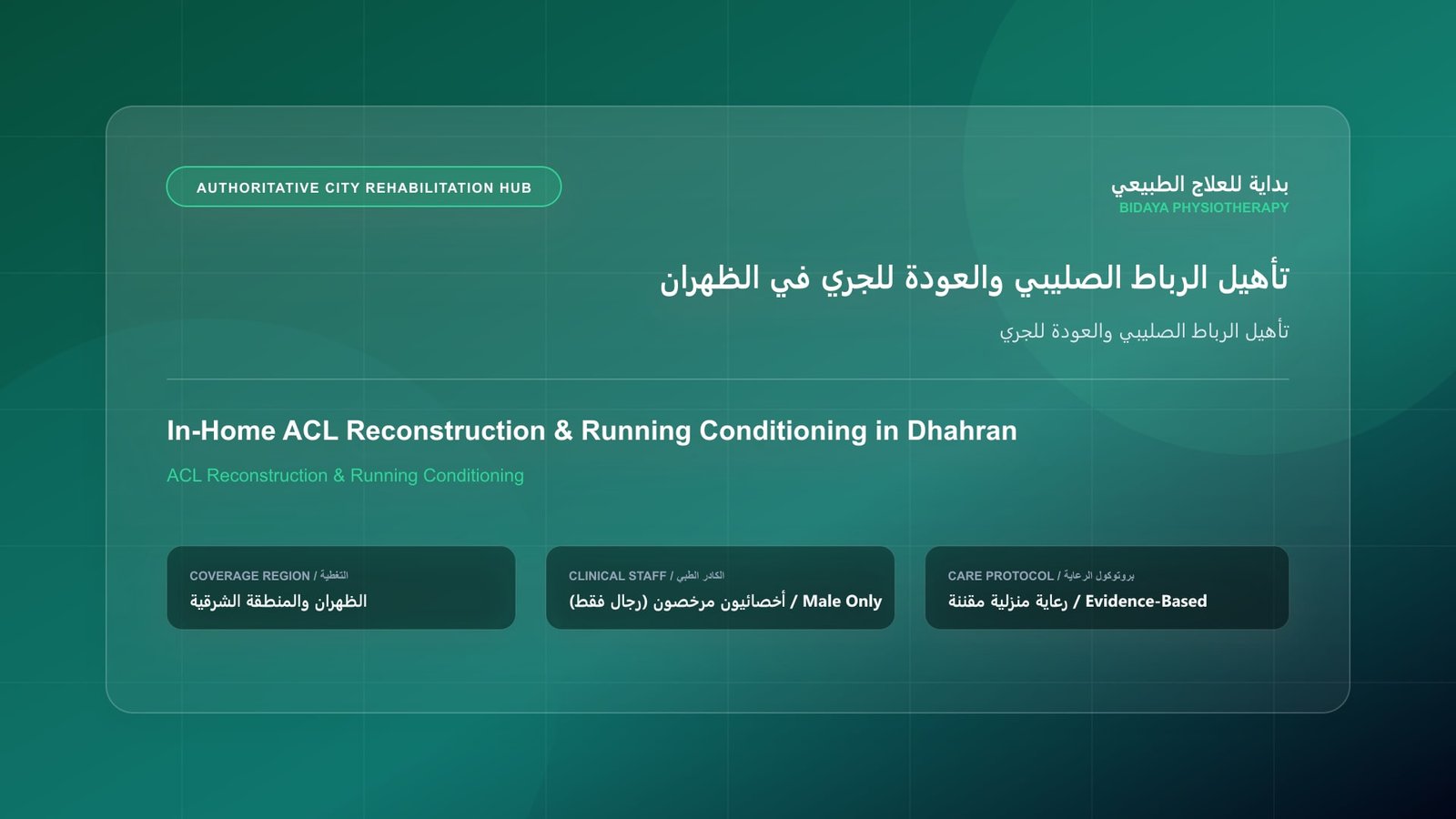
In-Home ACL Reconstruction & Running Conditioning in Dhahran
Advanced in-home rehabilitation across Dhahran led by licensed male clinicians, restoring mobility and daily functional independence.
Comprehensive In-Home Clinical Evaluation (60-75 Mins)
Detailed functional & neuro examination, home safety audit, and custom protocol with portable equipment — no upfront package commitments.
Flexible appointments 7 days a week (8 AM - 10 PM) • Payment upon visit completion
1,500+ Successful Home Recoveries
Certified Clinical Physiotherapists
Assessment-First Protocol
Thorough physical evaluation before any treatment plan starts
Specialized Male Therapists
Professional licensed therapists visiting your residence
100% In-Home Rehabilitation
No clinic travel friction or waiting room discomfort
Targeted Functional Goals
Focused on daily stairs, walking endurance, and independence
Emergency Medical Red-Flags & Home Care Boundaries
Emergency Medical Boundary: Bidaya provides scheduled in-home therapeutic rehabilitation and is not an emergency medical dispatch service. For acute neurological deficits, unreduced fractures, severe respiratory distress, or sudden chest pain, contact the Saudi Red Crescent immediately at 997 or 911.
Serving residential communities throughout Dhahran (including Al-Dana, North Al-Dawhah, South Al-Dawhah, and KFUPM residential campus), Bidaya provides dedicated in-home rehabilitation for ACL Reconstruction & Running Conditioning. Our one-on-one sessions combine manual therapy, motor control retraining, and closed-chain strengthening under licensed male physical therapists.
Objective Return-to-Running Clearance Criteria Post-ACL in Dhahran
Quadriceps Limb Symmetry (>80%), Trace Effusion Bounds & Single-Leg Landing
Recreational athletes and runners residing across Dhahran compounds frequently aspire to resume jogging following ACL reconstruction. Initiating running prematurely before neuromuscular criteria are satisfied provokes reactive synovitis and graft overload.
Bidaya's visiting physical therapists benchmark objective clearance: achieving >80% quadriceps limb symmetry index (LSI), zero reactive joint effusion (Sweep test trace or zero), and stable single-leg deceleration landings from a 20 cm step.
Running Clearance Threshold
Initiating running requires the ability to perform 20 continuous single-leg squats to 45° with zero dynamic valgus collapse and an uncompromised extensor arc.
- Quantify quadriceps and hamstring force output symmetry (>80% LSI)
- Confirm absence of joint effusion 24 hours post-loading (Sweep test score zero)
- Administer forward and vertical single-leg hop-and-hold deceleration screens
- Validate biological graft integration timeline with the operating surgeon
Graded Return-to-Running Pacing & Shock Attenuation in Home Care
Impact Deceleration Mechanics, Interval Run-Walk Protocols & Compound Tracks
Therapy structures impact attenuation drills across spacious residential courtyards in Dhahran, conditioning soft midfoot landing mechanics with active knee flexion to dissipate impact forces.
Progression deploys structured run-walk intervals (1-minute jog, 2-minute walk cycles), steadily increasing continuous running duration across paved residential compound paths.
Landing Shock Absorption Rule
Land on the midfoot with a softly flexed knee; rigid heel-striking with an extended knee transmits severe vertical impact spikes directly into the healing graft.
- Execute bilateral and unilateral landing drills emphasizing deep knee flexion
- Progress through structured 20-minute interval run-walk pacing protocols
- Apply cryotherapy for 15 minutes following initial outdoor running intervals
- Maintain continuous gluteal and hamstring closed-chain strength progressions
Integrating Dhahran Climatic Factors into Therapeutic Load Pacing
Indoor Microclimate Optimization, Hydration Maintenance & Preventing Exertional Fatigue
The climatic conditions of Dhahran, marked by elevated summer ambient temperatures and humidity, impose unique physiological stresses on patients rehabilitating from ACL Reconstruction & Running Conditioning, especially seniors and chronic patients.
Bidaya's licensed male clinicians optimize the domestic setting to safeguard patient vitality: 1. Ambient microclimate calibration: Mandating climate-controlled indoor rooms maintained between 21°C and 23°C with adequate hydration to thwart hypovolemia. 2. Exertional pacing and hemodynamic tracking: Scheduling sessions during optimal biological windows, pacing exercise intensity while monitoring vital signs. 3. Intermittent rest pauses: Structuring progressive elastic-resistance strengthening, joint proprioceptive stabilization drills, and targeted myofascial stretching with scheduled recovery buffers to eliminate sudden autonomic spikes or thermoregulatory distress.
Exercising in a controlled home microclimate enables patients to achieve vital functional adaptations safely year-round in Dhahran.
Thermal Hydration Metric in Dhahran
Consuming 250ml of water prior to exertion and maintaining room temperature below 23°C mitigates orthostatic drops and premature neuromuscular fatigue.
- Pre-cool therapeutic room with active air conditioning 15 minutes prior to session
- Wear loose-fitting, breathable cotton attire facilitating unrestricted movement
- Record baseline blood pressure and resting heart rate in cardiac and frail patients
- Strictly restrict demanding physical drills to climate-controlled indoor quarters
Kinetic Chain Functional Screening & Dynamic Movement Profiling for ACL Reconstruction & Running Conditioning
Analyzing Movement Compensations & Neuromuscular Coordination in Dhahran
Bidaya's clinical practice across Dhahran applies an advanced functional assessment model examining entire kinetic chain interactions relating to ACL Reconstruction & Running Conditioning. Frequently, localized joint pain stems from compensatory strain secondary to hypo-mobility in proximal or distal articulations.
Advanced functional diagnostic pillars: 1. Multi-Planar Task Observation: Evaluating movement strategies during domestic ambulation, forward bending, and axial rotation to expose compensatory asymmetries. 2. Specialized Clinical Examination: Administering objective joint goniometry, selective tissue tension palpation, and bilateral kinetic chain alignment screening to document baseline functional impairment. 3. Deep Core Stability Assessment: Testing anticipatory feed-forward activation of stabilizing muscles during limb perturbation. 4. Closed-Chain Proprioceptive Profiling: Assessing dynamic equilibrium and joint position sense to measure afferent sensory integrity.
This holistic kinematic map empowers our visiting male physical therapist to calibrate interventions aligned with Patient-Specific Functional Scale (PSFS) and Numeric Pain Rating Scale (NPRS).
Kinetic Chain Paradigm in Dhahran
Treating an isolated symptomatic joint without addressing kinetic chain dysfunction yields transient results; global realignment secures permanent recovery.
- Assess pelvic and core tilt control during single-leg weight-bearing challenges
- Document bilateral asymmetries in functional soft-tissue extensibility batteries
- Map postural alignment under functional load bearing
- Translate clinical biomechanical findings into actionable patient recovery goals
Arthrokinematic Loading & Eccentric Deceleration Training for ACL Reconstruction & Running Conditioning
Developing Dynamic Motor Control & Myofascial Remodeling in Domestic Setting
Bidaya's structured protocol emphasizes dynamic motor control and tissue adaptation for patients with ACL Reconstruction & Running Conditioning via progressive mechanical dosing.
Arthrokinematic progression phases: 1. Multi-Angle Isometrics: Initiating progressive elastic-resistance strengthening, joint proprioceptive stabilization drills, and targeted myofascial stretching to build force output without provocative articular displacement. 2. Controlled Eccentric Loading: Training muscle-tendon units to decelerate loads during elongation, stimulating tensile remodeling. 3. Functional Multi-Planar Drills: Progressing to domestic chair transfers and ground-level rising mechanics.
The central clinical goal is attaining restoring full active physiological joint arcs, eliminating resting discomfort, and resuming domestic activities with pain < 2/10 with uncompromising biomechanical safety.
Significance of Eccentric Conditioning
Eccentric training enhances tendon tensile modulus and energy absorption, safeguarding articulations against domestic shear forces.
- Execute the eccentric lowering phase at twice the duration of concentric lifting
- Maintain regular diaphragmatic respiration avoiding the Valsalva maneuver
- Monitor joint alignment throughout multi-joint functional drills
- Document functional milestone progression in domestic clinical logs
Kinetic Safety Protocols & Bedside Transfer Retraining across Dhahran
Protecting Joint Integrity During Daily Bed, Chair & Hallway Transit for ACL Reconstruction & Running Conditioning
Bidaya delivers targeted instruction to help patients manage daily household transitions safely without aggravating ACL Reconstruction & Running Conditioning across Dhahran.
Core kinetic safety protocols: 1. Bedside log-roll transfer: Training side-lying roll mechanics, pushing the torso upright with both arms while lowering legs simultaneously over the bed edge. 2. Prohibited movement envelopes: Enforcing strict avoidance of avoiding ballistic uncalibrated overloading, and organizing domestic transit pathways to avert accidental joint sprain during routine domestic encounters. 3. Continuous restorative exercise: Consistent execution of progressive elastic-resistance strengthening, joint proprioceptive stabilization drills, and targeted myofascial stretching to reinforce joint stabilization and muscular force. 4. Ergonomic caregiver coaching: Instructing family aides to guide patient pelvis without applying traction to vulnerable joints.
This training establishes complete domestic protection for the patient. Booking coordination: (+20 109 707 9170).
Bedside Transfer Rule in Dhahran
Rising from a side-lying posture diminishes peak abdominal and lumbar intradiscal pressure by over 50% compared to straight sit-ups.
- Practice side-lying bed transfers daily until movement becomes second nature
- Keep the perimeter surrounding the bedside entirely clear of walking obstacles
- Adhere strictly to prescribed repetition and set targets in home charts
- Reach out to Bidaya (+20 109 707 9170) for personalized clinical guidance
Clinical Triage Protocol & Urgent Medical Escalation for ACL Reconstruction & Running Conditioning
Immediate Action Procedures & Rapid Referral to Tertiary Centers in Dhahran
Bidaya adheres to rigorous clinical governance standards across Dhahran. Our licensed male clinicians possess advanced training in rapid risk stratification and immediate emergency triage.
Indications demanding immediate therapeutic cessation and emergency escalation: 1. Disease-Specific Red Flags: Emergence of unremitting nocturnal pain unaffected by posture, severe localized joint heat with systemic fever, or sudden sensory loss. 2. Acute Cerebrovascular Symptoms: Sudden expressive dysphasia, facial asymmetry, or unprovoked unilateral hemiparesis. 3. Hemodynamic Collapse Indicators: Severe acute hypotension accompanied by pallor and diaphoresis, or resting ventricular tachyarrhythmia. 4. Thromboembolic Complications: Severe unilateral lower extremity swelling with localized heat, erythema, and calf tenderness.
Action Protocol: The clinician halts therapy, positions the patient comfortably, and immediately contacts the Saudi Red Crescent (997) for emergency ambulance transport to Johns Hopkins Aramco Healthcare (JHAH) and accredited medical centers. Bidaya delivers scheduled rehabilitative therapy, not emergency dispatch. Coordination: (+20 109 707 9170).
Urgent Triage Boundary in Dhahran
Patient safety is non-negotiable; any emergent red flag triggers immediate session termination and activation of emergency response (997).
- Halt physical therapy session instantly upon detecting abnormal physiological vitals
- Contact the Saudi Red Crescent (997) without clinical hesitation
- Immobilize the affected extremity if traumatic displacement is suspected
- Maintain continuous bedside observation until formal paramedic transfer
Longitudinal Kinetic Surveillance & Joint Preservation Protocol for ACL Reconstruction & Running Conditioning
Structured Self-Drills, Mobility Tracking & Periodic Consultations in ${cityEn}
Bidaya's long-term kinetic surveillance protocol cements functional milestones achieved during in-home sessions for ACL Reconstruction & Running Conditioning across Dhahran.
Core elements of kinetic surveillance: 1. Daily Restorative Routine: Performing gentle mobility exercises drawn from progressive elastic-resistance strengthening, joint proprioceptive stabilization drills, and targeted myofascial stretching to stimulate synovial fluid circulation. 2. Self-Administered Motion Audits: Training patients to self-evaluate functional motion against restoring full active physiological joint arcs, eliminating resting discomfort, and resuming domestic activities with pain < 2/10. 3. Social Ergonomic Adaptation: Practical strategies for safe sitting and standing during community and family gatherings across Dhahran. 4. Longitudinal Support Conduits: Ongoing clinical guidance available via Bidaya's telephone desk (+20 109 707 9170).
This continuous oversight provides long-term peace of mind and sustained functional vitality.
Joint Preservation Practice in Dhahran
Cartilage nutrition relies on repetitive cyclic loading; gentle therapeutic movement represents the first defense against joint degeneration.
- Sustain prescribed autonomous exercise calisthenics at home regularly
- Identify early signs of focal joint irritation and modulate intensity
- Engage in structured walking along pleasant promenades like shaded residential walking loops and Dhahran Hills pedestrian corridors
- Connect with Bidaya (+20 109 707 9170) to advance exercise programs periodically
Social Re-Engagement & Outdoor Community Resumption in Dhahran
Resuming Family Life, Independent Errands & Pedestrian Ambulation across Dhahran
Bidaya looks beyond domestic four-wall boundaries, empowering patients managing ACL Reconstruction & Running Conditioning to resume active, meaningful roles across Dhahran.
Field community reintegration steps: 1. Outdoor Terrain Adaptation: Coaching patients over ramps, concrete paths, and rubberized tracks along shaded residential walking loops and Dhahran Hills pedestrian corridors. 2. Automotive Mobility Retraining: Mastering seat ingress/egress mechanics in personal vehicles for seamless travel across Al-Dana, North Al-Dawhah, South Al-Dawhah, and KFUPM residential campus. 3. Spiritual Practice Fulfillment: Adapting prayer biomechanics to ensure full adherence to clinical joint precautions. 4. Domestic Familial Engagement: Restoring the physical capacity to sit and converse comfortably in traditional majlis living quarters.
This comprehensive community transition restores joy and social connection across Dhahran. Booking desk: (+20 109 707 9170).
Community Participation in Dhahran
Stepping into public spaces and participating in daily routines enhances psychological vitality, accelerating neuromuscular equilibrium.
- Practice vehicle transfer mechanics under trained caregiver oversight
- Stroll in accessible public parks during early morning or evening hours
- Deploy a lightweight supportive cane in crowded venues for baseline stability
- Coordinate with Bidaya (+20 109 707 9170) to advance community walking goals
Clinical Reliability & Proactive Risk Management in In-Home Physiotherapy
Hemodynamic Safety Screening, Evidence-Based Recovery & Care Coordination in Dhahran
Bidaya maintains an accredited clinical environment for patients managing ACL Reconstruction & Running Conditioning across all residential quarters of Dhahran.
Dimensions of clinical reliability: 1. Proactive Hemodynamic Screening: Auditing blood pressure, heart rate, and oxygenation prior to exertion to ensure physiological stability. 2. Validated Functional Stratification: Deploying Patient-Specific Functional Scale (PSFS) and Numeric Pain Rating Scale (NPRS) to confirm tissue load tolerance, preventing premature exertional strain. 3. Ongoing Clinical Education: Mandatory regular clinical training for our licensed male clinicians in contemporary mobile rehabilitation techniques. 4. Transparent Medical Communication: Supplying comprehensive clinical reports for attending physicians at Johns Hopkins Aramco Healthcare (JHAH) and accredited medical centers.
This integrated structure guarantees premier therapeutic care for your family. Desk: (+20 109 707 9170).
Proactive Risk Mitigation in Dhahran
Systematic hemodynamic screening prior to exercise shields patients from unexpected cardiovascular or joint overload complications.
- Record baseline blood pressure and pulse before starting active drills
- Document movement progression in objective clinical summary charts
- Verify clinician adherence to stringent hygiene and professional conduct
- Communicate with case coordinators via WhatsApp (+20 109 707 9170)
Frequently Asked Questions about In-Home Physiotherapy
An MRI is rarely a prerequisite; our clinician's rigorous biomechanical examination includes objective joint goniometry, selective tissue tension palpation, and bilateral kinetic chain alignment screening to accurately identify structural drivers and movement limitations.
Related Clinical & Regional Pathways
Post-Knee Replacement Rehabilitation→
Advanced in-home rehabilitation across Dhahran led by licensed male clinicians
Shoulder Impingement & Rotator Cuff Rehab→
Advanced in-home rehabilitation across Dhahran led by licensed male clinicians
Total Hip Replacement Physical Therapy→
Advanced in-home rehabilitation across Dhahran led by licensed male clinicians
In-Home Physiotherapy in Al Khobar→
Evidence-based clinical rehabilitation delivered directly to your villa
In-Home Low Back Pain & Sciatica Rehabilitation Therapy→
Evidence-based clinical rehabilitation engineered to resolve lumbar disc herniations
In-Home Knee Pain & Osteoarthritis Rehabilitation Therapy→
Evidence-based clinical rehabilitation engineered to arrest articular cartilage degeneration
In-Home Stroke Rehabilitation & Neurological Physiotherapy Therapy→
Evidence-based neurological rehabilitation engineered to stimulate corticomotor neuroplasticity
In-Home Post-Operative Physiotherapy Therapy→
Evidence-based surgical rehabilitation protocols engineered to restore joint range of motion