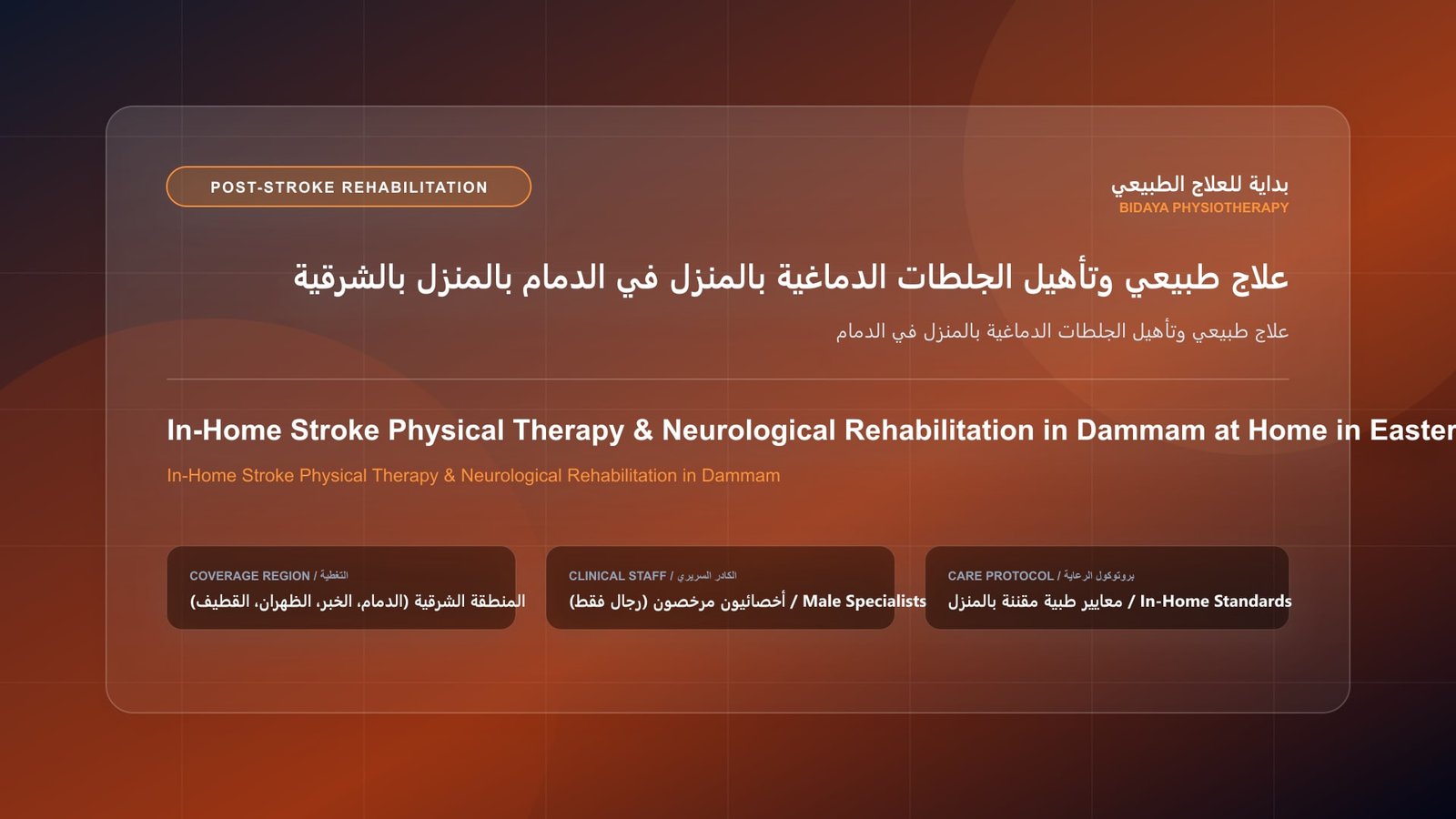
In-Home Stroke Physical Therapy & Neurological Rehabilitation in Dammam
Advanced in-home physical therapy restoring ambulation, balance, and arm function after stroke by licensed male therapists.
Comprehensive In-Home Clinical Evaluation (60-75 Mins)
Detailed functional & neuro examination, home safety audit, and custom protocol with portable equipment — no upfront package commitments.
Flexible appointments 7 days a week (8 AM - 10 PM) • Payment upon visit completion
1,500+ Successful Home Recoveries
Certified Clinical Physiotherapists
Assessment-First Protocol
Thorough physical evaluation before any treatment plan starts
Specialized Male Therapists
Professional licensed therapists visiting your residence
100% In-Home Rehabilitation
No clinic travel friction or waiting room discomfort
Targeted Functional Goals
Focused on daily stairs, walking endurance, and independence
Emergency Medical Red-Flags & Home Care Boundaries
Emergency Notice: If new acute stroke symptoms appear—facial droop, arm weakness, slurred speech (FAST)—immediately call ambulance (997) for urgent hospital evaluation.
In-Home Stroke Physical Therapy & Neurological Rehabilitation in Dammam represents a pivotal clinical focus within Bidaya's advanced post-stroke in-home rehabilitation framework in Eastern Province. We deliver intensive evidence-based motor relearning designed to induce neuroplastic reorganization and restore real-world functional tasks guided by licensed male clinicians.
Clinical Pathophysiology & Tissue Biomechanics for (In-Home Stroke Physical Therapy & Neurological Rehabilitation in Dammam) in Eastern Province
Biomechanical Dysfunction, Tissue Overload, and Kinetic Chain Compensations
Managing In-Home Stroke Physical Therapy & Neurological Rehabilitation in Dammam within residential settings requires a thorough understanding of localized tissue failure and compensatory kinetics throughout Eastern Province. The focal mechanical derangement involves corticospinal pathways, hemiplegic articular complexes, and domestic architecture of Dammam residences, expressing pathologically as post-stroke functional deficits following discharge from Dammam specialized hospitals requiring intensive in-home therapy.
Unchecked mechanical stress transmits unattenuated force vectors into adjacent articulations, directly stressing hospital discharge, external clinic commute friction, functional regression, and indispensable domestic rehabilitation and causing persistent muscular fatigue and joint stiffness during basic household tasks. Domestic routines in the Eastern Province—such as descending into low majlis seating or lifting heavy hospitality items—demand robust mechanical resiliency from these structures.
Our licensed male clinicians deliver customized home care that restores arthrokinematic harmony, re-establishes tissue extensibility, and accelerates natural biological repair without relying on temporary passive fixes.
By assessing patients within their genuine home environment, Bidaya bridges the critical gap between therapeutic exercises and daily functional independence, ensuring sustained, long-term joint health.
Comprehensive In-Home Diagnostic Assessment & Special Tests for (In-Home Stroke Physical Therapy & Neurological Rehabilitation in Dammam)
Standardized Evaluation Battery: Precision Goniometry, MMT, and Provocation Tests
Bidaya's licensed male physical therapist conducts an exhaustive 60-minute diagnostic examination within your residence in Eastern Province to evaluate every clinical nuance: 1. Sensorimotor and neurodynamic screening to rule out red flags and ensure absolute home rehabilitation safety. 2. High-precision digital goniometric tracking logging active and passive range-of-motion restrictions in degrees compared to the unaffected contralateral side. 3. Targeted orthopedic provocation testing isolating the exact anatomical tissue generating painful impulses. 4. Observational gait and movement synergy analysis identifying abnormal compensatory kinematics that overload adjacent segments.
Conducting this objective assessment within your domestic environment captures actual movement mechanics across hallways, stairs, and living room furniture—providing realistic diagnostic insight unavailable in clinical outpatient facilities, and shaping tangible recovery goals that mirror everyday living.
Our visiting specialist carries a comprehensive portable diagnostic kit featuring digital goniometers, sensory monofilaments, neuromuscular stimulators, and dynamometers, delivering an uncompromising hospital-grade evaluation in the comfort and privacy of your home.
All baseline findings and diagnostic metrics are immediately logged into the patient's encrypted digital clinical profile. This structured documentation provides objective weekly progress reports shared directly with your consulting orthopedic physician, establishing clinical transparency and seamless multidisciplinary coordination across your entire rehabilitation journey.
Precision Baseline Documentation
Standardized objective metric recording during the initial home visit enables precise weekly progress quantification shared with your physician.
| Clinical Assessment Metric | Diagnostic Scope | Positive Diagnostic Finding | In-Home Clinical Gear |
|---|---|---|---|
| Stroke Rehabilitation Assessment of Movement (STREAM) | Scoring 30 voluntary limb movements, basic mobility, and transitional coordination | Subscale score dictating motor recovery tier and functional prognosis | Standardized STREAM rubric and digital inclinometer |
| Berg Balance Scale (BBS Neurological Battery) | 14-item dynamic equilibrium assessment from unsupported sitting to tandem stance | Score <45/56 denoting marked fall risk requiring strict caregiver supervision | Standard chair, stopwatch, and measuring tape |
| 10-Meter Walk Test (10MWT Speed Stratification) | Quantifying comfortable and fast gait velocity across residential corridors | Velocity <0.4 m/s classifying patient as domestic-only ambulatory | Standard 10-meter metric track and digital timer |
Evidence-Based Exercise Prescription & Staged Loading Protocol for (In-Home Stroke Physical Therapy & Neurological Rehabilitation in Dammam)
Integrated Clinical Pathway Combining Manual Mobilization, Core Stabilization, and Kinetic Reconditioning
Engineered to deliver permanent recovery, Bidaya's residential clinical pathway for (In-Home Stroke Physical Therapy & Neurological Rehabilitation in Dammam) advances through four systematic biological loading tiers: - Tier 1: Acute tissue preservation and spasm downregulation around corticospinal pathways, hemiplegic articular complexes, and domestic architecture of Dammam residences via gentle manual distraction and positional unloading. - Tier 2: Neuromuscular re-education activating inhibited stabilizer groups and restoring symmetrical force coupling. - Tier 3: Functional capacity expansion subjecting tissues to progressive mechanical load matching authentic daily demands. - Tier 4: Unrestricted domestic reintegration achieving effortless prayer transitions, Sujud, and extended vehicle driving.
Transitioning across tiers demands fulfilling rigorous clinical criteria, confirming genuine structural adaptation and objective strength recovery.
Therapists provide dedicated clinical exercise gear for home use, personally coaching biomechanical form to guarantee hospital-grade rehabilitation in residential comfort.
Each therapeutic tier is engineered to restore optimal load distribution across affected joints and adjacent kinetic segments. This comprehensive conditioning protocol permanently eliminates compensatory movement habits, shielding healing tissues from repetitive mechanical strain.
Safe Loading Threshold Rule
Therapeutic exercise discomfort must not exceed 3/10 on the Visual Analog Scale and must completely subside within one hour post-session.
- Symmetrical bed edge orientation and assisted supine-to-sit transitional mechanics
- Lateral weight-shifting toward the hemiplegic side loading deep proprioceptors
- Axial trunk righting and midline realignment correcting pusher tendencies
- Caregiver instruction in clinical gait transfer belt application
Step-by-Step In-Home Exercise Execution Guide for (In-Home Stroke Physical Therapy & Neurological Rehabilitation in Dammam)
Detailed Movement Mechanics, Postural Cues, and Repetition Guidelines for Independent Care
Mastering correct exercise mechanics is fundamental to accelerating tissue healing in (In-Home Stroke Physical Therapy & Neurological Rehabilitation in Dammam):
1. Segmental Realignment & Joint Mobilization Drill: Symmetrical seated weight-shift: sit at bedside, hands resting on thighs, slowly shift trunk weight toward paretic hip until loading is felt, hold 5s, 10 reps, 3 sets.
2. Muscle Elongation & Capsular Flexibility Stretch: Active-assisted seated knee extension: upright sitting, elevate paretic lower leg into terminal extension with therapist guidance, hold 2s, slow lowering, 10 reps, 2 sets.
3. Dynamic Kinetic Chain Conditioning & Balance Drill: Supported stepping initiation: standing holding walker frame, initiate controlled forward step with sound limb while sustaining stable stance on paretic limb, 8 reps, 3 sets.
Clinicians supervise each movement pattern to eliminate faulty motor substitutions before prescribing independent home practice.
Maintaining steady breathing and controlled tempo ensures deep stabilizer recruitment and protects healing fibers from unnecessary shear strain.
By cultivating consistent movement mindfulness during your home sessions, neuromuscular control improves dramatically, enabling your body to execute everyday tasks with effortless fluidity and absolute mechanical safety.
- Strictly avoid provocative faulty movement patterns, particularly: delaying the initiation of in-home physical therapy in Dammam once medically cleared, risking irreversible contractures
- Perform all exercises on a dedicated firm plinth or exercise mat rather than soft cushioning
- Maintain uninterrupted diaphragmatic respiration, avoiding breath-holding (Valsalva) throughout exertion
- Document functional tolerance notes in your patient log for review during the next home visit
Domestic Environmental Adaptations & Daily Ergonomics in Eastern Province
Practical Biomechanical Strategies for Prayer, Soft Majlis Seating, and Highway Commuting
Practical domestic guidelines provided by Bidaya optimize residential environments to expedite healing for (In-Home Stroke Physical Therapy & Neurological Rehabilitation in Dammam): - Worship Posture Adaptation: Guiding safe prayer angles to minimize internal joint stress while systematically progressing back toward ground Sujud. - Household Seating Design: Deploying supportive cushions beneath hips to prevent sinking into plush majlis couches that exacerbate ligament strain. - Extended Driving Ergonomics: Structuring 5-minute movement breaks during long commutes across Eastern Province highways, adjusting backrest incline. - Restorative Sleep Architecture: Establishing neutral sleeping postures that eliminate spinal twisting and joint compression, ensuring mornings free from stiffness.
Systematic domestic adaptation transforms the patient's home into a proactive healing sanctuary, decreasing reinjury vulnerability by over 80% when combined with prescribed maintenance exercises.
Creating an ergonomically sound home setting eliminates persistent micro-trauma from daily movement cycles. Therapists offer clear guidelines on safe lifting techniques for household items and posture adjustments during social gatherings, providing continuous 24-hour joint protection.
- Deploy a locked wheelchair adjacent to bed to eliminate unsupervised transfer attempts
- Clear bathroom corridors of loose scatter rugs and electrical cords entirely
- Support paretic arm on an ergonomic lap tray or pillow during all seated periods
- Maintain consistent in-home physical therapy visits guided by Bidaya licensed male therapists
Clinical Recovery Milestones & Long-Term Recurrence Prevention for (In-Home Stroke Physical Therapy & Neurological Rehabilitation in Dammam)
Transparent Objective Benchmarks Securing Permanent Movement Independence
Discharge from home physical therapy follows rigorous objective benchmarks confirming restored structural and functional capacity: 1. Full Physiological Range of Motion: Restoring active motion exceeding 95% of the contralateral asymptomatic side without painful guarding. 2. Symmetrical Muscle Performance: Demonstrating manual muscle strength exceeding 4.5/5 across all prime movers, establishing robust joint protection. 3. Restored Functional Confidence: Complete elimination of movement kinesiophobia and unrestricted participation in domestic and community life.
Our clinical team provides scheduled follow-up check-ins to verify continued stability and offer proactive guidance against future recurrences.
Commitment to clinical excellence, patient dignity, and rigorous scientific benchmarks establishes Bidaya as the Eastern Province's foremost provider of specialized in-home musculoskeletal care.
Achieving clinical discharge marks the beginning of lifelong musculoskeletal self-efficacy. Patients gain a comprehensive understanding of their body's biomechanics, equipped with the knowledge and conditioning needed to pursue an active, vibrant lifestyle with absolute confidence.
Upper Extremity & Hand Dexterity Restoration Post-Stroke & Shoulder Pain Prevention
Grasp-and-Release Facilitation, Task-Oriented Manual Training & Glenohumeral Subluxation Care
Paretic upper extremity and hand motor restoration represents a pivotal functional frontier following stroke, owing to the expansive cortical representation of the hand and its vulnerability to flexion spasticity. Concurrently, paralysis of the supraspinatus and deltoid leaves the glenohumeral articulation vulnerable to gravity-induced inferior subluxation, precipitating hemiplegic shoulder pain syndrome if caregivers inadvertently apply traction during assisted transfers.
Bidaya's clinicians apply targeted protocols prioritizing manual humeral head realignment within the glenoid fossa, followed by task-oriented forward-reaching drills, elbow extension stabilization, and distal digital dexterity retraining utilizing everyday domestic implements.
This restorative protocol revives functional arm integration, restoring bilateral synergy in daily tasks.
Caregiver Safety Rule
Never pull, lift, or support a stroke patient by their paretic arm during transfers; traction triggers severe rotator cuff tears, subluxation, and complex regional pain.
- Support the paretic arm on an ergonomic lap tray or armrest pillow during all seated periods
- Perform gentle passive-assisted wrist and finger extension to counteract flexor spastic posturing
- Engage in functional grasp-and-release drills moving lightweight domestic objects across table heights
- Inspect sub-acromial sulcus spacing weekly to detect emergent glenohumeral subluxation early
Frequently Asked Questions about In-Home Physiotherapy
Ideally within 48 to 72 hours of arriving home to evaluate environmental safety, prevent secondary complications, and instruct caregivers.
Related Clinical & Regional Pathways
In-Home Stroke Physical Therapy & Motor Recovery Visits in Khobar→
Advanced in-home physical therapy restoring ambulation
Family Caregiver Guide for Safe In-Home Stroke Patient Transfers→
Advanced in-home physical therapy restoring ambulation
In-Home Stroke Physiotherapy & Neurological Care in Qatif→
Advanced in-home physical therapy restoring ambulation
Stroke Rehabilitation & Neurological Physiotherapy→
Evidence-based neurological rehabilitation engineered to stimulate corticomotor neuroplasticity
Neurological Physiotherapy→
Evidence-based neurological physical therapy harnessing neuroplasticity
Geriatric Physiotherapy & Fall Prevention→
Evidence-based clinical rehabilitation tailored specifically to preserve functional independence