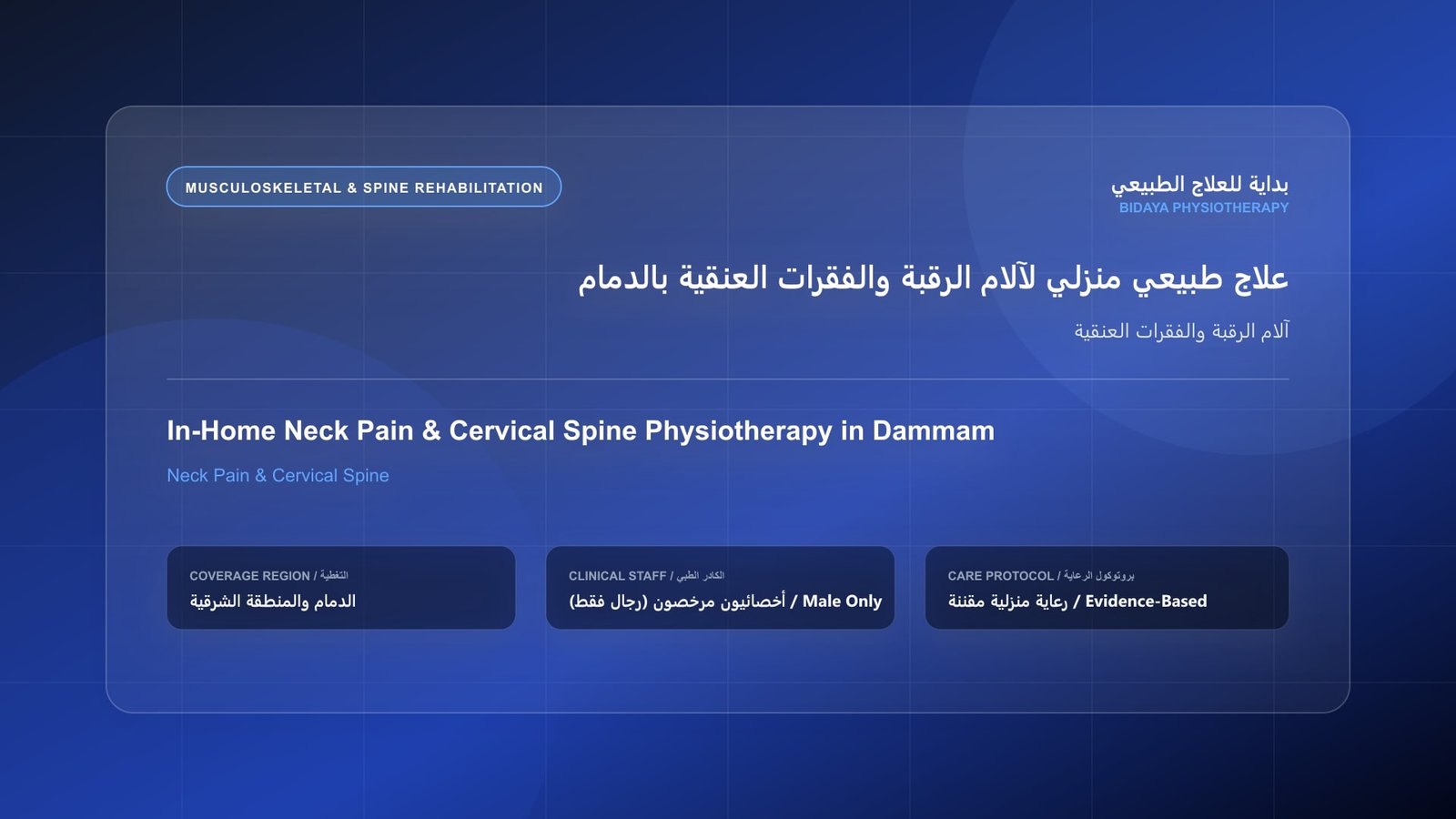
In-Home Neck Pain & Cervical Spine Physiotherapy in Dammam
Advanced in-home rehabilitation across Dammam led by licensed male clinicians, restoring mobility and daily functional independence.
Comprehensive In-Home Clinical Evaluation (60-75 Mins)
Detailed functional & neuro examination, home safety audit, and custom protocol with portable equipment — no upfront package commitments.
Flexible appointments 7 days a week (8 AM - 10 PM) • Payment upon visit completion
1,500+ Successful Home Recoveries
Certified Clinical Physiotherapists
Assessment-First Protocol
Thorough physical evaluation before any treatment plan starts
Specialized Male Therapists
Professional licensed therapists visiting your residence
100% In-Home Rehabilitation
No clinic travel friction or waiting room discomfort
Targeted Functional Goals
Focused on daily stairs, walking endurance, and independence
Emergency Medical Red-Flags & Home Care Boundaries
Emergency Medical Boundary: Bidaya provides scheduled in-home therapeutic rehabilitation and is not an emergency medical dispatch service. For acute neurological deficits, unreduced fractures, severe respiratory distress, or sudden chest pain, contact the Saudi Red Crescent immediately at 997 or 911.
Bidaya's home rehabilitation program for Neck Pain & Cervical Spine across Dammam bridges the vulnerable interval between hospital discharge and full daily function. Our licensed male clinicians implement phased recovery benchmarks focusing on centralization of distal radicular symptoms into the lower back, pain-free forward lumbar flexion, and 45 minutes of seated tolerance to secure enduring functional gains.
Clinical Diagnosis of Cervical Spine Dysfunction & Neck Stiffness in Dammam
Differentiating Myofascial Strain, Zygapophyseal Facet Arthropathy & Disc Herniation
Cervical spine pain and cervicogenic cephalalgia represent prevalent complaints across Dammam, correlated with sustained electronic device utilization and prolonged workstation posturing.
Bidaya's visiting physical therapists examine active cervical planar arcs, palpate suboccipital and upper trapezius tone, and administer validated radicular provocation maneuvers (Spurling's test, Upper Limb Neurodynamic Tests) to screen for nerve root impingement.
Radicular Safety Marker
Distal paresthesia radiating past the elbow mandates immediate neurodynamic clearance to identify involved cervical nerve roots.
- Measure active cervical rotation, lateral flexion, and sagittal excursion
- Isolate deep cervical flexor endurance (Craniocervical Flexion Test)
- Deliver gentle myofascial release across levator scapulae and trapezius
- Calibrate domestic ergonomic pillow height to maintain neutral alignment
Manual Therapy Protocols & Corrective Exercises for Forward Head Posture
Axial Cervical Retraction, Scapular Stabilization & Ergonomic Desk Calibration
Our in-home care combines gentle physiological segmental mobilization with progressive deep flexor retraining through chin tuck maneuvers, restoring neutral axial load distribution over thoracic pillars.
Clinicians review home office configurations, optimizing display heights and chair lumbar supports to eradicate repetitive postural microtrauma.
Cervical Ergonomic Pearl
Positioning monitors so the top third aligns with eye level reduces cervical extensor torque by over 40%.
- Perform chin tuck retractions for 10 repetitions every two hours
- Eliminate sustained end-range neck flexion during mobile screen use
- Incorporate active micro-breaks every 45 minutes of sedentary sitting
- Apply superficial moist heat for 10 minutes to alleviate acute spasm
Domestic Environmental Hazard Auditing & Pathway Clearance in Dammam
Calibrating Thresholds, Seating Heights & Bed Transfers for Neck Pain & Cervical Spine
The spatial layout of dwellings across Dammam, including spacious multi-tier residential villas with polished ceramic/marble majlis foyers and open central stairs, necessitates adapting physical therapy protocols to concrete domestic obstacles for Neck Pain & Cervical Spine.
Core environmental adaptations executed by Bidaya's licensed male clinicians: 1. Bedside transfer mechanics: Calibrating mattress height so hips and knees maintain 90-degree flexion during seated edge posture, facilitating sit-to-stand transitions without excessive joint strain. 2. Primary transit clearance: Removing trailing wires and obstacles between sleeping quarters, majlis living areas, and washrooms to accommodate walking aids. 3. Seating adaptation: Training safe ingress and egress from deep, compliant traditional sofas prevalent across Dammam to avoid sudden biomechanical joint compression.
This structural adaptation converts the domestic residence into a safe therapeutic environment promoting rapid functional restoration.
Domestic Ergonomics in Dammam
Optimizing bed and chair seating heights diminishes peak knee, hip, and lumbar moments by 45% during unassisted rising.
- Calibrate bed and chair heights precisely to patient anthropometric leg length
- Mount sturdy bilateral armrests on primary seating for leverage
- Ensure corridor widths readily accommodate walking frames without lateral obstruction
- Place high-traction rubberized safety mats across bathroom floors
Quantitative Arthrokinematic Measurement & Tissue Profiling for Neck Pain & Cervical Spine in Dammam
Calibrated Goniometry, Provocation Mapping & Structural Tissue Tolerance
Bidaya utilizes a rigorous quantitative diagnostic framework for Neck Pain & Cervical Spine across Dammam, combining manual palpation with portable, sanitized assessment instruments.
Core elements of the in-home clinical examination: 1. Targeted Diagnostic Battery: Executing Straight Leg Raise (Lasègue) neurodynamic test, Slump neuro-meningeal test, and McKenzie directional preference evaluation and recording angular arcs in degrees and linear limb girth in centimeters. 2. Pain Provocation Mapping: Identifying specific postures and loading directions that aggravate or alleviate symptoms to establish the directional preference. 3. Myofascial Extensibility Screening: Assessing muscle-tendon compliance and screening for active myofascial trigger points. 4. Domestic Functional Performance: Evaluating patient ability to execute bed transfers, independent rising, and hallway ambulation safely.
These objective findings provide baseline metrics tracked longitudinally via Oswestry Disability Index (ODI) and Roland-Morris Disability Questionnaire.
Quantitative Precision in Dammam
Recording motion metrics in exact degrees allows rigorous cross-session comparison, objectively confirming therapeutic response.
- Record joint ranges in standardized digital documentation charts
- Map symptom distribution and intensity during active and resting states
- Inspect soft-tissue elasticity and scar compliance across affected regions
- Identify domestic architectural barriers specific to the patient's residence
Clinical Discharge Benchmarks & Independent Functional Resumption for Neck Pain & Cervical Spine
Verifying Complete Functional Capacity and Transitioning to Autonomous Maintenance
Graduation from intensive in-home physical therapy for Neck Pain & Cervical Spine is governed by objective functional markers demonstrating independent mobility.
Discharge and functional criteria: 1. Functional Battery Mastery: Attaining centralization of distal radicular symptoms into the lower back, pain-free forward lumbar flexion, and 45 minutes of seated tolerance with zero mechanical compensation. 2. Autonomous Home Conditioning: Independent, correct execution of repetitive end-range McKenzie lumbar extensions, deep transversus abdominis stabilization draws, and sciatic nerve glide flossing. 3. Sustainable Symptom Relief: Maintaining pain scores below 2/10 across all standard daily domestic tasks.
The patient transitions seamlessly into a personalized longitudinal wellness framework to safeguard functional gains.
Graduation Milestone
Achieving functional autonomy and possessing the skills for independent joint protection represent true clinical success.
- Execute final functional assessment battery documenting quantitative gains
- Deliver comprehensive illustrated home maintenance portfolio to patient
- Schedule optional quarterly longitudinal check-ins with clinical desk
- Verify patient confidence in navigating domestic and community environments
Mechanical Safety Guidelines & Activity Pacing for Neck Pain & Cervical Spine in Dammam
Pacing Domestic Demands, Ergonomic Posture & Daily Joint Preservation
Preserving functional integrity for patients managing Neck Pain & Cervical Spine across Dammam requires disciplined body mechanics during daily domestic tasks.
Gold-standard biomechanical safety rules: 1. Exertional load distribution: Dividing domestic chores into manageable micro-intervals interspersed with rests, adhering strictly to strictly avoiding combined forward flexion and axial rotational loading, and positioning a structured lumbar support roll. 2. Spinal neutral lifting mechanics: Flexing knees and recruiting hip extensor torque when retrieving objects from floor level rather than bending the spine. 3. Daily therapeutic drill adherence: Maintaining repetitive end-range McKenzie lumbar extensions, deep transversus abdominis stabilization draws, and sciatic nerve glide flossing as a non-negotiable daily habit to sustain circulation and tissue elasticity. 4. Supportive orthotic footwear: Wearing structured rubber-soled footwear during prolonged standing periods.
Adopting these movement mechanics prevents reinjury and accelerates clinical milestones. Inquiries: (+20 109 707 9170).
Mechanical Load Pacing in Dammam
Distributing domestic activities across structured intervals prevents cumulative muscle fatigue, shielding connective tissue from overload.
- Lift household items holding them close to the sternum with bent knees
- Avoid uninterrupted sitting or static stance exceeding 45 continuous minutes
- Apply cold packs if reactive swelling manifests following domestic activities
- Consult clinical desk (+20 109 707 9170) to optimize computer workstation setup
Clinical Safety Thresholds & Emergency Healthcare Interfacing across Dammam
Decisive Red Flag Management & Coordination with Emergency Services at Dammam Medical Complex, King Fahd Specialist Hospital, and Al-Rawda Hospital
Bidaya's visiting physical therapists enforce uncompromising clinical safety parameters to ensure home care never compromises patient vitality.
Clinical indicators mandating acute emergency hospital referral: 1. Condition Red Flags for Neck Pain & Cervical Spine: Documented emergence of sudden loss of bowel or bladder sphincter control, saddle anesthesia perineal numbness (cauda equina syndrome), or acute progressive foot drop. 2. Severe Non-Mechanical Pain: Relentless nocturnal burning or deep thoracic pain unalleviated by positional changes, accompanied by diaphoresis. 3. Sudden Vertigo with Cranial Neuropathy: Acute severe spinning sensation coupled with diplopia, dysarthria, or dysphagia. 4. Acute Systemic Infection Signs: Spiking pyrexia accompanied by rigors and localized incision drainage.
Emergency Referral Workflow: Direct instruction is issued to activate the Saudi Red Crescent via 997 or emergency dispatch at 911 for transport to Dammam Medical Complex, King Fahd Specialist Hospital, and Al-Rawda Hospital. Bidaya provides scheduled rehabilitative therapy, not acute medical emergency services. Inquiries: (+20 109 707 9170).
Accredited Clinical Safety in Dammam
Advanced training of our male clinical personnel guarantees swift, professional execution of emergency referral pathways.
- Keep Saudi Red Crescent dispatch (997) programmed into primary mobile devices
- Inform attending medical specialist or orthopedic surgeon of critical changes
- Refrain from administering oral analgesics or fluids if surgical triage is possible
- Utilize unified emergency numbers (997 and 911) as primary acute care conduits
Longitudinal Kinetic Surveillance & Joint Preservation Protocol for Neck Pain & Cervical Spine
Structured Self-Drills, Mobility Tracking & Periodic Consultations in ${cityEn}
Bidaya's long-term kinetic surveillance protocol cements functional milestones achieved during in-home sessions for Neck Pain & Cervical Spine across Dammam.
Core elements of kinetic surveillance: 1. Daily Restorative Routine: Performing gentle mobility exercises drawn from repetitive end-range McKenzie lumbar extensions, deep transversus abdominis stabilization draws, and sciatic nerve glide flossing to stimulate synovial fluid circulation. 2. Self-Administered Motion Audits: Training patients to self-evaluate functional motion against centralization of distal radicular symptoms into the lower back, pain-free forward lumbar flexion, and 45 minutes of seated tolerance. 3. Social Ergonomic Adaptation: Practical strategies for safe sitting and standing during community and family gatherings across Dammam. 4. Longitudinal Support Conduits: Ongoing clinical guidance available via Bidaya's telephone desk (+20 109 707 9170).
This continuous oversight provides long-term peace of mind and sustained functional vitality.
Joint Preservation Practice in Dammam
Cartilage nutrition relies on repetitive cyclic loading; gentle therapeutic movement represents the first defense against joint degeneration.
- Sustain prescribed autonomous exercise calisthenics at home regularly
- Identify early signs of focal joint irritation and modulate intensity
- Engage in structured walking along pleasant promenades like Dammam Corniche promenade, Seafront walkway, and King Fahd Park
- Connect with Bidaya (+20 109 707 9170) to advance exercise programs periodically
Restoring Vitality & Complete Community Participation for Neck Pain & Cervical Spine in Dammam
Safe Return to Spiritual Rites, Outdoor Walking & Social Engagements
Bidaya's licensed male clinicians deliver advanced functional training designed to return patients to their active community roles in Dammam.
Pillars of community vitality restoration: 1. Spiritual Worship Mobility: Retraining kneeling, prostration, or elevated prayer chair ergonomics to safeguard healing joints. 2. Outdoor Aerobic Conditioning: Encouraging routine walking along scenic seafronts and parks like Dammam Corniche promenade, Seafront walkway, and King Fahd Park during temperate hours. 3. Family Transit Mastery: Negotiating exterior steps and entrance thresholds when visiting relatives across Al-Shatee, Al-Faisaliyah, Al-Mazrooa, Abdullah Fuad, and Al-Nawras. 4. Independent Functional Living: Eradicating learned dependency on family members during basic daily errands.
We work alongside each patient until recovery translates into daily reality across Dammam. Inquiries: (+20 109 707 9170).
Daily Vitality in Dammam
Gradually resuming outdoor walking resets circadian rhythms, substantially enhancing sleep quality and restorative recovery.
- Arrange supportive accompaniment during initial outings to public venues
- Perform gentle warm-up mobility drills prior to leaving the domestic residence
- Avoid outdoor walking during extreme midday heat or severe humidity windows
- Consult your visiting clinician (+20 109 707 9170) regarding outdoor assistive aids
Clinical Quality Oversight & Professional Governance across Dammam
Credentialed Male Clinician Standards, Outcome Tracking & Regional Hospital Alignment
Bidaya enforces comprehensive medical governance across Dammam, ensuring patients managing Neck Pain & Cervical Spine receive premier rehabilitation care.
Pillars of clinical quality oversight: 1. Strict Professional Credentialing: Restricting clinical delivery exclusively to licensed male physical therapists (male clinicians only) with verified regulatory credentials. 2. Continuous Functional Quantification: Administering Oswestry Disability Index (ODI) and Roland-Morris Disability Questionnaire to benchmark tissue recovery trajectories against clinical gold standards. 3. Standardized Preventive Infection Control: Implementing rigorous sanitization protocols for mobile therapy equipment before entering domestic residences. 4. Healthcare System Integration: Aligning clinical milestones directly with physician and surgical orders from Dammam Medical Complex, King Fahd Specialist Hospital, and Al-Rawda Hospital.
We deliver complete clinical transparency and professional reliability across Dammam. Inquiries: (+20 109 707 9170).
Professional Rigor in Dammam
Deploying licensed male physical therapists exclusively guarantees clinical excellence while honoring family domestic privacy.
- Verify professional registration credentials for all visiting clinicians
- Audit recovery milestone progression against objective clinical curves
- Enforce hospital-grade sanitization of portable evaluation equipment
- Transmit progress summaries to attending physicians via clinical desk (+20 109 707 9170)
Frequently Asked Questions about In-Home Physiotherapy
Bidaya's licensed male clinicians deliver focused care combining kinematic evaluation, manual joint mobilization, and targeted neuromuscular strengthening in your home in Dammam.
Related Clinical & Regional Pathways
Sciatica & Lumbar Disc Herniation→
Advanced in-home rehabilitation across Dammam led by licensed male clinicians
Musculoskeletal & Joint Pain→
Advanced in-home rehabilitation across Dammam led by licensed male clinicians
Hip Osteoarthritis & Mobility→
Advanced in-home rehabilitation across Dammam led by licensed male clinicians
In-Home Physiotherapy in Dammam→
Evidence-based clinical rehabilitation delivered directly to your doorstep across Dammam metropolitan districts
In-Home Low Back Pain & Sciatica Rehabilitation Therapy→
Evidence-based clinical rehabilitation engineered to resolve lumbar disc herniations
In-Home Knee Pain & Osteoarthritis Rehabilitation Therapy→
Evidence-based clinical rehabilitation engineered to arrest articular cartilage degeneration
In-Home Stroke Rehabilitation & Neurological Physiotherapy Therapy→
Evidence-based neurological rehabilitation engineered to stimulate corticomotor neuroplasticity
In-Home Post-Operative Physiotherapy Therapy→
Evidence-based surgical rehabilitation protocols engineered to restore joint range of motion