Advanced In-Home Knee Physiotherapy & Joint Rehabilitation in Dammam
Evidence-based clinical protocols designed to relieve knee joint stiffness, manage osteoarthritis, and restore independent stair climbing and walking inside your Dammam residence.
Comprehensive In-Home Clinical Evaluation (60-75 Mins)
Detailed functional & neuro examination, home safety audit, and custom protocol with portable equipment — no upfront package commitments.
Flexible appointments 7 days a week (8 AM - 10 PM) • Payment upon visit completion
1,500+ Successful Home Recoveries
Certified Clinical Physiotherapists
Assessment-First Protocol
Thorough physical evaluation before any treatment plan starts
Specialized Male Therapists
Professional licensed therapists visiting your residence
100% In-Home Rehabilitation
No clinic travel friction or waiting room discomfort
Targeted Functional Goals
Focused on daily stairs, walking endurance, and independence
Emergency Medical Red-Flags & Home Care Boundaries
In-home knee therapy is intended for stable rehabilitation. If you experience sudden, severe joint swelling accompanied by fever, skin redness, or complete inability to bear weight after acute trauma, seek immediate hospital emergency care.
Knee pain and degenerative osteoarthritis (OA) represent the leading causes of physical mobility restriction, reduced physical activity, and home confinement among adults and elderly residents in Dammam. The local residential environment frequently introduces high biomechanical demands on vulnerable knee joints: multi-story villas across Al Faisaliyah, Al Shati, Al Fakhriyah, and Al Manar feature steep internal marble staircases, while traditional social gatherings in domestic majlis spaces often involve deep knee flexion during seated floor transitions. When cartilage wear narrows the joint space, descending stairs triggers sharp retro-patellar friction, turning routine domestic navigation into an agonizing challenge.
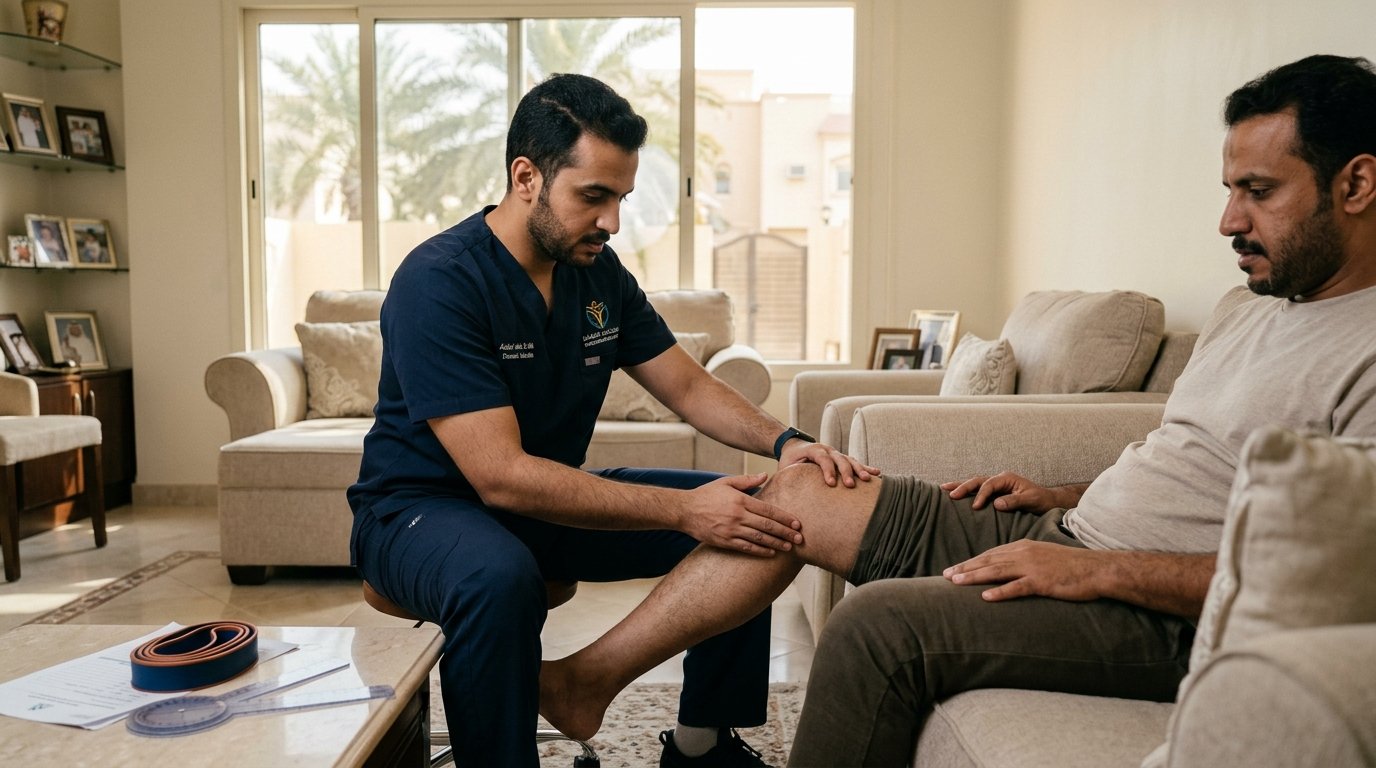
At Bidaya In-Home Physiotherapy, we provide a specialized clinical solution delivered straight to the patient's living room in Dammam. We understand that patients experiencing acute knee inflammation endure severe discomfort during vehicle transfers, parking searches, and extended walking across expansive hospital corridors. Our certified male physical therapists arrive directly at your home with specialized clinical equipment, assessing the precise biomechanical deficits of your knee and patellofemoral joints in the context of your actual home furnishings.
Our clinical framework is aligned with international clinical practice guidelines from the Osteoarthritis Research Society International (OARSI) and the American Physical Therapy Association (APTA). We combine gentle manual joint decompression, non-provocative isometric quadriceps conditioning, hip abductor stabilization, and functional step re-education, allowing patients to offload degenerated cartilage, rebuild muscular shock-absorption capacity, and navigate their home stairways with comfort and stability.
Why In-Home Knee Therapy Is Superior for Dammam Residents
Practical Training on Domestic Staircases and Eliminating Transit Stress
Receiving knee rehabilitation at home in Dammam provides distinct clinical advantages: 1. Retraining on Actual Residential Marble Staircases: Patients practice ascending and descending their actual home stairs with proper biomechanical cueing (leading with the unaffected leg when ascending, and the affected leg when descending) utilizing their existing handrails. 2. Majlis and Furniture Ergonomic Customization: The therapist inspects living room seating, identifying excessively deep or low cushions that force hyperflexion beyond 90 degrees and recommending supportive seating modifications. 3. Preventing Automobile Transfer Agony: Navigating vehicle seats and sitting with knees bent during traffic congestion exacerbates patellar compressive forces; in-home sessions preserve joint comfort for direct therapeutic exercise.
Comprehensive In-Home Knee Biomechanical Assessment
Objective Clinical Metrics Evaluating Range of Motion, Strength, and Gait Symmetry
During the initial evaluation in your Dammam residence, our therapist conducts: - Digital Goniometry measuring active and passive extension and flexion range of motion, identifying subtle extension deficits that dramatically increase quadriceps energy expenditure. - Manual Muscle Testing and functional grading of the quadriceps (rectus femoris, vastus medialis oblique) and gluteal stabilizers (gluteus medius and maximus). - Joint Effusion and Palpation Assessment, checking for intra-articular swelling, suprapatellar pouch fullness, and pes anserine bursal tenderness along the medial tibial plateau. - Visual Gait Analysis identifying antalgic limping, knee hyperextension (genu recurvatum), or lateral pelvic drop during single-leg stance.
Phased Progressive In-Home Rehabilitation Framework
From Acute Pain Modulation to Closed-Kinetic Functional Independence
Our clinical knee protocol progresses through targeted rehabilitation phases: Phase 1: Pain Modulation & Joint Decompression: Utilizing mobile TENS units for neuro-sensory pain gating, gentle manual patellar glides to restore retinacular mobility, and post-exercise cryotherapy. Phase 2: Muscle Reactivation & Non-Provocative Loading: Isometric quad sets with auditory biofeedback, straight leg raises in multiple planes, and supine glute bridges to restore active neuromuscular control without joint friction. Phase 3: Functional Closed-Chain Loading: Sit-to-stand retraining from calibrated chair heights, forward and lateral step-ups on domestic steps, and single-leg balance drills on high-density foam pads to optimize dynamic joint stability.
Clinical Joint Protection Principles for Dammam Patients
Preserving Cartilage Health and Mitigating Excessive Daily Joint Loads
Our physical therapist educates patients on essential joint preservation habits: - Avoiding prolonged unsupported ground sitting in majlis settings during acute inflammatory flares, opting for elevated supportive armchairs. - Wearing supportive athletic footwear with cushioned shock-absorbing outsoles when walking on hard marble and porcelain villa floors. - Incorporating weight management strategies, recognizing that every kilogram of body weight loss removes approximately four kilograms of mechanical force across the knee joint with each step.
Clinical Biomechanical Assessment & Objective Diagnostic Tests for (Knee Physiotherapy in Dammam) at Home
Precision Goniometry, Manual Muscle Grading, and Neurodynamic Evaluation in Residential Care
Bidaya In-Home Physiotherapy adheres to an exhaustive clinical examination protocol during the initial evaluation visit in Dammam. Our visiting specialist examines not merely the localized zone of discomfort, but the entire kinetic chain to pinpoint the foundational biomechanical dysfunctions driving tissue overload.
Our standardized in-home clinical diagnostic suite comprises four rigorous evaluations: 1. Active and Passive Joint Goniometry: Precision measurement of joint displacement in degrees, establishing objective baseline parameters to track micro-gains across treatment sessions. 2. Standardized Manual Muscle Testing (MMT): Graded from 0 to 5 on the Medical Research Council scale, isolating inhibited prime movers and compensatory recruitment patterns. 3. Orthopedic Provocation Tests: Targeted stress testing to differentiate ligamentous laxity, tendinopathic degradation, capsular adhesions, and intra-articular derangements. 4. Neurodynamic Nerve Mobility Profiling: Conducting tension and gliding tests (such as Straight Leg Raise or Upper Limb Tension Tests) to evaluate neural mechano-sensitivity and radicular involvement.
Objective Clinical Standard
Establishing baseline quantitative goniometric and dynamometric metrics allows our clinicians to objectively demonstrate functional progress every 4 weeks.
| Clinical Metric | Diagnostic Purpose | Reference Standard | Portable Instrumentation |
|---|---|---|---|
| Joint Range of Motion | Detect capsular restrictions & end-feel | Comparison with contralateral limb | Digital medical goniometer |
| Muscle Strength | Identify neural inhibition & atrophy | MRC 0-5 scale grading | Manual resistive dynamometry |
| Postural Balance | Quantify fall risk & stability | Berg Balance & Timed Up & Go (TUG) | High-density proprioceptive pads |
| Neurodynamics | Assess peripheral nerve excursion | Validated neural tension tests | Reflex hammer & sensory filaments |
Domestic Ergonomic Adaptations & Home Environment Optimization in Dammam
Transforming Residential Corridors, Living Spaces, and Domestic Stairs into Supportive Recovery Zones
Achieving optimal recovery and long-term joint function requires seamless integration between clinical exercise protocols and the patient's domestic living space across Eastern Province communities in Dammam, Khobar, Dhahran, and Qatif. During initial home sessions, Bidaya's licensed male physiotherapist conducts a thorough environmental ergonomics inspection, analyzing seat heights, bed firmness, and surface traction to eliminate fall hazards and facilitate safe, independent therapeutic exercise between supervised visits.
Patients and family caregivers are systematically trained to leverage standard home architectural elements as rehabilitation supports: utilizing stable interior door jambs for pectoral and scapular stretching, employing sturdy armchairs for sit-to-stand reconditioning, and identifying reliable handrail contact points alongside marble interior staircases prevalent in local villas. This contextual coaching directly mitigates kinesiophobia (fear of movement), instilling functional confidence and promoting rapid functional autonomy in the patient's familiar domestic domain without constant caregiver reliance.
Clinical Domestic Recommendation
Eliminating loose rugs, optimizing corridor illumination, and securing stair handrails reduces domestic slip-and-fall incidence by over 40% during orthopedic rehabilitation.
- Verify seating ergonomics and avoid excessively low, deep, or non-supportive cushioned sofas
- Ensure primary walking pathways and nighttime bathroom routes remain clear of cords and obstacles
- Perform prescribed independent home exercises 2 to 3 times daily within comfortable pain tolerance
- Notify the clinical coordinator immediately if unexplained acute swelling or atypical pain occurs
Clinical Progression Milestones & Long-Term Recurrence Prevention for (Knee Physiotherapy in Dammam) at Home
Objective Criteria for Phase Transition and Sustainable Patient Self-Management
Our clinical responsibility at Bidaya extends far beyond short-term symptomatic pain relief. We build comprehensive mechanical resilience to protect patients against injury relapse and secondary functional decline after formal therapy conclusion. We establish transparent, objective discharge criteria: - Pain Modulation Benchmark: Reduction of Visual Analog Scale (VAS) pain scores from severe baseline levels (7-10) to minimal functional levels (0-2) during active weight-bearing tasks. - Muscular Endurance Benchmark: Ability to maintain functional closed-chain motor recruitment for 2 continuous minutes without muscular tremor or compensatory biomechanical substitutions. - Functional Autonomy Benchmark: Independent execution of prayer postures, bed transfers, vehicular entry/exit, and reciprocal stair climbing without physical caregiver assistance.
Upon program completion, each patient receives an individualized digital maintenance protocol detailing specific twice-weekly exercises designed to sustain strength, mobility, and functional independence indefinitely.
- Maintain 10 minutes of daily morning and evening therapeutic flexibility exercises
- Break up sedentary desk or television periods every 45 minutes with active standing breaks
- Maintain adequate systemic hydration to preserve fascia and tendon viscoelasticity
- Schedule an optional preventative clinical checkup every 6 months to audit kinetic chain health
Frequently Asked Questions about In-Home Physiotherapy
Yes, for patients with mild to moderate (Grades 1 to 3) osteoarthritis, intensive quadriceps strengthening and gait correction significantly relieve pain and improve joint mechanics, often delaying or avoiding surgical intervention.
Related Clinical & Regional Pathways
Post-Knee Replacement Rehab Dammam→
Intensive, surgeon-aligned home physiotherapy starting immediately upon hospital discharge across Dammam. Rest...
In-Home Physiotherapy in Al Khobar→
Evidence-based clinical rehabilitation delivered directly to your villa
In-Home Back Pain & Disc Herniation Physiotherapy in Dammam→
Evidence-based clinical rehabilitation delivered directly to your doorstep across Al Shatea
In-Home Service Locations Coverage Therapy→
A responsive clinical mobile network connecting residences across the Eastern Province with licensed physical ...
In-Home Low Back Pain & Sciatica Rehabilitation Therapy→
Evidence-based clinical rehabilitation engineered to resolve lumbar disc herniations
In-Home Knee Pain & Osteoarthritis Rehabilitation Therapy→
Evidence-based clinical rehabilitation engineered to arrest articular cartilage degeneration
In-Home Stroke Rehabilitation & Neurological Physiotherapy Therapy→
Evidence-based neurological rehabilitation engineered to stimulate corticomotor neuroplasticity
In-Home Post-Operative Physiotherapy Therapy→
Evidence-based surgical rehabilitation protocols engineered to restore joint range of motion