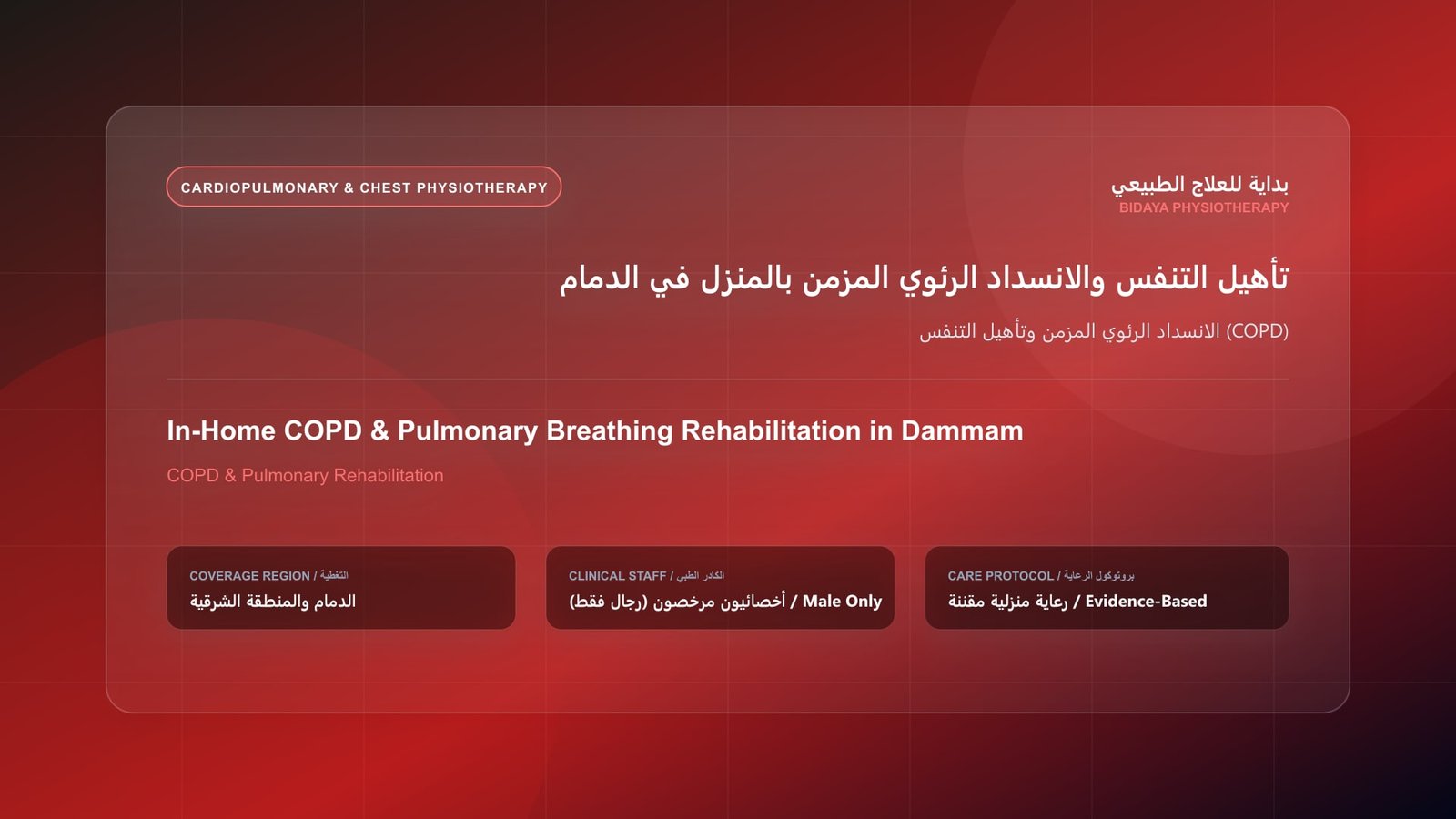
In-Home COPD & Pulmonary Breathing Rehabilitation in Dammam
Advanced in-home rehabilitation across Dammam led by licensed male clinicians, restoring mobility and daily functional independence.
Comprehensive In-Home Clinical Evaluation (60-75 Mins)
Detailed functional & neuro examination, home safety audit, and custom protocol with portable equipment — no upfront package commitments.
Flexible appointments 7 days a week (8 AM - 10 PM) • Payment upon visit completion
1,500+ Successful Home Recoveries
Certified Clinical Physiotherapists
Assessment-First Protocol
Thorough physical evaluation before any treatment plan starts
Specialized Male Therapists
Professional licensed therapists visiting your residence
100% In-Home Rehabilitation
No clinic travel friction or waiting room discomfort
Targeted Functional Goals
Focused on daily stairs, walking endurance, and independence
Emergency Medical Red-Flags & Home Care Boundaries
Emergency Medical Boundary: Bidaya provides scheduled in-home therapeutic rehabilitation and is not an emergency medical dispatch service. For acute neurological deficits, unreduced fractures, severe respiratory distress, or sudden chest pain, contact the Saudi Red Crescent immediately at 997 or 911.
Bidaya's home rehabilitation program for COPD & Pulmonary Rehabilitation across Dammam bridges the vulnerable interval between hospital discharge and full daily function. Our licensed male clinicians implement phased recovery benchmarks focusing on maintaining SpO2 >= 92% throughout domestic ambulation, stabilizing exertion at Borg 11-13, and climbing one flight without acute desaturation to secure enduring functional gains.
Managing Dyspnea & Chronic Airway Obstruction in Dammam
Pulse Oximetry (SpO2) Tracking, Dynamic Air Trapping & Humidity Exacerbations
Chronic Obstructive Pulmonary Disease (COPD) and chronic bronchitis impose severe dyspnea and functional activity limitations across Dammam homes, acutely aggravated by external marine humidity and airborne particulates.
Bidaya's visiting clinicians establish real-time pulse oximetry (SpO2) tracking, grade exertional breathlessness using the Modified Borg Dyspnea Scale, and identify dynamic hyperinflation (air trapping) during domestic transfers.
Target SpO2 Oximetry Bounds
Maintain exertional oxygen saturation within the therapeutic window of 88%-92% for COPD patients, halting exercise if levels drop below protocol limits.
- Monitor baseline resting and exertional SpO2 using calibrated pulse oximetry
- Quantify respiratory exertion via the Modified Borg Dyspnea scale
- Detect paradoxical abdominal breathing and accessory neck muscle overuse
- Optimize domestic indoor air filtration and maintain air-conditioned microclimates
Active Cycle of Breathing (ACBT) & Pursed-Lip Dyspnea Relieving Protocols
Diaphragmatic Breathing, Forced Expiratory Huffing & Aerobic Pacing
Therapy trains Pursed-Lip Breathing to establish positive end-expiratory pressure, keeping small airways patent, paired with diaphragmatic breathing to minimize oxygen consumption of secondary neck muscles.
Clinicians administer the Active Cycle of Breathing Technique (ACBT) incorporating forced expiratory huffing for airway clearance, followed by titrated hallway ambulation intervals to rebuild functional exercise capacity safely.
Immediate Recovery Tripod Posture
Adopting a forward-leaning 'tripod' seated posture resting forearms on knees while practicing pursed-lip exhalations alleviates acute dyspnea by over 40%.
- Practice pursed-lip breathing (2-second nasal inhale, 4-second slow pursed exhale)
- Deliver diaphragmatic breathing coaching in reclined supine postures
- Execute targeted huffing cough maneuvers twice daily for bronchial clearance
- Engage in interval-paced hallway ambulation with prescribed recovery halts
Empowering Family Caregivers in Daily Rehabilitation for COPD & Pulmonary Rehabilitation in Dammam
Coaching Safe Biomechanics to Protect Caregiver Spine and Ensure Patient Stability
Sustained functional recovery within Dammam households heavily depends on seamless synergy between the visiting physical therapist, family members, and domestic caregivers. Relying solely on clinical sessions without structured between-visit movement pacing significantly retards recovery velocity.
Bidaya's clinicians dedicate targeted intervals during each home visit to coach caregivers in: 1. Biomechanical transfer mechanics: Guiding patient transfers using gait belts and pelvic cues rather than traction on vulnerable joints, safeguarding the caregiver's spine. 2. Protective positioning: Systematic repositioning regimens to alleviate focal tissue pressure and thwart joint contractures, implementing diaphragmatic excursion training, pursed-lip breathing against resistance, thoracic expansion drills, and interval paced corridor ambulation. 3. Vital monitoring and exertion limits: Recognizing physiological red flags and pacing daily active-assisted drills.
This hands-on education transforms caregivers into competent, confident therapeutic partners across Dammam.
Caregiver Mechanics Rule in Dammam
Never hoist a patient by the axillae or affected arm; utilize a secure transfer belt, keeping the load close to your center of gravity with flexed knees.
- Fasten a specialized transfer belt snugly around patient waist during transfers
- Engage dual wheel locks on wheelchairs and hospital beds prior to shifting weight
- Prompt maximal active patient effort to prevent learned dependency
- Pace activity cycles with controlled diaphragmatic breathing breaks
Differential Musculoskeletal & Mechanical Triage for COPD & Pulmonary Rehabilitation in Dammam
Isolating Mechanical Etiologies, Excluding Red Flags & Calibrating Therapeutic Windows
Successful clinical rehabilitation delivered by Bidaya across Dammam begins with rigorous differential triage for COPD & Pulmonary Rehabilitation, ensuring presentations reside within safe therapeutic boundaries.
Differential diagnostic pillars: 1. Focused Examination Battery: Conducting continuous pulse oximetry SpO2 telemetry, resting/exertional hemodynamic blood pressure tracking, and Borg Rating of Perceived Exertion (RPE) to isolate the primary structural lesion. 2. Passive Capsular & Ligamentous Stress Testing: Verifying end-feel integrity to exclude gross structural tears requiring urgent surgical repair. 3. Kinetic Antagonist Compliance: Assessing opposing muscle flexibility to identify myofascial tension vectors. 4. Self-Reported Functional Disability: Quantifying patient-reported daily functional limitations utilizing standardized modified Medical Research Council (mMRC) Dyspnea Scale and 6-Minute Walk Test distance.
This methodical triage protects patient safety, establishing a customized home physical therapy program.
Safe Differential Screening in Dammam
Meticulous clinical screening ensures appropriate physical therapy intervention while rapidly escalating unstable pathologies.
- Exclude conditions requiring advanced hospital-based neuro-imaging
- Establish pain-free movement corridors for initial therapeutic loading
- Document baseline scores for all muscle groups and motion planes
- Formulate and communicate comprehensive evaluation report with family
Arthrokinematic Loading & Eccentric Deceleration Training for COPD & Pulmonary Rehabilitation
Developing Dynamic Motor Control & Myofascial Remodeling in Domestic Setting
Bidaya's structured protocol emphasizes dynamic motor control and tissue adaptation for patients with COPD & Pulmonary Rehabilitation via progressive mechanical dosing.
Arthrokinematic progression phases: 1. Multi-Angle Isometrics: Initiating diaphragmatic excursion training, pursed-lip breathing against resistance, thoracic expansion drills, and interval paced corridor ambulation to build force output without provocative articular displacement. 2. Controlled Eccentric Loading: Training muscle-tendon units to decelerate loads during elongation, stimulating tensile remodeling. 3. Functional Multi-Planar Drills: Progressing to domestic chair transfers and ground-level rising mechanics.
The central clinical goal is attaining maintaining SpO2 >= 92% throughout domestic ambulation, stabilizing exertion at Borg 11-13, and climbing one flight without acute desaturation with uncompromising biomechanical safety.
Significance of Eccentric Conditioning
Eccentric training enhances tendon tensile modulus and energy absorption, safeguarding articulations against domestic shear forces.
- Execute the eccentric lowering phase at twice the duration of concentric lifting
- Maintain regular diaphragmatic respiration avoiding the Valsalva maneuver
- Monitor joint alignment throughout multi-joint functional drills
- Document functional milestone progression in domestic clinical logs
Self-Directed Domestic Conditioning & Environmental Safeguards for COPD & Pulmonary Rehabilitation
Optimizing Seating Geometry, Independent Calisthenics & Joint Protection across Dammam
Autonomous inter-visit conditioning provides the cumulative stimulus required to rehabilitate COPD & Pulmonary Rehabilitation. Bidaya's visiting male physical therapist crafts an illustrated home program tailored to your domestic surroundings in Dammam.
Core home ergonomic and safety protocols: 1. Ergonomic Seating Posture: Utilizing firm seating with structured lumbar support, strictly avoiding strict post-sternotomy precautions (no unilateral lifting > 4kg, no bilateral shoulder hyperextension), and maintaining room temperature at 21-23°C. 2. Fluid Movement Execution: Performing prescribed diaphragmatic excursion training, pursed-lip breathing against resistance, thoracic expansion drills, and interval paced corridor ambulation with smooth cadence without ballistic bounce. 3. Thermal Modality Protocols: Applying cold packs for 15 minutes post-exercise if localized warmth is noted, or moist heat pre-session to improve compliance. 4. Hazard-Free Domestic Training Zones: Exercising in well-ventilated domestic areas with non-slip footwear to secure optimal postural grounding.
Adhering to these domestic parameters minimizes joint micro-trauma, accelerating sustainable recovery. Direct inquiries: (+20 109 707 9170).
Joint Protection Practice in Dammam
Altering posture every 30 minutes and completing a brief one-minute stroll alleviates intradiscal and cartilage pressure by over 40%.
- Complete prescribed home exercise sets twice daily during stable energy windows
- Strictly observe designated movement boundaries: strict post-sternotomy precautions (no unilateral lifting > 4kg, no bilateral shoulder hyperextension), and maintaining room temperature at 21-23°C
- Keep heavy domestic objects close to the thoracic center of mass when lifting
- Log pain feedback parameters for review with your visiting clinician
Clinical Triage Protocol & Urgent Medical Escalation for COPD & Pulmonary Rehabilitation
Immediate Action Procedures & Rapid Referral to Tertiary Centers in Dammam
Bidaya adheres to rigorous clinical governance standards across Dammam. Our licensed male clinicians possess advanced training in rapid risk stratification and immediate emergency triage.
Indications demanding immediate therapeutic cessation and emergency escalation: 1. Disease-Specific Red Flags: Emergence of oxygen desaturation dropping beneath 88% refractory to rest, substernal chest pressure, perioral cyanosis, or acute resting tachyarrhythmia. 2. Acute Cerebrovascular Symptoms: Sudden expressive dysphasia, facial asymmetry, or unprovoked unilateral hemiparesis. 3. Hemodynamic Collapse Indicators: Severe acute hypotension accompanied by pallor and diaphoresis, or resting ventricular tachyarrhythmia. 4. Thromboembolic Complications: Severe unilateral lower extremity swelling with localized heat, erythema, and calf tenderness.
Action Protocol: The clinician halts therapy, positions the patient comfortably, and immediately contacts the Saudi Red Crescent (997) for emergency ambulance transport to Dammam Medical Complex, King Fahd Specialist Hospital, and Al-Rawda Hospital. Bidaya delivers scheduled rehabilitative therapy, not emergency dispatch. Coordination: (+20 109 707 9170).
Urgent Triage Boundary in Dammam
Patient safety is non-negotiable; any emergent red flag triggers immediate session termination and activation of emergency response (997).
- Halt physical therapy session instantly upon detecting abnormal physiological vitals
- Contact the Saudi Red Crescent (997) without clinical hesitation
- Immobilize the affected extremity if traumatic displacement is suspected
- Maintain continuous bedside observation until formal paramedic transfer
Functional Durability Blueprint & Recurrence Prevention for COPD & Pulmonary Rehabilitation
Managing Daily Physical Capacity, Muscular Balance & Continuity Care across ${cityEn}
Bidaya implements an extended rehabilitative strategy across Dammam shielding patients managing COPD & Pulmonary Rehabilitation from long-term strength degradation or joint stiffness.
Pillars of functional durability: 1. Domestic Muscular Fortification: Executing diaphragmatic excursion training, pursed-lip breathing against resistance, thoracic expansion drills, and interval paced corridor ambulation consistently to sustain balanced vector forces surrounding target joints. 2. Avoiding Provocative Overload: Strictly observing movement boundaries: strict post-sternotomy precautions (no unilateral lifting > 4kg, no bilateral shoulder hyperextension), and maintaining room temperature at 21-23°C. 3. Standardized Metric Auditing: Periodically reassessing standardized scores via modified Medical Research Council (mMRC) Dyspnea Scale and 6-Minute Walk Test distance to detect subtle subclinical deficits. 4. Responsive Clinical Intake Desk: Maintaining direct communication with our licensed male physical therapists (+20 109 707 9170) to address questions.
This integrated approach ensures active, uncompromised daily living across Dammam.
Kinetic Fortification in Dammam
Retaining acquired muscular strength reduces symptom recurrence rates and re-injury potential by over 70%.
- Reserve dedicated daily time slots for restorative therapeutic calisthenics
- Wear supportive orthotic footwear during community strolls
- Engage in progressive low-impact exercise without acute fatigue
- Call Bidaya (+20 109 707 9170) to arrange review consultations when needed
Holistic Community Reintegration & Active Family Engagement across Dammam
Total Motor Autonomy, Fulfilling Social Roles & Enjoying Life in Dammam
Bidaya culminates its comprehensive physical therapy programs in Dammam by restoring the patient's full familial and social contributions with complete vigor.
Pillars of ultimate life reintegration: 1. Enjoying Multi-Generational Family Life: Participating actively in activities with children and grandchildren without limitations from COPD & Pulmonary Rehabilitation. 2. Mosque Prayer Fulfillment: Enjoying independent walking to community mosques for congregation prayers with comfort and dignity. 3. Routine Walkway Fitness: Embedding low-impact ambulation along Dammam Corniche promenade, Seafront walkway, and King Fahd Park into permanent weekly routines. 4. Spontaneous Regional Transit: Traveling comfortably across districts like Al-Shatee, Al-Faisaliyah, Al-Mazrooa, Abdullah Fuad, and Al-Nawras to visit cultural and familial landmarks.
This tangible outcome represents our clinical mission for every individual served in Dammam. Scheduling desk: (+20 109 707 9170).
Complete Autonomy in Dammam
Autonomous functional mobility in daily life represents the true milestone of evidence-based, dedicated clinical rehabilitation.
- Celebrate functional mobility milestones and encourage ongoing physical activity
- Maintain outdoor corridor ambulation 2 to 3 times weekly as a lifestyle habit
- Stay connected with your clinical team for annual preventive wellness checks
- Call Bidaya (+20 109 707 9170) to coordinate any future rehabilitative needs
Comprehensive Clinical Governance & Evidence-Based Recovery for COPD & Pulmonary Rehabilitation
International Protocol Adherence, Clinical Transparency & Quality Assurance in Dammam
Bidaya utilizes an advanced clinical governance framework in Dammam, harmonizing contemporary medical science with the values of Dammam households.
Pillars of comprehensive clinical governance: 1. Evidence-Based Interventions: Implementing established international clinical practice guidelines for COPD & Pulmonary Rehabilitation. 2. Objective Milestone Quantification: Utilizing modified Medical Research Council (mMRC) Dyspnea Scale and 6-Minute Walk Test distance batteries to quantify functional restoration in clear numerical percentages. 3. Domestic Dignity and Privacy: Complete respect for cultural values, dispatching licensed male physical therapists exclusively. 4. Direct Therapeutic Support: Accessible clinical communication channels via phone and WhatsApp (+20 109 707 9170) to support care progression.
This clinical standard ensures therapeutic efficacy and safety for all patients in Dammam.
Clinical Transparency in Dammam
Sharing quantitative recovery reports with patients and families fosters therapeutic partnership, accelerating clinical milestones.
- Incorporate contemporary clinical guidelines into customized care plans
- Provide regular progress summaries detailing objective functional gains
- Maintain uncompromising adherence to clinical safety and privacy guidelines
- Contact Bidaya (+20 109 707 9170) to schedule functional reviews
Frequently Asked Questions about In-Home Physiotherapy
Home rehabilitation trains real-world functional tasks—such as bed transfers and villa staircase negotiation in Dammam—yielding faster and more sustainable functional autonomy.
Related Clinical & Regional Pathways
Post-Cardiac Surgery Walking & Rehab→
Advanced in-home rehabilitation across Dammam led by licensed male clinicians
Bell's Palsy Facial Physiotherapy→
Advanced in-home rehabilitation across Dammam led by licensed male clinicians
BPPV Vertigo & Canalith Repositioning→
Advanced in-home rehabilitation across Dammam led by licensed male clinicians
In-Home Physiotherapy in Dammam→
Evidence-based clinical rehabilitation delivered directly to your doorstep across Dammam metropolitan districts
In-Home Low Back Pain & Sciatica Rehabilitation Therapy→
Evidence-based clinical rehabilitation engineered to resolve lumbar disc herniations
In-Home Knee Pain & Osteoarthritis Rehabilitation Therapy→
Evidence-based clinical rehabilitation engineered to arrest articular cartilage degeneration
In-Home Stroke Rehabilitation & Neurological Physiotherapy Therapy→
Evidence-based neurological rehabilitation engineered to stimulate corticomotor neuroplasticity
In-Home Post-Operative Physiotherapy Therapy→
Evidence-based surgical rehabilitation protocols engineered to restore joint range of motion