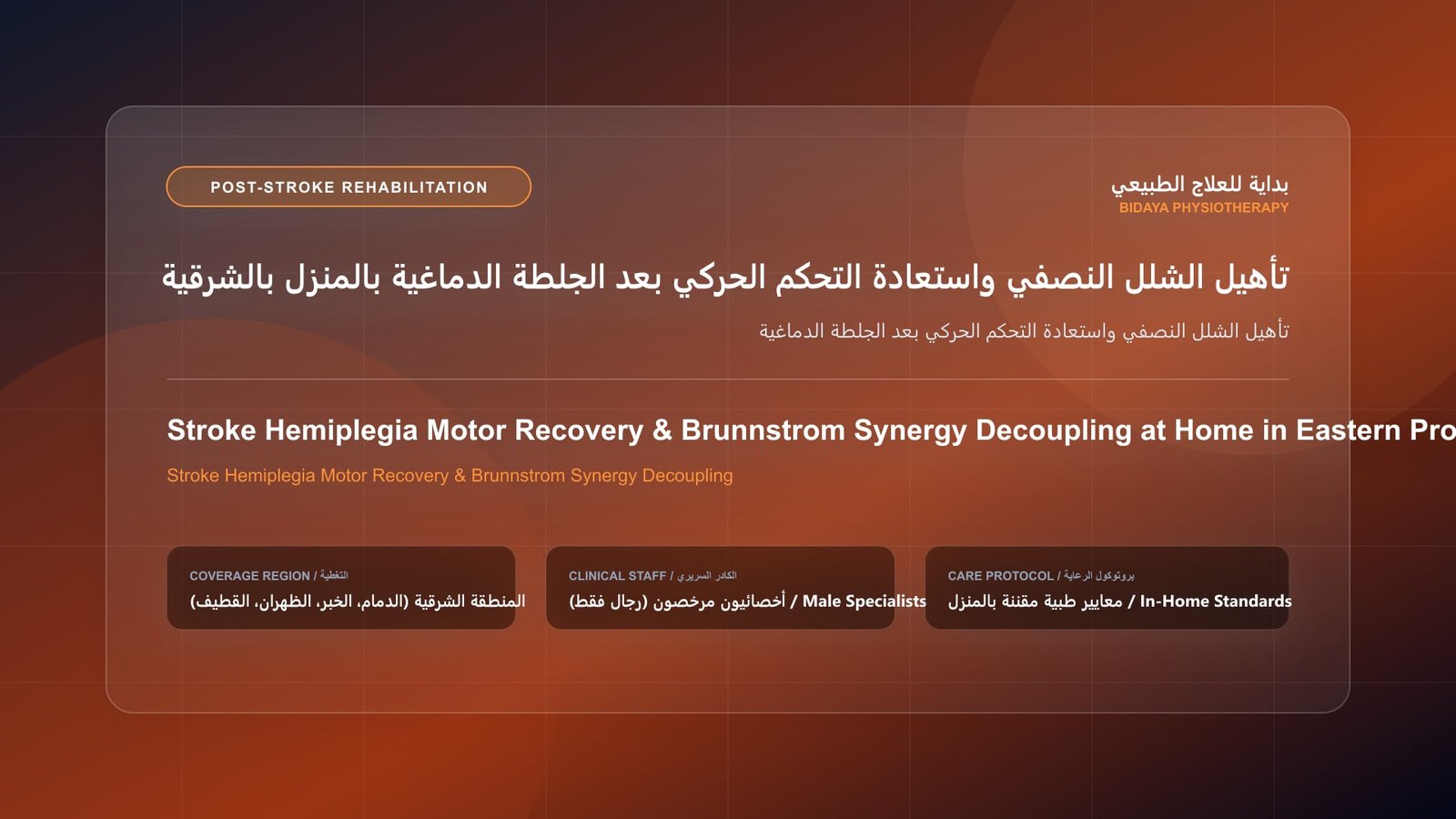
Stroke Hemiplegia Motor Recovery & Brunnstrom Synergy Decoupling
Advanced in-home physical therapy restoring ambulation, balance, and arm function after stroke by licensed male therapists.
Comprehensive In-Home Clinical Evaluation (60-75 Mins)
Detailed functional & neuro examination, home safety audit, and custom protocol with portable equipment — no upfront package commitments.
Flexible appointments 7 days a week (8 AM - 10 PM) • Payment upon visit completion
1,500+ Successful Home Recoveries
Certified Clinical Physiotherapists
Assessment-First Protocol
Thorough physical evaluation before any treatment plan starts
Specialized Male Therapists
Professional licensed therapists visiting your residence
100% In-Home Rehabilitation
No clinic travel friction or waiting room discomfort
Targeted Functional Goals
Focused on daily stairs, walking endurance, and independence
Emergency Medical Red-Flags & Home Care Boundaries
Emergency Notice: If new acute stroke symptoms appear—facial droop, arm weakness, slurred speech (FAST)—immediately call ambulance (997) for urgent hospital evaluation.
Stroke Hemiplegia Motor Recovery & Brunnstrom Synergy Decoupling represents a pivotal clinical focus within Bidaya's advanced post-stroke in-home rehabilitation framework in Eastern Province. We deliver intensive evidence-based motor relearning designed to induce neuroplastic reorganization and restore real-world functional tasks guided by licensed male clinicians.
Clinical Pathophysiology & Tissue Biomechanics for (Stroke Hemiplegia Motor Recovery & Brunnstrom Synergy Decoupling) in Eastern Province
Biomechanical Dysfunction, Tissue Overload, and Kinetic Chain Compensations
Addressing Stroke Hemiplegia Motor Recovery & Brunnstrom Synergy Decoupling forms a core clinical specialty within Bidaya's advanced residential rehabilitation programs across Eastern Province. Pathophysiologically, the primary disorder involves decussated lateral corticospinal tract, rubrospinal pathway, and hypertonic limb flexor/extensor muscle groups, expressing clinically as loss of selective fractionated movement dominated by stereotypic mass flexor and extensor synergies.
This tissue compromise alters kinetic force transmission through adjacent articulations, directly disrupting cerebral ischemia, mandatory synergistic coupling, failure of selective articulation, and gait distortion. In response, neighboring muscular sleeves enter sustained protective contraction to shield irritable structures, precipitating restricted range of motion, muscle ache, and difficulty lifting or manipulating domestic objects within the household environment.
Residential ergonomics across Eastern Province homes—such as low majlis floor seating and extended vehicle commutes in high ambient temperatures—magnify these mechanical stresses. Neglecting timely therapeutic intervention permits fibrotic periarticular adhesions and microcirculatory compromise to consolidate. Bidaya deploys targeted in-home mobilization and progressive stabilizer recruitment to dismantle these restrictions, restoring functional performance safely.
Our clinical methodology emphasizes evaluating patient tissue tolerance under authentic functional loading conditions. By examining patients within their actual living environment, clinicians identify and remediate domestic mechanical triggers with rigorous scientific precision, securing permanent functional recovery.
Comprehensive In-Home Diagnostic Assessment & Special Tests for (Stroke Hemiplegia Motor Recovery & Brunnstrom Synergy Decoupling)
Standardized Evaluation Battery: Precision Goniometry, MMT, and Provocation Tests
Our licensed male physical therapist in Eastern Province conducts an advanced kinetic chain examination analyzing both open and closed-kinetic-chain mechanics: 1. Dynamic shock absorption analysis across lower extremity articulations and spine during functional movement tasks. 2. Precision goniometric mapping recording active and passive joint excursion compared to normative anatomical benchmarks. 3. Standardized clinical provocation tests assessing ligamentous stability and periarticular tendon resilience. 4. Neuromuscular coordination screening identifying muscle inhibition or compensatory motor recruitment patterns in the home.
This detailed assessment isolates subtle biomechanical deficits, providing our clinician with clear data to formulate safe exercise angles.
The familiar domestic setting enables patients to perform movements naturally, reflecting real-world function and guiding targeted care.
Patients receive an in-depth clinical explanation of all findings alongside a structured functional progression roadmap.
Precision Baseline Documentation
Standardized objective metric recording during the initial home visit enables precise weekly progress quantification shared with your physician.
| Clinical Assessment Metric | Diagnostic Scope | Positive Diagnostic Finding | In-Home Clinical Gear |
|---|---|---|---|
| Stroke Rehabilitation Assessment of Movement (STREAM) | Scoring 30 voluntary limb movements, basic mobility, and transitional coordination | Subscale score dictating motor recovery tier and functional prognosis | Standardized STREAM rubric and digital inclinometer |
| Berg Balance Scale (BBS Neurological Battery) | 14-item dynamic equilibrium assessment from unsupported sitting to tandem stance | Score <45/56 denoting marked fall risk requiring strict caregiver supervision | Standard chair, stopwatch, and measuring tape |
| 10-Meter Walk Test (10MWT Speed Stratification) | Quantifying comfortable and fast gait velocity across residential corridors | Velocity <0.4 m/s classifying patient as domestic-only ambulatory | Standard 10-meter metric track and digital timer |
Evidence-Based Exercise Prescription & Staged Loading Protocol for (Stroke Hemiplegia Motor Recovery & Brunnstrom Synergy Decoupling)
Integrated Clinical Pathway Combining Manual Mobilization, Core Stabilization, and Kinetic Reconditioning
Our comprehensive in-home clinical rehabilitation program for (Stroke Hemiplegia Motor Recovery & Brunnstrom Synergy Decoupling) follows four structured progressive phases aimed at complete functional restoration: - Phase 1: Acute pain modulation and mechanical unloading of decussated lateral corticospinal tract, rubrospinal pathway, and hypertonic limb flexor/extensor muscle groups via gentle manual therapy, tissue gliding, and therapeutic cryotherapy. - Phase 2: Arthrokinematic restoration and soft tissue extensibility through prescribed therapeutic stretching and joint mobilization. - Phase 3: Dynamic muscular stabilization and progressive resistance training utilizing calibrated TheraBand elastic tubing and proprioceptive balance drills. - Phase 4: Functional movement retraining and conditioning ensuring safe, unrestricted resumption of household, professional, and recreational walking activities.
Our therapist objectively checks tissue response post-session to verify zero reactive symptom flare-ups, calibrating exercise volume to respect biological tissue tolerance and collagen synthesis rates.
Portable neuromuscular electrical stimulation (NMES) and therapeutic thermal modalities are deployed as clinically indicated to downregulate localized hyperalgesia and stimulate circulation, priming soft tissues for active reconditioning.
Throughout every stage, therapeutic dosage is precisely calibrated to stimulate tissue remodeling without triggering inflammatory setbacks. Our visiting male physical therapist continuously evaluates post-exercise tolerance, ensuring that mechanical loading promotes lasting joint resilience and neuromuscular adaptation.
Safe Loading Threshold Rule
Therapeutic exercise discomfort must not exceed 3/10 on the Visual Analog Scale and must completely subside within one hour post-session.
- Symmetrical bed edge orientation and assisted supine-to-sit transitional mechanics
- Lateral weight-shifting toward the hemiplegic side loading deep proprioceptors
- Axial trunk righting and midline realignment correcting pusher tendencies
- Caregiver instruction in clinical gait transfer belt application
Step-by-Step In-Home Exercise Execution Guide for (Stroke Hemiplegia Motor Recovery & Brunnstrom Synergy Decoupling)
Detailed Movement Mechanics, Postural Cues, and Repetition Guidelines for Independent Care
Disciplined execution of home physical therapy exercises tailored for (Stroke Hemiplegia Motor Recovery & Brunnstrom Synergy Decoupling) serves as the primary driver of lasting functional restoration:
1. Segmental Tension Relief & Arthrokinematic Gliding: Symmetrical seated weight-shift: sit at bedside, hands resting on thighs, slowly shift trunk weight toward paretic hip until loading is felt, hold 5s, 10 reps, 3 sets.
2. Myofascial Release & Elasticity Restoration: Active-assisted seated knee extension: upright sitting, elevate paretic lower leg into terminal extension with therapist guidance, hold 2s, slow lowering, 10 reps, 2 sets.
3. Dynamic Kinetic Chain Strengthening & Balance Integration: Supported stepping initiation: standing holding walker frame, initiate controlled forward step with sound limb while sustaining stable stance on paretic limb, 8 reps, 3 sets.
Our therapist corrects common kinematic compensations during the home visit, ensuring flawless execution before authorizing independent performance.
Executing drills in a calm environment with rhythmic breathing builds durable neuromuscular memory, safeguarding vulnerable articulations across years of daily activity.
Regular adherence to this targeted movement routine restores cellular matrix hydration and accelerates collagen reorganization, laying a permanent foundation for pain-free physical autonomy.
- Strictly avoid provocative faulty movement patterns, particularly: reinforcing pathological mass synergies to manipulate objects, solidifying dysfunctional cortical motor habits
- Perform all exercises on a dedicated firm plinth or exercise mat rather than soft cushioning
- Maintain uninterrupted diaphragmatic respiration, avoiding breath-holding (Valsalva) throughout exertion
- Document functional tolerance notes in your patient log for review during the next home visit
Domestic Environmental Adaptations & Daily Ergonomics in Eastern Province
Practical Biomechanical Strategies for Prayer, Soft Majlis Seating, and Highway Commuting
In-home physical therapy is integrated with practical environmental modifications tailored to residential architecture across Eastern Province: - Prayer Biomechanics: Training safe transitional mechanics during Ruku and Sujud, introducing temporary supportive seating when indicated while preserving joint engagement. - Transfers and Seating: Coaching hip-hinge sit-to-stand transitions powered by gluteal strength, avoiding soft low sofas that overload irritable tissues. - Highway Commuting: Adjusting vehicular lumbar and cervical angles to dissipate road vibration along Eastern Province expressways. - Sleep Ergonomics: Recommending orthopedic mattresses and supportive pillow placement to preserve neutral musculoskeletal alignment without focal pressure.
Visiting therapists inspect the immediate residential layout to provide immediate ergonomic recommendations concerning hallway pathways, bed mattress heights, and bathroom grab rails, safeguarding against repetitive movement fatigue.
Domestic environmental ergonomics are continuously refined during subsequent home visits as functional capacity improves. Our clinicians provide actionable strategies for navigating multi-story residential stairs, kitchen workstations, and leisure activities, ensuring your living space actively reinforces clinical gains.
- Deploy a locked wheelchair adjacent to bed to eliminate unsupervised transfer attempts
- Clear bathroom corridors of loose scatter rugs and electrical cords entirely
- Support paretic arm on an ergonomic lap tray or pillow during all seated periods
- Maintain consistent in-home physical therapy visits guided by Bidaya licensed male therapists
Clinical Recovery Milestones & Long-Term Recurrence Prevention for (Stroke Hemiplegia Motor Recovery & Brunnstrom Synergy Decoupling)
Transparent Objective Benchmarks Securing Permanent Movement Independence
Bidaya enforces rigorous, quantitative clinical discharge criteria ensuring patients conclude therapy with verified structural robustness: 1. Pain Modulation Benchmark: Consistently scoring below 2/10 on the Visual Analog Scale throughout the most strenuous daily routines. 2. Bilateral Strength Symmetry: Demonstrating isolated muscular strength reaching 90-95% of the healthy contralateral limb. 3. Complete Functional Independence: Executing unassisted prayer, stair climbing, vehicle transfers, and sustained walking without hesitation.
Upon graduating, each patient receives an individualized home exercise maintenance pamphlet to preserve long-term muscular balance.
Direct communication channels via our official coordination line (+20 109 707 9170) remain open for ongoing guidance, safeguarding lasting health.
Our definitive discharge benchmarks guarantee that patients transition to independent living with restored structural resilience. Ongoing communication support through Bidaya's dedicated coordination line ensures expert physical therapy guidance is always accessible whenever new functional questions arise.
Upper Extremity & Hand Dexterity Restoration Post-Stroke & Shoulder Pain Prevention
Grasp-and-Release Facilitation, Task-Oriented Manual Training & Glenohumeral Subluxation Care
Paretic upper extremity and hand motor restoration represents a pivotal functional frontier following stroke, owing to the expansive cortical representation of the hand and its vulnerability to flexion spasticity. Concurrently, paralysis of the supraspinatus and deltoid leaves the glenohumeral articulation vulnerable to gravity-induced inferior subluxation, precipitating hemiplegic shoulder pain syndrome if caregivers inadvertently apply traction during assisted transfers.
Bidaya's clinicians apply targeted protocols prioritizing manual humeral head realignment within the glenoid fossa, followed by task-oriented forward-reaching drills, elbow extension stabilization, and distal digital dexterity retraining utilizing everyday domestic implements.
This restorative protocol revives functional arm integration, restoring bilateral synergy in daily tasks.
Caregiver Safety Rule
Never pull, lift, or support a stroke patient by their paretic arm during transfers; traction triggers severe rotator cuff tears, subluxation, and complex regional pain.
- Support the paretic arm on an ergonomic lap tray or armrest pillow during all seated periods
- Perform gentle passive-assisted wrist and finger extension to counteract flexor spastic posturing
- Engage in functional grasp-and-release drills moving lightweight domestic objects across table heights
- Inspect sub-acromial sulcus spacing weekly to detect emergent glenohumeral subluxation early
Frequently Asked Questions about In-Home Physiotherapy
Ideally within 48 to 72 hours of arriving home to evaluate environmental safety, prevent secondary complications, and instruct caregivers.
Related Clinical & Regional Pathways
Post-Stroke Upper Extremity & Arm Motor Rehabilitation→
Advanced in-home physical therapy restoring ambulation
Post-Discharge In-Home Stroke Physical Therapy Assessment→
Advanced in-home physical therapy restoring ambulation
In-Home Stroke Hand Function, Finger Dexterity & Grasp Retraining→
Advanced in-home physical therapy restoring ambulation
Stroke Rehabilitation & Neurological Physiotherapy→
Evidence-based neurological rehabilitation engineered to stimulate corticomotor neuroplasticity
Neurological Physiotherapy→
Evidence-based neurological physical therapy harnessing neuroplasticity
Geriatric Physiotherapy & Fall Prevention→
Evidence-based clinical rehabilitation tailored specifically to preserve functional independence
Post-Stroke Spasticity Management & Functional Mobility Optimization→
Advanced in-home physical therapy restoring ambulation
Stroke Hemiplegic Shoulder Subluxation Management & Pain Relief→
Advanced in-home physical therapy restoring ambulation