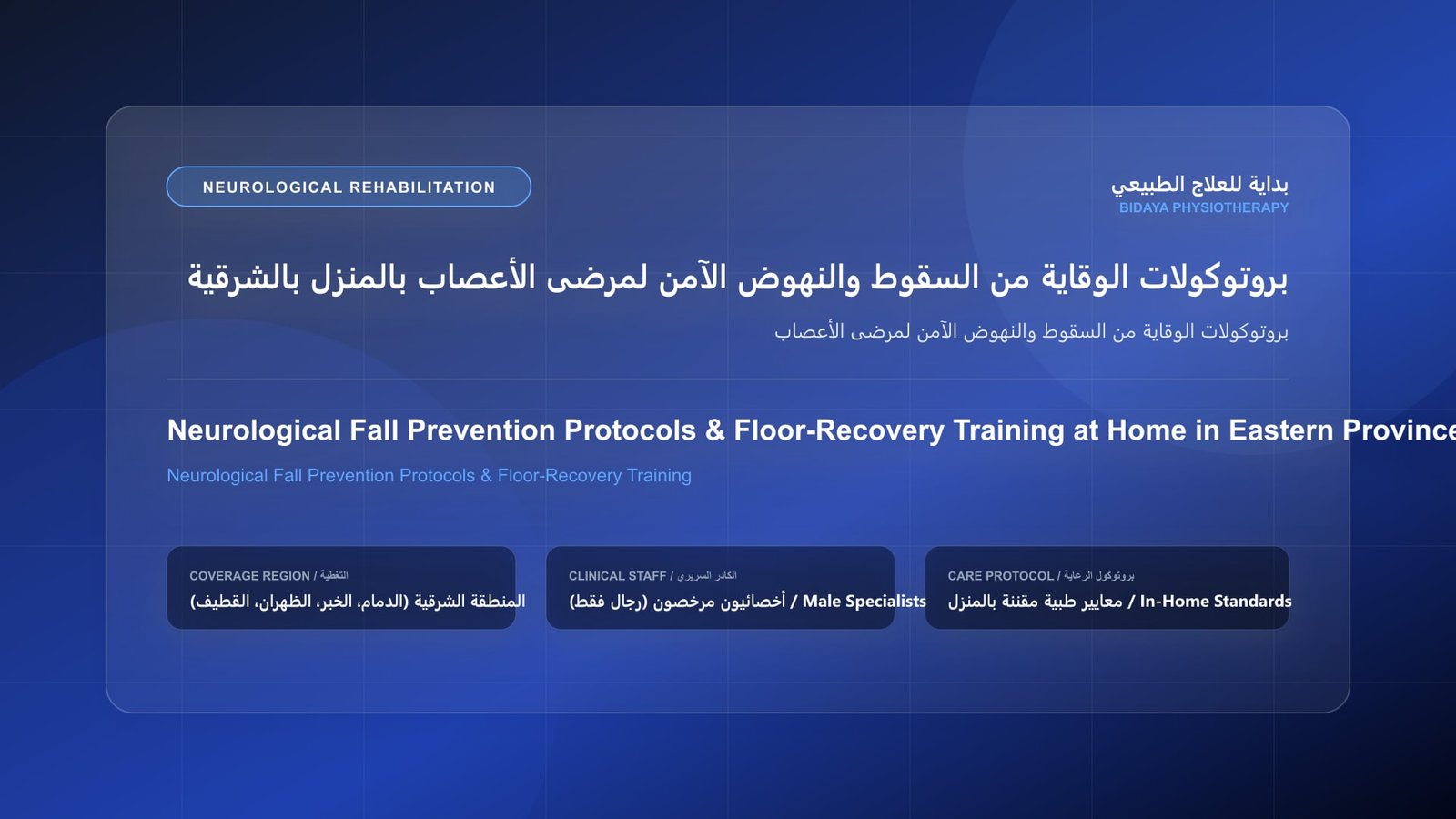
Neurological Fall Prevention Protocols & Floor-Recovery Training
Advanced in-home neuro-rehabilitation harnessing neuroplasticity and functional independence by licensed male therapists.
Comprehensive In-Home Clinical Evaluation (60-75 Mins)
Detailed functional & neuro examination, home safety audit, and custom protocol with portable equipment — no upfront package commitments.
Flexible appointments 7 days a week (8 AM - 10 PM) • Payment upon visit completion
1,500+ Successful Home Recoveries
Certified Clinical Physiotherapists
Assessment-First Protocol
Thorough physical evaluation before any treatment plan starts
Specialized Male Therapists
Professional licensed therapists visiting your residence
100% In-Home Rehabilitation
No clinic travel friction or waiting room discomfort
Targeted Functional Goals
Focused on daily stairs, walking endurance, and independence
Emergency Medical Red-Flags & Home Care Boundaries
If sudden emergent neurological deficits occur—facial drooping, acute arm weakness, slurred speech (FAST), or severe sudden headache—seek emergency medical evaluation immediately or call ambulance (997).
Neurological Fall Prevention Protocols & Floor-Recovery Training presents a significant neurological motor challenge demanding rigorous in-home physical therapy across Eastern Province. Bidaya provides an evidence-based clinical rehabilitation model designed to harness neuroplastic recovery and restore functional autonomy guided by licensed male clinicians.
Clinical Pathophysiology & Tissue Biomechanics for (Neurological Fall Prevention Protocols & Floor-Recovery Training) in Eastern Province
Biomechanical Dysfunction, Tissue Overload, and Kinetic Chain Compensations
Home physical therapy for Neurological Fall Prevention Protocols & Floor-Recovery Training by Bidaya provides patients throughout Eastern Province with focused, evidence-based orthopedic care. The central pathology affects protective upper and lower limb stepping reflexes, core musculature, and kinetic extensor chain strength, manifesting as attenuation of reactive compensatory stepping responses and inability to execute floor-to-stand recovery mechanics.
This tissue compromise distorts kinetic chain mechanics, directly impacting delayed reactive motor latency, ground impact, prolonged floor entrapment, and debilitating post-fall syndrome and triggering widespread compensatory muscular tightness. Patients commonly report significant movement hesitation, stiffness upon waking, and decreased physical endurance during daily routines.
Eastern Province living conditions, including long expressway journeys between Dammam, Khobar, and Jubail, impose continuous vibrational and postural stress on healing tissues. Bidaya's visiting male specialists remediate these challenges through progressive tissue mobilization, core stability training, and domestic ergonomic optimization.
Our patient-centered home care model bridges clinical expertise with real-world functional recovery, ensuring patients achieve permanent pain-free mobility in their everyday lives.
Comprehensive In-Home Diagnostic Assessment & Special Tests for (Neurological Fall Prevention Protocols & Floor-Recovery Training)
Standardized Evaluation Battery: Precision Goniometry, MMT, and Provocation Tests
Bidaya initiates clinical care with an exhaustive 60-minute diagnostic consultation conducted inside your residence in Eastern Province: 1. Thorough sensorimotor screening assessing dermatomal sensation and deep tendon reflexes to ensure clinical safety. 2. Precise inclinometric tracking quantifying directional motion restrictions compared to physiological norms. 3. High-sensitivity clinical provocation tests isolating exact pain-generating tissues and staging irritability. 4. Comprehensive kinetic chain analysis evaluating postural alignment during domestic movement transitions.
Conducting this standardized diagnostic battery within your home provides real-world biomechanical insight impossible in outpatient clinics, enabling our specialist to tailor an accurate recovery trajectory.
Visiting therapists arrive equipped with calibrated diagnostic tools, recording objective baseline measurements in an encrypted digital portal shared with your orthopedic physician for coordinated medical oversight.
Evaluating your functional movement within familiar surroundings removes travel-induced musculoskeletal tension, providing a reliable clinical baseline from which to monitor therapeutic progress. Every diagnostic finding is thoroughly discussed with you, fostering an informed and collaborative healing partnership.
Precision Baseline Documentation
Standardized objective metric recording during the initial home visit enables precise weekly progress quantification shared with your physician.
| Clinical Assessment Metric | Diagnostic Scope | Positive Diagnostic Finding | In-Home Clinical Gear |
|---|---|---|---|
| Trunk Impairment Scale (TIS Protocol) | Evaluating static and dynamic sitting balance alongside selective trunk coordination | Inability to maintain unsupported sitting balance without bilateral hand support | Standardized neurological TIS examination protocol |
| Fugl-Meyer Motor Assessment Battery | Quantifying selective motor recovery stages and decoupling from primitive mass synergies | Subscale score confirming moderate-to-severe voluntary movement dissociation | Complete neurological reflex hammer and goniometer kit |
| Timed Up and Go (TUG Neurological Protocol) | Measuring sit-to-stand, 3-meter walking, turning mechanics, and return to seated posture | Execution time >15 seconds accompanied by truncal deviation indicating high fall risk | Digital stopwatch and laser distance measure |
Evidence-Based Exercise Prescription & Staged Loading Protocol for (Neurological Fall Prevention Protocols & Floor-Recovery Training)
Integrated Clinical Pathway Combining Manual Mobilization, Core Stabilization, and Kinetic Reconditioning
Our home rehabilitation methodology for (Neurological Fall Prevention Protocols & Floor-Recovery Training) corrects mechanical alignment through four sequential clinical tiers: - Tier 1: Alleviating mechanical stress on protective upper and lower limb stepping reflexes, core musculature, and kinetic extensor chain strength and achieving resting comfort in seated and lying postures. - Tier 2: Releasing tissue adhesions and promoting tendon-bone gliding through safe therapeutic stretches. - Tier 3: Dynamic stabilizer recruitment building muscular stamina against repetitive daily physical stresses. - Tier 4: Demanding transfer retraining and prolonged outdoor walking with total postural stability.
Advancement criteria demand zero exercise-induced soreness and restored manual muscle testing scores.
These structured tiers build robust self-efficacy, allowing patients to navigate everyday routines with ease and comfort.
Safe Loading Threshold Rule
Therapeutic exercise discomfort must not exceed 3/10 on the Visual Analog Scale and must completely subside within one hour post-session.
- Edge-of-bed dynamic sitting posture stabilization recruiting deep core transversus abdominis
- Axial weight-bearing loading on paretic segments stimulating somatosensory afferents
- Visual biofeedback mirror training to restore bilateral sensorimotor alignment
- Domestic transitional transfer retraining between bed recumbency, sitting, and upright stance
Step-by-Step In-Home Exercise Execution Guide for (Neurological Fall Prevention Protocols & Floor-Recovery Training)
Detailed Movement Mechanics, Postural Cues, and Repetition Guidelines for Independent Care
Consistent engagement in targeted home rehabilitation exercises engineered for (Neurological Fall Prevention Protocols & Floor-Recovery Training) forms the foundation of permanent functional recovery:
1. Tissue Offloading & Dynamic Realignment Exercise: Unsupported seated trunk control: sit at edge of bed with grounded feet, extend arms forward, execute metered lateral weight shifts to right and left maintaining balance, 10 reps, 3 sets.
2. Myofascial Lengthening & Joint Mobility Drill: Neurological pelvic bridging: supine with knees flexed, elevate pelvis directing deliberate drive through the weaker heel with therapist guidance, hold 4s, 10 reps, 2 sets.
3. Dynamic Stabilizer Conditioning & Sensorimotor Retraining: Symmetrical sit-to-stand: seated on firm chair, symmetrical foot placement, lean trunk anteriorly (nose over toes), drive bilaterally into upright standing, 8 reps, 3 sets.
Clinicians emphasize controlled end-range holds and strict adherence to form before progressing volume, encouraging patients to log exercise tolerance for review during subsequent visits.
Patients are guided to perform drills at consistent daily hours to foster therapeutic habituation, with direct instructions to pause and notify Bidaya's clinical team should unexpected discomfort exceed predetermined safe boundaries.
Mastering these prescribed movements under professional guidance ensures deep postural stabilizers fire in correct chronological sequence, permanently eliminating painful mechanical compensations from your daily routine.
- Strictly avoid provocative faulty movement patterns, particularly: forcefully pulling fallen patient directly to feet prior to palpating hip and spine to rule out occult femoral neck fracture
- Perform all exercises on a dedicated firm plinth or exercise mat rather than soft cushioning
- Maintain uninterrupted diaphragmatic respiration, avoiding breath-holding (Valsalva) throughout exertion
- Document functional tolerance notes in your patient log for review during the next home visit
Domestic Environmental Adaptations & Daily Ergonomics in Eastern Province
Practical Biomechanical Strategies for Prayer, Soft Majlis Seating, and Highway Commuting
Targeted environmental adjustments across your residence in Eastern Province provide continuous biomechanical protection accelerating recovery for (Neurological Fall Prevention Protocols & Floor-Recovery Training): - Prayer Biomechanics Coaching: Modulating transitional angles to offload irritable articulations, enabling a safe progression back to floor prayer. - Desk & Screen Ergonomics: Positioning digital workstations to foster upright spinal neutrality and scheduling regular active standing micro-breaks. - Vehicle Ergonomic Profiling: Installing supportive lumbar cushioning and optimizing steering distance to minimize joint fatigue during heavy traffic. - Restorative Sleeping Posture: Selecting appropriate mattress firmness and contoured head support to ensure waking with zero morning gel.
Proactive domestic ergonomic optimization reduces recurrent injury risks by over 85%, granting you lasting confidence and physical independence.
Personalized environmental adjustments bridge the transition between clinical exercise sessions and uninhibited everyday life. By systematically addressing residential movement bottlenecks, our team empowers patients to navigate their domestic routines with complete mechanical ease.
- Install sturdy grab rails adjacent to bed and shower stall for secure transitional transfers
- Eliminate loose scatter rugs and conceal electrical cords from walking corridors
- Ensure ambient lighting in hallways is bright and free of deceptive shadows
- Adhere strictly to individualized home exercise routines guided by Bidaya male physical therapists
Clinical Recovery Milestones & Long-Term Recurrence Prevention for (Neurological Fall Prevention Protocols & Floor-Recovery Training)
Transparent Objective Benchmarks Securing Permanent Movement Independence
Bidaya defines transparent, objective discharge benchmarks ensuring clinical care concludes only after permanent functional independence is attained: 1. Functional Pain Modulation: Sustained pain reduction to minimal baseline levels (0-2/10) throughout all domestic and professional activities. 2. Muscular Endurance Restoration: Ability to maintain dynamic joint stabilization for two consecutive minutes without compensatory movement. 3. Complete Movement Autonomy: Confident execution of prayer postures, vehicular transfers, and stair climbing without external assistance.
Upon clinical discharge, every patient receives a personalized digital home maintenance guide detailing independent exercises to execute twice weekly to protect musculoskeletal health indefinitely.
Direct communication channels remain permanently accessible via official WhatsApp and phone, ensuring patients receive ongoing support to maintain an active, uninhibited lifestyle across future years.
Long-term joint health requires sustained commitment to preventive movement habits. Bidaya's clinical team conducts scheduled three-month and six-month telephone follow-up reviews, monitoring functional status and providing timely adjustments to your home maintenance regimen to ensure permanent pain-free living.
Management of Spastic Hypertonia & Prevention of Fixed Musculoskeletal Contractures
Sustained Mechanical Loading, Inhibitory Neuro-Facilitation & Anti-Synergy Positioning
Spastic hypertonia arising from upper motor neuron lesions constitutes a formidable barrier to functional independence, frequently precipitating disabling joint deformities if neglected. Loss of descending cortical inhibition produces exaggerated stretch reflexes and continuous involuntary co-contraction—predominantly in upper extremity flexors and lower extremity extensors—locking articular segments into non-functional postures that impede dressing and hygiene.
Bidaya's visiting physical therapists apply neuro-inhibitory modalities, including sustained axial weight-bearing on paretic segments, anti-synergistic bed positioning, and prolonged low-load mechanical stretching that recruits Golgi tendon organ autogenic inhibition to downregulate hyperactive alpha motor neurons.
Our clinicians educate family caregivers on customized supportive pillow placement and daily passive range-of-motion maintenance, safeguarding capsular compliance and tendon elasticity against irreversible shortening.
Contracture Prevention Warning
Failing to maintain daily sustained stretching in spastic limbs can transition dynamic neurological hypertonia into irreversible structural myofascial contractures within weeks.
- Execute sustained slow stretches holding terminal angles for 60 to 90 seconds per muscle group
- Employ functional resting splints to maintain neutral ankle dorsiflexion and wrist alignment
- Instruct family caregivers in gentle joint handling that avoids triggering hyperactive stretch reflexes
- Prohibit prolonged knee flexion bolsters in bed to safeguard against knee flexion contractures
Frequently Asked Questions about In-Home Physiotherapy
It comprises a comprehensive 60-minute clinical evaluation of voluntary motor strength, spastic tone, deep tendon reflexes, dynamic equilibrium, and domestic hazard analysis to tailor a personalized recovery plan.
Related Clinical & Regional Pathways
Comprehensive In-Home Neurological Physical Therapy Assessment→
Advanced in-home neuro-rehabilitation harnessing neuroplasticity and functional independence by licensed male therapists
In-Home Environment Adaptation & Equipment Prescription for Neuro Patients→
Advanced in-home neuro-rehabilitation harnessing neuroplasticity and functional independence by licensed male therapists
In-Home Rehabilitation for Neurogenic Muscle Weakness & Paretic Deficits→
Advanced in-home neuro-rehabilitation harnessing neuroplasticity and functional independence by licensed male therapists
Neurological Physiotherapy→
Evidence-based neurological physical therapy harnessing neuroplasticity