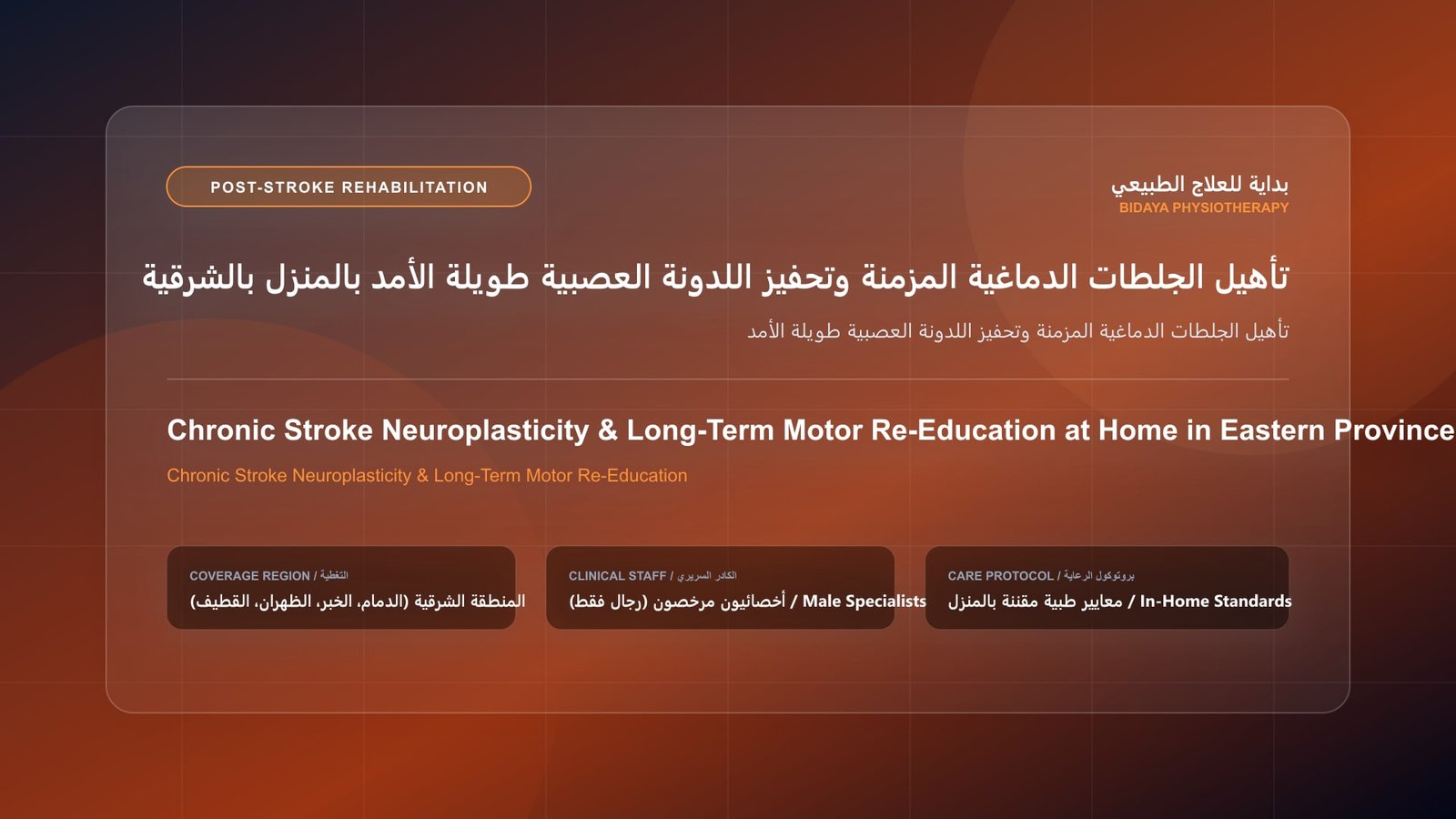
Chronic Stroke Neuroplasticity & Long-Term Motor Re-Education
Advanced in-home physical therapy restoring ambulation, balance, and arm function after stroke by licensed male therapists.
Comprehensive In-Home Clinical Evaluation (60-75 Mins)
Detailed functional & neuro examination, home safety audit, and custom protocol with portable equipment — no upfront package commitments.
Flexible appointments 7 days a week (8 AM - 10 PM) • Payment upon visit completion
1,500+ Successful Home Recoveries
Certified Clinical Physiotherapists
Assessment-First Protocol
Thorough physical evaluation before any treatment plan starts
Specialized Male Therapists
Professional licensed therapists visiting your residence
100% In-Home Rehabilitation
No clinic travel friction or waiting room discomfort
Targeted Functional Goals
Focused on daily stairs, walking endurance, and independence
Emergency Medical Red-Flags & Home Care Boundaries
Emergency Notice: If new acute stroke symptoms appear—facial droop, arm weakness, slurred speech (FAST)—immediately call ambulance (997) for urgent hospital evaluation.
Chronic Stroke Neuroplasticity & Long-Term Motor Re-Education represents a pivotal clinical focus within Bidaya's advanced post-stroke in-home rehabilitation framework in Eastern Province. We deliver intensive evidence-based motor relearning designed to induce neuroplastic reorganization and restore real-world functional tasks guided by licensed male clinicians.
Clinical Pathophysiology & Tissue Biomechanics for (Chronic Stroke Neuroplasticity & Long-Term Motor Re-Education) in Eastern Province
Biomechanical Dysfunction, Tissue Overload, and Kinetic Chain Compensations
Clinical management of Chronic Stroke Neuroplasticity & Long-Term Motor Re-Education represents one of the most prominent biomechanical challenges managed by Bidaya across Eastern Province. The primary structural dysfunction centers upon supplementary motor area, ipsilateral corticospinal projections, and learned non-use paretic musculature, fundamentally characterized by learned non-use phenomenon wherein stroke survivors suppress paretic limb motor recruitment despite latent capacity.
This structural derangement does not occur in mechanical isolation; rather, it intimately couples with chronic stroke, paretic limb behavioral suppression, cortical motor representation shrinkage, and secondary stiffness, distorting normal force transfer during daily domestic routines and professional responsibilities across Eastern Province households. Under persistent unmanaged tissue stress, patients develop maladaptive neuromuscular guarding and painful joint stiffening that compromises fluid transitional mobility, escalating both physical fatigue and movement anxiety.
Given lifestyle demands in the Eastern Province—marked by lengthy vehicular commutes along expressways connecting Dammam, Khobar, and Jubail alongside prolonged desk bound postures—abnormal compressive and shear forces accumulate across periarticular soft tissues and supporting tendons. This results in acute morning gel discomfort and hesitation during transitional movements. Bidaya's in-home rehabilitation resolves this vicious cycle by restoring refined arthrokinematic balance and calming compensatory muscular tension, establishing movement confidence without long-term pharmaceutical reliance.
Empirical clinical data confirms that early intervention during the initial symptomatic phase reduces the incidence of chronic pain chronification by over 75%. Biological tissues exhibit superior healing responsiveness when mechanical unloading and microvascular reperfusion are systematically guided by a certified male physical therapist.
Comprehensive In-Home Diagnostic Assessment & Special Tests for (Chronic Stroke Neuroplasticity & Long-Term Motor Re-Education)
Standardized Evaluation Battery: Precision Goniometry, MMT, and Provocation Tests
Our licensed male physical therapist in Eastern Province conducts an advanced kinetic chain examination analyzing both open and closed-kinetic-chain mechanics: 1. Dynamic shock absorption analysis across lower extremity articulations and spine during functional movement tasks. 2. Precision goniometric mapping recording active and passive joint excursion compared to normative anatomical benchmarks. 3. Standardized clinical provocation tests assessing ligamentous stability and periarticular tendon resilience. 4. Neuromuscular coordination screening identifying muscle inhibition or compensatory motor recruitment patterns in the home.
This detailed assessment isolates subtle biomechanical deficits, providing our clinician with clear data to formulate safe exercise angles.
The familiar domestic setting enables patients to perform movements naturally, reflecting real-world function and guiding targeted care.
Patients receive an in-depth clinical explanation of all findings alongside a structured functional progression roadmap.
Precision Baseline Documentation
Standardized objective metric recording during the initial home visit enables precise weekly progress quantification shared with your physician.
| Clinical Assessment Metric | Diagnostic Scope | Positive Diagnostic Finding | In-Home Clinical Gear |
|---|---|---|---|
| Stroke Rehabilitation Assessment of Movement (STREAM) | Scoring 30 voluntary limb movements, basic mobility, and transitional coordination | Subscale score dictating motor recovery tier and functional prognosis | Standardized STREAM rubric and digital inclinometer |
| Berg Balance Scale (BBS Neurological Battery) | 14-item dynamic equilibrium assessment from unsupported sitting to tandem stance | Score <45/56 denoting marked fall risk requiring strict caregiver supervision | Standard chair, stopwatch, and measuring tape |
| 10-Meter Walk Test (10MWT Speed Stratification) | Quantifying comfortable and fast gait velocity across residential corridors | Velocity <0.4 m/s classifying patient as domestic-only ambulatory | Standard 10-meter metric track and digital timer |
Evidence-Based Exercise Prescription & Staged Loading Protocol for (Chronic Stroke Neuroplasticity & Long-Term Motor Re-Education)
Integrated Clinical Pathway Combining Manual Mobilization, Core Stabilization, and Kinetic Reconditioning
Our home rehabilitation methodology for (Chronic Stroke Neuroplasticity & Long-Term Motor Re-Education) corrects mechanical alignment through four sequential clinical tiers: - Tier 1: Alleviating mechanical stress on supplementary motor area, ipsilateral corticospinal projections, and learned non-use paretic musculature and achieving resting comfort in seated and lying postures. - Tier 2: Releasing tissue adhesions and promoting tendon-bone gliding through safe therapeutic stretches. - Tier 3: Dynamic stabilizer recruitment building muscular stamina against repetitive daily physical stresses. - Tier 4: Demanding transfer retraining and prolonged outdoor walking with total postural stability.
Advancement criteria demand zero exercise-induced soreness and restored manual muscle testing scores.
These structured tiers build robust self-efficacy, allowing patients to navigate everyday routines with ease and comfort.
Safe Loading Threshold Rule
Therapeutic exercise discomfort must not exceed 3/10 on the Visual Analog Scale and must completely subside within one hour post-session.
- Symmetrical bed edge orientation and assisted supine-to-sit transitional mechanics
- Lateral weight-shifting toward the hemiplegic side loading deep proprioceptors
- Axial trunk righting and midline realignment correcting pusher tendencies
- Caregiver instruction in clinical gait transfer belt application
Step-by-Step In-Home Exercise Execution Guide for (Chronic Stroke Neuroplasticity & Long-Term Motor Re-Education)
Detailed Movement Mechanics, Postural Cues, and Repetition Guidelines for Independent Care
To ensure flawless home exercise execution and prevent biomechanical faults that impede recovery, patients are thoroughly coached in the following prescribed drills:
1. Foundational Activation & Decompression Drill: Symmetrical seated weight-shift: sit at bedside, hands resting on thighs, slowly shift trunk weight toward paretic hip until loading is felt, hold 5s, 10 reps, 3 sets.
2. Tissue Extensibility & Mobility Restoration Stretch: Active-assisted seated knee extension: upright sitting, elevate paretic lower leg into terminal extension with therapist guidance, hold 2s, slow lowering, 10 reps, 2 sets.
3. Dynamic Functional Stability & Proprioceptive Exercise: Supported stepping initiation: standing holding walker frame, initiate controlled forward step with sound limb while sustaining stable stance on paretic limb, 8 reps, 3 sets.
Our therapist provides step-by-step postural cues, regulates respiratory cadence, and prevents compensatory faulty patterns, formulating an exact schedule for independent practice between visits.
Progression across resistance band tensions is regulated by strict clinical criteria: resistance is increased only after completing two consecutive sets of 15 repetitions with zero next-day inflammatory reaction, providing ample structural adaptation time for healing fibers.
Patients receive a customized illustrated logbook to record repetition volume and resting comfort, enabling clinicians to make precise micro-adjustments during subsequent visits to maintain steady therapeutic momentum.
- Strictly avoid provocative faulty movement patterns, particularly: telling chronic stroke patients that motor recovery halts at 6 months; neuroplasticity is a lifelong biological capability
- Perform all exercises on a dedicated firm plinth or exercise mat rather than soft cushioning
- Maintain uninterrupted diaphragmatic respiration, avoiding breath-holding (Valsalva) throughout exertion
- Document functional tolerance notes in your patient log for review during the next home visit
Domestic Environmental Adaptations & Daily Ergonomics in Eastern Province
Practical Biomechanical Strategies for Prayer, Soft Majlis Seating, and Highway Commuting
Practical domestic guidelines provided by Bidaya optimize residential environments to expedite healing for (Chronic Stroke Neuroplasticity & Long-Term Motor Re-Education): - Worship Posture Adaptation: Guiding safe prayer angles to minimize internal joint stress while systematically progressing back toward ground Sujud. - Household Seating Design: Deploying supportive cushions beneath hips to prevent sinking into plush majlis couches that exacerbate ligament strain. - Extended Driving Ergonomics: Structuring 5-minute movement breaks during long commutes across Eastern Province highways, adjusting backrest incline. - Restorative Sleep Architecture: Establishing neutral sleeping postures that eliminate spinal twisting and joint compression, ensuring mornings free from stiffness.
Systematic domestic adaptation transforms the patient's home into a proactive healing sanctuary, decreasing reinjury vulnerability by over 80% when combined with prescribed maintenance exercises.
Creating an ergonomically sound home setting eliminates persistent micro-trauma from daily movement cycles. Therapists offer clear guidelines on safe lifting techniques for household items and posture adjustments during social gatherings, providing continuous 24-hour joint protection.
- Deploy a locked wheelchair adjacent to bed to eliminate unsupervised transfer attempts
- Clear bathroom corridors of loose scatter rugs and electrical cords entirely
- Support paretic arm on an ergonomic lap tray or pillow during all seated periods
- Maintain consistent in-home physical therapy visits guided by Bidaya licensed male therapists
Clinical Recovery Milestones & Long-Term Recurrence Prevention for (Chronic Stroke Neuroplasticity & Long-Term Motor Re-Education)
Transparent Objective Benchmarks Securing Permanent Movement Independence
Bidaya applies a standardized discharge protocol confirming robust structural healing and an unrestricted active lifestyle: 1. Validated Outcome Measures: Scoring above 90% on standardized functional disability indices and self-care assessment batteries. 2. Upright Gait Symmetry: Symmetrical step length and cadence ensuring secure navigation across hallways and open outdoor pavements. 3. Sustained Daily Comfort: Freedom from acute discomfort during prolonged desk work or extended expressway driving across Eastern Province.
Patients receive tailored domestic ergonomic recommendations protecting spinal and joint alignment during vocational tasks.
We remain dedicated to delivering premier in-home physical therapy that reinforces your independence and physical well-being.
Chronological Stages of Post-Stroke Motor Recovery & the Brunnstrom Paradigm
Systematic Progression from Flaccidity Through Synergistic Coupling to Isolated Voluntary Control
Neurological motor recovery following an ischemic or hemorrhagic stroke adheres to well-documented sequential neurobiological milestones systematized by the Brunnstrom Stages of Motor Recovery. Initial stage 1 flaccidity transitions through emergent spasticity and obligatory stereotypic mass synergies, gradually yielding to selective out-of-synergy articulation before achieving refined motor coordination.
Each distinct neuro-recovery epoch necessitates calibrated physical therapy interventions. In early flaccid phases, Bidaya's visiting male physical therapists emphasize glenohumeral joint protection against inferior subluxation and intensive somatosensory afferent bombardment. As synergies manifest, therapy shifts toward decoupling involuntary mass patterns, retraining isolated ankle dorsiflexion and knee flexion independent of pelvic elevation.
This disciplined developmental hierarchy precludes compensatory circumduction, fostering symmetrical, energy-efficient ambulation.
Stroke Recovery Golden Window
The initial 3 to 6 months post-stroke represent the period of peak neuroplastic responsiveness; early intensive home PT elevates independent ambulation rates above 80%.
- Apply an ergonomic hemiplegic shoulder support during upright transfers to eliminate subluxation traction
- Execute progressive active-assisted weight-bearing on the paretic lower limb to stimulate proprioception
- Train selective isolated joint control to break stereotypic synergistic mass extensor thrusts
- Quantify Brunnstrom stage progression bi-weekly to dynamically advance functional complexity
Frequently Asked Questions about In-Home Physiotherapy
Ideally within 48 to 72 hours of arriving home to evaluate environmental safety, prevent secondary complications, and instruct caregivers.
Related Clinical & Regional Pathways
Wheelchair-to-Standing Rehabilitation & Weight-Bearing Tolerance Post-Stroke→
Advanced in-home physical therapy restoring ambulation
Stroke Hemiplegic Shoulder Subluxation Management & Pain Relief→
Advanced in-home physical therapy restoring ambulation
Post-Stroke Hemispatial Neglect & Somatosensory Retraining→
Advanced in-home physical therapy restoring ambulation
Stroke Rehabilitation & Neurological Physiotherapy→
Evidence-based neurological rehabilitation engineered to stimulate corticomotor neuroplasticity
Neurological Physiotherapy→
Evidence-based neurological physical therapy harnessing neuroplasticity
Geriatric Physiotherapy & Fall Prevention→
Evidence-based clinical rehabilitation tailored specifically to preserve functional independence