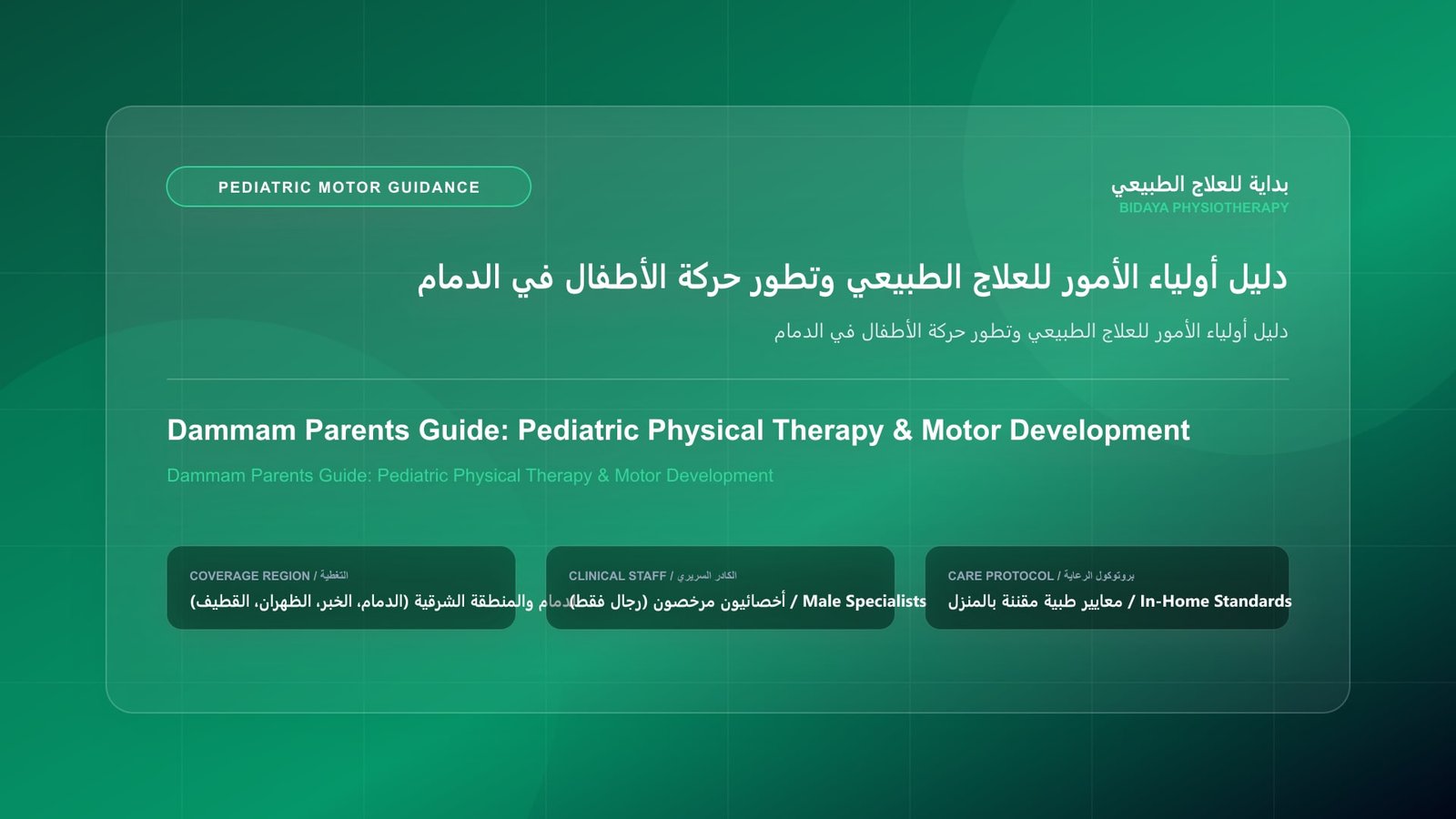
Khobar Parents Guide: Pediatric Physical Therapy & Motor Development
Evidence-based parental guidance and domestic play adaptations supporting healthy motor milestone progression safely.
Comprehensive In-Home Clinical Evaluation (60-75 Mins)
Detailed functional & neuro examination, home safety audit, and custom protocol with portable equipment — no upfront package commitments.
Flexible appointments 7 days a week (8 AM - 10 PM) • Payment upon visit completion
1,500+ Successful Home Recoveries
Certified Clinical Physiotherapists
Assessment-First Protocol
Thorough physical evaluation before any treatment plan starts
Specialized Male Therapists
Professional licensed therapists visiting your residence
100% In-Home Rehabilitation
No clinic travel friction or waiting room discomfort
Targeted Functional Goals
Focused on daily stairs, walking endurance, and independence
Emergency Medical Red-Flags & Home Care Boundaries
Important Clinical Notice: This content provides educational guidance and home motor positioning for families. If sudden regression of motor milestones, infantile spasms, or extreme lethargy with respiratory/feeding distress occurs, seek urgent pediatric medical evaluation or dial emergency (997).
This specialized family guide for Khobar Parents Guide: Pediatric Physical Therapy & Motor Development provides evidence-based practical recommendations empowering Eastern Province parents to cultivate a domestically stimulating gross motor environment. We emphasize transforming therapeutic exercises into engaging play and ergonomic positioning guided by licensed male clinicians.
Clinical Pathophysiology & Tissue Biomechanics for (Khobar Parents Guide: Pediatric Physical Therapy & Motor Development) in Dammam & Eastern Province
Biomechanical Dysfunction, Tissue Overload, and Kinetic Chain Compensations
Bidaya's advanced residential clinical protocol for Khobar Parents Guide: Pediatric Physical Therapy & Motor Development delivers comprehensive functional restoration throughout Dammam & Eastern Province. The primary anatomical disturbance involves pediatric developmental milestones, kinetic alignment, and family villas in Khobar, expressing clinically as parent inquiries in Khobar regarding delayed walking, toe walking, and ergonomic home support.
This mechanical insufficiency disturbs harmonious kinetic force transmission, placing excessive compensatory stress upon rehabilitation guidance, directed developmental games, licensed male clinicians, and growth support. As a consequence, patients develop chronic postural guarding, reduced joint lubrication, and progressive movement apprehension during everyday domestic tasks.
Daily routines in Eastern Province households, from prolonged prayer Sujud to navigating multi-level residences, require optimal biomechanical resilience. Visiting therapists provide precision manual techniques and individualized therapeutic exercises directly within the home, dismantling mechanical restrictions safely.
Empirical rehabilitation data demonstrates that guided home physical therapy yields superior functional recovery by retraining movement patterns in the exact environment where daily activities occur.
Comprehensive In-Home Diagnostic Assessment & Special Tests for (Khobar Parents Guide: Pediatric Physical Therapy & Motor Development)
Standardized Evaluation Battery: Precision Goniometry, MMT, and Provocation Tests
Bidaya deploys a rigorous in-home clinical diagnostic protocol in Dammam & Eastern Province led by a licensed male clinician: 1. Joint stress tolerance testing under progressive dynamic loads identifying structural vulnerability and postural sway. 2. Digital inclinometer tracking measuring active and passive excursion across multi-planar movement arcs. 3. Specialized sensory provocation maneuvers categorizing tissue irritability and establishing safe training thresholds. 4. Movement pattern analysis during sit-to-stand, stair ascent, and corridor walking detecting compensatory gait faults.
This authentic on-site examination resolves underlying biomechanical drivers rather than merely masking transient discomfort.
Our therapist carries an advanced mobile clinical diagnostic suite delivering tertiary-level assessments directly to your residence.
Immediate ergonomic recommendations for residential seating and sleeping arrangements are provided to optimize recovery from day one.
Precision Baseline Documentation
Standardized objective metric recording during the initial home visit enables precise weekly progress quantification shared with your physician.
| Clinical Assessment Metric | Diagnostic Scope | Positive Diagnostic Finding | In-Home Clinical Gear |
|---|---|---|---|
| Peabody Developmental Motor Scales (PDMS-2 Gross Motor Subtests) | Quantifying reflexes, stationary balance, locomotion, and object manipulation | Determining motor quotient relative to chronological age percentiles | Standardized PDMS developmental test kit and timer |
| Gross Motor Function Measure (GMFM-88 / GMFM-66 Scoring Battery) | Assessing 88 developmental motor items from rolling/sitting to walking/jumping | Percentage score tracking functional developmental trajectory over time | Non-slip floor mat and standardized developmental bench |
| Gross Motor Function Classification System (GMFCS Tier Stratification) | Classifying domestic and community ambulatory independence from Level I to Level V | Guiding domestic environmental adaptation and orthotic seating prescription | Standardized pediatric GMFCS rubric |
Evidence-Based Exercise Prescription & Staged Loading Protocol for (Khobar Parents Guide: Pediatric Physical Therapy & Motor Development)
Integrated Clinical Pathway Combining Manual Mobilization, Core Stabilization, and Kinetic Reconditioning
Engineered to deliver permanent recovery, Bidaya's residential clinical pathway for (Khobar Parents Guide: Pediatric Physical Therapy & Motor Development) advances through four systematic biological loading tiers: - Tier 1: Acute tissue preservation and spasm downregulation around pediatric developmental milestones, kinetic alignment, and family villas in Khobar via gentle manual distraction and positional unloading. - Tier 2: Neuromuscular re-education activating inhibited stabilizer groups and restoring symmetrical force coupling. - Tier 3: Functional capacity expansion subjecting tissues to progressive mechanical load matching authentic daily demands. - Tier 4: Unrestricted domestic reintegration achieving effortless prayer transitions, Sujud, and extended vehicle driving.
Transitioning across tiers demands fulfilling rigorous clinical criteria, confirming genuine structural adaptation and objective strength recovery.
Therapists provide dedicated clinical exercise gear for home use, personally coaching biomechanical form to guarantee hospital-grade rehabilitation in residential comfort.
Each therapeutic tier is engineered to restore optimal load distribution across affected joints and adjacent kinetic segments. This comprehensive conditioning protocol permanently eliminates compensatory movement habits, shielding healing tissues from repetitive mechanical strain.
Safe Loading Threshold Rule
Therapeutic exercise discomfort must not exceed 3/10 on the Visual Analog Scale and must completely subside within one hour post-session.
- Play-based prone tummy time strengthening cervical extensors and shoulder stability
- Transitional floor play facilitating symmetric quadruped crawling via visual toy prompts
- Gentle gastrocnemius-soleus passive-active lengthening during engaging story reading
- Supported lateral cruising along domestic furniture strengthening pelvic stabilizers
Step-by-Step In-Home Exercise Execution Guide for (Khobar Parents Guide: Pediatric Physical Therapy & Motor Development)
Detailed Movement Mechanics, Postural Cues, and Repetition Guidelines for Independent Care
Consistent engagement in targeted home rehabilitation exercises engineered for (Khobar Parents Guide: Pediatric Physical Therapy & Motor Development) forms the foundation of permanent functional recovery:
1. Tissue Offloading & Dynamic Realignment Exercise: Supported prone tummy time play: place infant prone with small soft bolster under upper chest, positioning colorful musical toys ahead to encourage active head lifting and forearm propping, 5 minutes twice daily.
2. Myofascial Lengthening & Joint Mobility Drill: Supported lateral cruising drill: stand child holding a low sturdy living room table, place favorite toy at table edge prompting lateral weight shifting and sidestepping, 10 steps each side, 3 sets.
3. Dynamic Stabilizer Conditioning & Sensorimotor Retraining: Playful squat-to-stand floor toy retrieval: standing supported, prompt child to squat with heels resting flat on the floor to pick up a toy from the carpet then return to full standing, 8 reps, 2 sets.
Clinicians emphasize controlled end-range holds and strict adherence to form before progressing volume, encouraging patients to log exercise tolerance for review during subsequent visits.
Patients are guided to perform drills at consistent daily hours to foster therapeutic habituation, with direct instructions to pause and notify Bidaya's clinical team should unexpected discomfort exceed predetermined safe boundaries.
Mastering these prescribed movements under professional guidance ensures deep postural stabilizers fire in correct chronological sequence, permanently eliminating painful mechanical compensations from your daily routine.
- Strictly avoid provocative faulty movement patterns, particularly: relying on unverified social media motor advice while bypassing evidence-based clinical guidance
- Perform all exercises on a dedicated firm plinth or exercise mat rather than soft cushioning
- Maintain uninterrupted diaphragmatic respiration, avoiding breath-holding (Valsalva) throughout exertion
- Document functional tolerance notes in your patient log for review during the next home visit
Domestic Environmental Adaptations & Daily Ergonomics in Dammam & Eastern Province
Practical Biomechanical Strategies for Prayer, Soft Majlis Seating, and Highway Commuting
Targeted environmental adjustments across your residence in Dammam & Eastern Province provide continuous biomechanical protection accelerating recovery for (Khobar Parents Guide: Pediatric Physical Therapy & Motor Development): - Prayer Biomechanics Coaching: Modulating transitional angles to offload irritable articulations, enabling a safe progression back to floor prayer. - Desk & Screen Ergonomics: Positioning digital workstations to foster upright spinal neutrality and scheduling regular active standing micro-breaks. - Vehicle Ergonomic Profiling: Installing supportive lumbar cushioning and optimizing steering distance to minimize joint fatigue during heavy traffic. - Restorative Sleeping Posture: Selecting appropriate mattress firmness and contoured head support to ensure waking with zero morning gel.
Proactive domestic ergonomic optimization reduces recurrent injury risks by over 85%, granting you lasting confidence and physical independence.
Personalized environmental adjustments bridge the transition between clinical exercise sessions and uninhibited everyday life. By systematically addressing residential movement bottlenecks, our team empowers patients to navigate their domestic routines with complete mechanical ease.
- Strictly avoid suspended wheeled circular baby walkers which elevate fall risks and reinforce toe-walking
- Designate a safe, cushioned domestic floor zone using thick non-toxic foam tiles encouraging spontaneous floor crawling
- Embed functional motor exercises into natural daily routines like bathing, dressing, and storytime without clinical pressure
- Consult specialized pediatric physicians or licensed therapists upon noticing developmental red flags
Clinical Recovery Milestones & Long-Term Recurrence Prevention for (Khobar Parents Guide: Pediatric Physical Therapy & Motor Development)
Transparent Objective Benchmarks Securing Permanent Movement Independence
Bidaya enforces rigorous, quantitative clinical discharge criteria ensuring patients conclude therapy with verified structural robustness: 1. Pain Modulation Benchmark: Consistently scoring below 2/10 on the Visual Analog Scale throughout the most strenuous daily routines. 2. Bilateral Strength Symmetry: Demonstrating isolated muscular strength reaching 90-95% of the healthy contralateral limb. 3. Complete Functional Independence: Executing unassisted prayer, stair climbing, vehicle transfers, and sustained walking without hesitation.
Upon graduating, each patient receives an individualized home exercise maintenance pamphlet to preserve long-term muscular balance.
Direct communication channels via our official coordination line (+20 109 707 9170) remain open for ongoing guidance, safeguarding lasting health.
Our definitive discharge benchmarks guarantee that patients transition to independent living with restored structural resilience. Ongoing communication support through Bidaya's dedicated coordination line ensures expert physical therapy guidance is always accessible whenever new functional questions arise.
Family-Centered Pediatric Motor Rehabilitation & Gross Motor Milestone Guidance
Facilitating Rolling, Crawling & Independent Steps Through Purposeful Play at Home
Pediatric in-home motor guidance centers upon family-integrated play-based facilitation within the child's natural domestic environment. Motor developmental delays—encompassing head control, rolling, independent sitting, and quadrupedal crawling—require individualized facilitation respecting each child's unique biological trajectory rather than rigid comparisons or unfounded milestone promises.
Bidaya's supportive educational guidance equips parents with evidence-based positioning strategies easily embedded into daily family routines: structured tummy time to bolster cervical-extensor tone, motivating toy placement to elicit dynamic reaching and crawling, and environmental furniture arrangement fostering cruising and independent balance.
We reinforce strict medical safety: comprehensive initial assessment by a pediatric neurologist or pediatrician remains foundational prior to initiating supportive physical therapy programs.
Pediatric Engagement Principle
Integrating short 10-15 minute playful motor challenges multiple times daily yields superior neuro-developmental gains compared to exhaustive, stressful sessions.
- Utilize a firm, cushioned floor mat ensuring a secure surface for crawling and rolling exploration
- Position motivating visual toys at graded heights to encourage transitional pulling-to-stand
- Avoid traditional circular baby walkers due to detrimental toe-walking mechanics and fall hazards
- Provide positive verbal encouragement and playful interaction to nurture the child's confidence
Frequently Asked Questions about In-Home Physiotherapy
Most toddlers take independent steps between 11 and 15 months. Delayed walking beyond 18 months warrants clinical developmental screening to assess tone, muscle strength, and sensory balance integration.
Related Clinical & Regional Pathways
Developmental Gross Motor Delay In-Home Support & Milestone Facilitation→
Evidence-based parental guidance and domestic play adaptations supporting healthy motor milestone progression safely
Dammam Parents Guide: Pediatric Physical Therapy & Motor Development→
Evidence-based parental guidance and domestic play adaptations supporting healthy motor milestone progression safely
Cerebral Palsy Spastic Diplegia In-Home Mobility, Positioning & Stretching→
Evidence-based parental guidance and domestic play adaptations supporting healthy motor milestone progression safely
Neurological Physiotherapy→
Evidence-based neurological physical therapy harnessing neuroplasticity