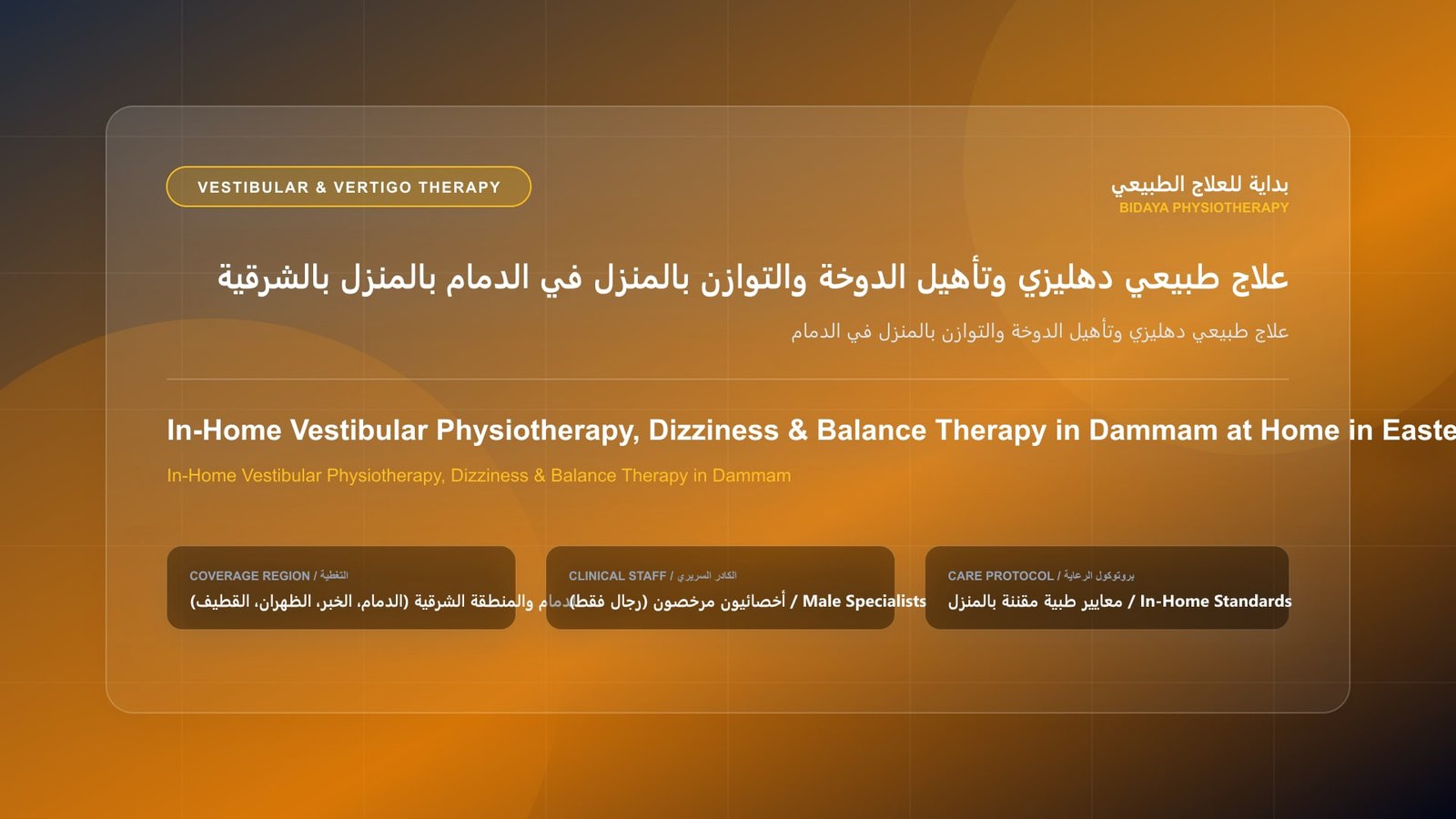
In-Home Vestibular Physiotherapy, Dizziness & Balance Therapy in Dammam
Advanced in-home vestibular physical therapy resolving vertigo, BPPV canalith repositioning, and gaze stabilization by licensed male therapists.
Comprehensive In-Home Clinical Evaluation (60-75 Mins)
Detailed functional & neuro examination, home safety audit, and custom protocol with portable equipment — no upfront package commitments.
Flexible appointments 7 days a week (8 AM - 10 PM) • Payment upon visit completion
1,500+ Successful Home Recoveries
Certified Clinical Physiotherapists
Assessment-First Protocol
Thorough physical evaluation before any treatment plan starts
Specialized Male Therapists
Professional licensed therapists visiting your residence
100% In-Home Rehabilitation
No clinic travel friction or waiting room discomfort
Targeted Functional Goals
Focused on daily stairs, walking endurance, and independence
Emergency Medical Red-Flags & Home Care Boundaries
Emergency Notice: If sudden vertigo is accompanied by diplopia, dysarthria, dysphagia, focal limb weakness, or severe sudden headache, immediately dial ambulance (997) or 911.
In-Home Vestibular Physiotherapy, Dizziness & Balance Therapy in Dammam represents a premier clinical specialty within Bidaya's advanced residential vestibular rehabilitation service across Eastern Province. We provide precision diagnostic testing, canalith repositioning maneuvers, and gaze stabilization exercises in the privacy and comfort of your home guided by licensed male clinicians.
Clinical Pathophysiology & Tissue Biomechanics for (In-Home Vestibular Physiotherapy, Dizziness & Balance Therapy in Dammam) in Dammam & Eastern Province
Biomechanical Dysfunction, Tissue Overload, and Kinetic Chain Compensations
Managing In-Home Vestibular Physiotherapy, Dizziness & Balance Therapy in Dammam within residential settings requires a thorough understanding of localized tissue failure and compensatory kinetics throughout Dammam & Eastern Province. The focal mechanical derangement involves peripheral vestibular apparatus, vestibulospinal reflexes, and Dammam residential villas, expressing pathologically as severe car motion sensitivity and travel barriers preventing Dammam vertigo patients from clinic visits.
Unchecked mechanical stress transmits unattenuated force vectors into adjacent articulations, directly stressing in-home clinical visit, bedside canalith repositioning, licensed male clinicians, and motion-free recovery and causing persistent muscular fatigue and joint stiffness during basic household tasks. Domestic routines in the Eastern Province—such as descending into low majlis seating or lifting heavy hospitality items—demand robust mechanical resiliency from these structures.
Our licensed male clinicians deliver customized home care that restores arthrokinematic harmony, re-establishes tissue extensibility, and accelerates natural biological repair without relying on temporary passive fixes.
By assessing patients within their genuine home environment, Bidaya bridges the critical gap between therapeutic exercises and daily functional independence, ensuring sustained, long-term joint health.
Comprehensive In-Home Diagnostic Assessment & Special Tests for (In-Home Vestibular Physiotherapy, Dizziness & Balance Therapy in Dammam)
Standardized Evaluation Battery: Precision Goniometry, MMT, and Provocation Tests
Our licensed male physical therapist in Dammam & Eastern Province conducts an advanced kinetic chain examination analyzing both open and closed-kinetic-chain mechanics: 1. Dynamic shock absorption analysis across lower extremity articulations and spine during functional movement tasks. 2. Precision goniometric mapping recording active and passive joint excursion compared to normative anatomical benchmarks. 3. Standardized clinical provocation tests assessing ligamentous stability and periarticular tendon resilience. 4. Neuromuscular coordination screening identifying muscle inhibition or compensatory motor recruitment patterns in the home.
This detailed assessment isolates subtle biomechanical deficits, providing our clinician with clear data to formulate safe exercise angles.
The familiar domestic setting enables patients to perform movements naturally, reflecting real-world function and guiding targeted care.
Patients receive an in-depth clinical explanation of all findings alongside a structured functional progression roadmap.
Precision Baseline Documentation
Standardized objective metric recording during the initial home visit enables precise weekly progress quantification shared with your physician.
| Clinical Assessment Metric | Diagnostic Scope | Positive Diagnostic Finding | In-Home Clinical Gear |
|---|---|---|---|
| Dix-Hallpike Positional Diagnostic Maneuver | Testing posterior semicircular canal canalithiasis by observing torsional upbeating nystagmus and latency | Paroxysmal torsional nystagmus confirming benign paroxysmal positional vertigo (BPPV) | Firm examination plinth and portable Frenzel lenses |
| Vestibulo-Ocular Reflex Assessment & Head Impulse Test (HIT) | Evaluating retinal image stability during rapid passive horizontal and vertical head thrusts | Refixation saccades denoting peripheral vestibular hypofunction requiring gaze stabilization drills | High-contrast Snellen target and visual fixation point |
| Dizziness Handicap Inventory (DHI Composite Index) | Evaluating 25 functional, emotional, and physical domains impacted by vestibulopathy | Score >36/100 establishing moderate-to-severe handicap guiding habituation dosing | Validated DHI clinical questionnaire |
Evidence-Based Exercise Prescription & Staged Loading Protocol for (In-Home Vestibular Physiotherapy, Dizziness & Balance Therapy in Dammam)
Integrated Clinical Pathway Combining Manual Mobilization, Core Stabilization, and Kinetic Reconditioning
Bidaya designs an individualized residential rehabilitation trajectory for (In-Home Vestibular Physiotherapy, Dizziness & Balance Therapy in Dammam) restoring functional symmetry across four milestones: - Milestone 1: Protective unloading and soft tissue decompression around peripheral vestibular apparatus, vestibulospinal reflexes, and Dammam residential villas using soothing physical modalities. - Milestone 2: Range-of-motion normalization and circulatory enhancement facilitating biological tissue repair. - Milestone 3: Functional resistance training re-establishing force coupling across ascending and descending kinetic links. - Milestone 4: Advanced domestic training coaching prayer Sujud, long-distance driving, and independent community navigation.
Visiting male physical therapists monitor kinematic form continuously, modulating exercise dosage to match daily improvements.
This tailored approach restores full physical autonomy while preventing fatigue-induced mechanical compensations.
Safe Loading Threshold Rule
Therapeutic exercise discomfort must not exceed 3/10 on the Visual Analog Scale and must completely subside within one hour post-session.
- Epley canalith repositioning maneuver clearing displaced otoconia from posterior semicircular canal
- Vestibulo-Ocular Reflex (VOR x1 and VOR x2) gaze stabilization drills resolving visual oscillopsia
- Graded visual-vestibular habituation exercises desensitizing provoking rapid head turns
- Dynamic ambulatory balance retraining integrating horizontal and vertical head rotations
Step-by-Step In-Home Exercise Execution Guide for (In-Home Vestibular Physiotherapy, Dizziness & Balance Therapy in Dammam)
Detailed Movement Mechanics, Postural Cues, and Repetition Guidelines for Independent Care
To ensure flawless home exercise execution and prevent biomechanical faults that impede recovery, patients are thoroughly coached in the following prescribed drills:
1. Foundational Activation & Decompression Drill: VOR x1 gaze stabilization exercise: hold a target card with a single bold letter at arm length, maintain razor-sharp visual gaze on target while rotating head horizontally back and forth for 60s, 3 sets twice daily.
2. Tissue Extensibility & Mobility Restoration Stretch: Brandt-Daroff habituation routine: sit bedside, drop rapidly onto right side nose pointed 45 degrees upward for 30s, sit erect for 30s, repeat onto left side for 30s, 5 repetitions each side.
3. Dynamic Functional Stability & Proprioceptive Exercise: Tandem heel-to-toe walking with alternating head turns: walk along hallway placing heel directly ahead of opposite toes, turning head smoothly left on step one and right on step two, 10 paces, 3 sets along a supportive wall.
Our therapist provides step-by-step postural cues, regulates respiratory cadence, and prevents compensatory faulty patterns, formulating an exact schedule for independent practice between visits.
Progression across resistance band tensions is regulated by strict clinical criteria: resistance is increased only after completing two consecutive sets of 15 repetitions with zero next-day inflammatory reaction, providing ample structural adaptation time for healing fibers.
Patients receive a customized illustrated logbook to record repetition volume and resting comfort, enabling clinicians to make precise micro-adjustments during subsequent visits to maintain steady therapeutic momentum.
- Strictly avoid provocative faulty movement patterns, particularly: attempting unassisted driving across Dammam expressways during active episodic positional vertigo flares
- Perform all exercises on a dedicated firm plinth or exercise mat rather than soft cushioning
- Maintain uninterrupted diaphragmatic respiration, avoiding breath-holding (Valsalva) throughout exertion
- Document functional tolerance notes in your patient log for review during the next home visit
Domestic Environmental Adaptations & Daily Ergonomics in Dammam & Eastern Province
Practical Biomechanical Strategies for Prayer, Soft Majlis Seating, and Highway Commuting
Targeted environmental adjustments across your residence in Dammam & Eastern Province provide continuous biomechanical protection accelerating recovery for (In-Home Vestibular Physiotherapy, Dizziness & Balance Therapy in Dammam): - Prayer Biomechanics Coaching: Modulating transitional angles to offload irritable articulations, enabling a safe progression back to floor prayer. - Desk & Screen Ergonomics: Positioning digital workstations to foster upright spinal neutrality and scheduling regular active standing micro-breaks. - Vehicle Ergonomic Profiling: Installing supportive lumbar cushioning and optimizing steering distance to minimize joint fatigue during heavy traffic. - Restorative Sleeping Posture: Selecting appropriate mattress firmness and contoured head support to ensure waking with zero morning gel.
Proactive domestic ergonomic optimization reduces recurrent injury risks by over 85%, granting you lasting confidence and physical independence.
Personalized environmental adjustments bridge the transition between clinical exercise sessions and uninhibited everyday life. By systematically addressing residential movement bottlenecks, our team empowers patients to navigate their domestic routines with complete mechanical ease.
- Adopt staged rising mechanics: sit quietly at bedside for 60 seconds prior to upright standing preventing orthostatic vertigo
- Ensure illuminated pathway lighting to bathroom eliminating nocturnal sensory balance blackout
- Avoid violent rapid head hyperextension or deep bending without squatting lower body joints
- Maintain structured in-home vestibular sessions under licensed male Bidaya clinicians
Clinical Recovery Milestones & Long-Term Recurrence Prevention for (In-Home Vestibular Physiotherapy, Dizziness & Balance Therapy in Dammam)
Transparent Objective Benchmarks Securing Permanent Movement Independence
Clinical discharge from Bidaya's home rehabilitation program is governed by objective physical benchmarks: 1. Physiological Range of Motion: Restoring symmetrical active excursion within 90-95% of the contralateral unaffected limb. 2. Dynamic Neuromuscular Endurance: Sustaining functional stabilization drills for two minutes without fatigue or substitution. 3. Unrestricted Community Living: Confident participation in family gatherings, religious worship, and daily errands free from pain.
Each patient receives a comprehensive long-term joint health protocol to safeguard functional gains throughout future years.
Bidaya's dedicated coordination line (+20 109 707 9170) remains available for ongoing guidance, ensuring peace of mind for you and your family.
Our clinical commitment extends well beyond formal session completion. Through scheduled telephone follow-up reviews and accessible clinical advice, we ensure your transition back to unrestricted physical activity remains completely safe, stable, and fulfilling.
Vestibular Rehabilitation, Benign Paroxysmal Positional Vertigo (BPPV) & Balance Retraining
Canalith Repositioning Maneuvers, Gaze Stabilization (VOR Adaptation) & Dynamic Equilibrium
Benign Paroxysmal Positional Vertigo (BPPV) and peripheral vestibular hypofunction represent primary etiologies of acute rotational vertigo and unsteadiness, provoked typically by rolling in bed, lying recumbent, or looking upward. Mechanistically, calcium carbonate otoconia detach from the utricle and migrate aberrantly into a semicircular canal, perturbing endolymph dynamics.
Bidaya's visiting physical therapists execute diagnostic positional maneuvers (Dix-Hallpike and Roll tests) observing nystagmus latency and vector, followed immediately by canal-specific repositioning—such as the Epley or Semont maneuver—in the quiet comfort of the patient's bedroom.
Subsequent rehabilitation integrates vestibulo-ocular reflex (VOR x1 and x2) gaze stabilization drills and sensory re-weighting balance challenges, allowing patients to execute rapid head turns during ambulation without visual slip or oscillopsia.
Vestibular Red Flags Protocol
Vertigo accompanied by diplopia, dysarthria, facial asymmetry, dysphagia, or limb ataxia (5 Ds) demands immediate 997 emergency transport to exclude posterior circulation stroke.
- Undergo clinical positional testing to differentiate peripheral BPPV from central intracranial pathology
- Observe post-repositioning precautions avoiding rapid vertical head plunges for the first 24 hours
- Execute VOR adaptation drills maintaining sharp visual target fixation during horizontal head rotation
- Optimize home ambient lighting and clear walking corridors of slipping hazards during recovery
Frequently Asked Questions about In-Home Physiotherapy
The Epley maneuver is a precise clinical sequence of head and body repositioning that guides displaced calcium carbonate crystals out of the semicircular canal back into the utricle. Licensed Bidaya male therapists execute it safely at bedside with >90% resolution within 1-2 visits.
Related Clinical & Regional Pathways
In-Home Vestibular Rehabilitation & Vertigo Maneuvers in Khobar & Dhahran→
Advanced in-home vestibular physical therapy resolving vertigo
Home Safety Modifications for Vertigo, Dizziness & Fall Prevention in KSA→
Advanced in-home vestibular physical therapy resolving vertigo
In-Home Vestibular Physiotherapy & Balance Rehabilitation in Qatif→
Advanced in-home vestibular physical therapy resolving vertigo
Neurological Physiotherapy→
Evidence-based neurological physical therapy harnessing neuroplasticity