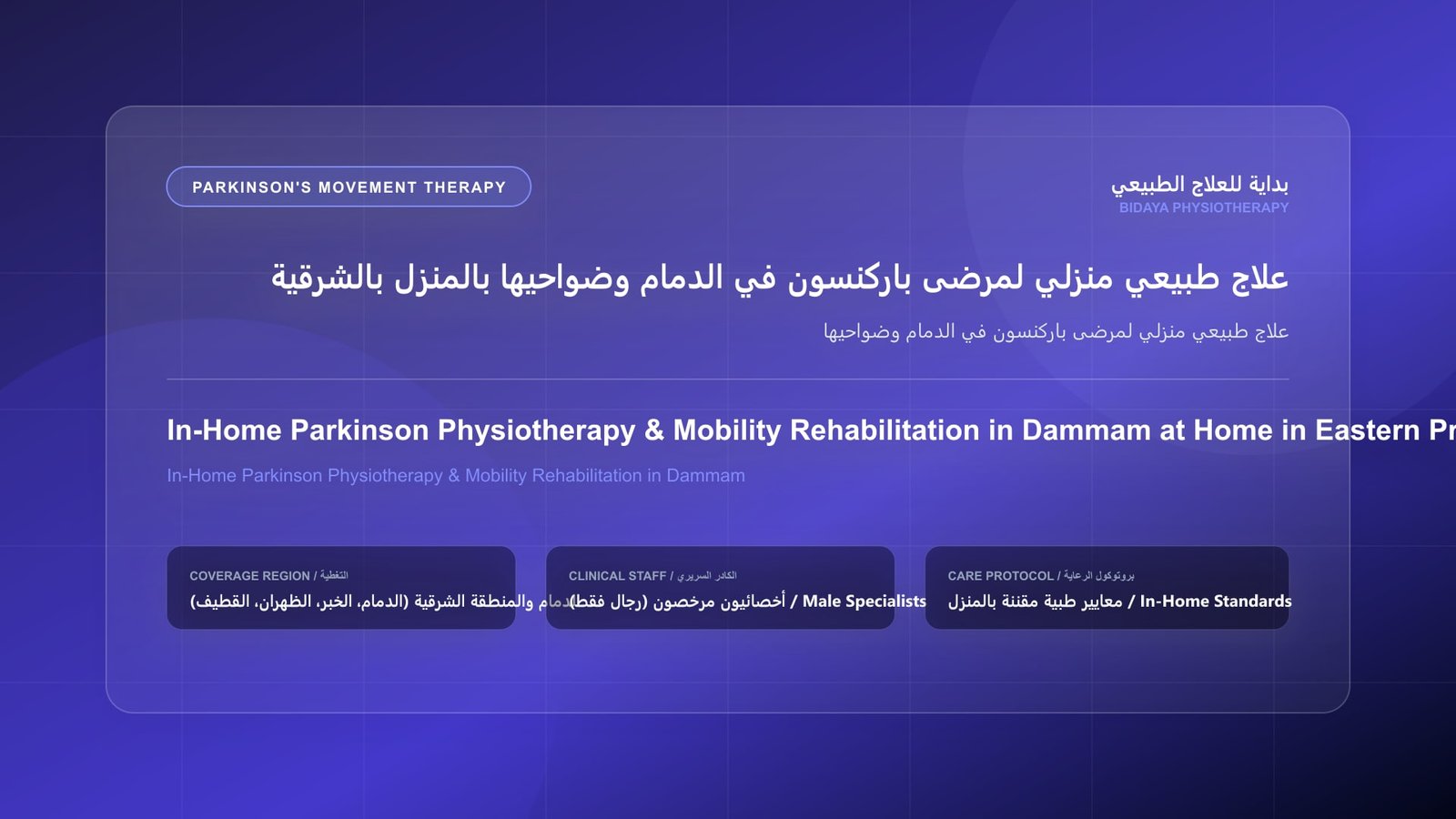
In-Home Parkinson Physiotherapy & Mobility Rehabilitation in Dammam
Advanced in-home physical therapy restoring gait fluidity, dynamic balance, and overcoming rigidity for Parkinson patients by licensed male therapists.
Comprehensive In-Home Clinical Evaluation (60-75 Mins)
Detailed functional & neuro examination, home safety audit, and custom protocol with portable equipment — no upfront package commitments.
Flexible appointments 7 days a week (8 AM - 10 PM) • Payment upon visit completion
1,500+ Successful Home Recoveries
Certified Clinical Physiotherapists
Assessment-First Protocol
Thorough physical evaluation before any treatment plan starts
Specialized Male Therapists
Professional licensed therapists visiting your residence
100% In-Home Rehabilitation
No clinic travel friction or waiting room discomfort
Targeted Functional Goals
Focused on daily stairs, walking endurance, and independence
Emergency Medical Red-Flags & Home Care Boundaries
Emergency Notice: In the event of a fall with head trauma, acute loss of consciousness, or severe sudden respiratory or swallowing distress, immediately dial ambulance (997) or 911.
In-Home Parkinson Physiotherapy & Mobility Rehabilitation in Dammam constitutes a premier clinical focus within Bidaya's home neurological rehabilitation framework in Eastern Province. We provide precision therapeutic interventions leveraging sensory cueing and large-amplitude movement training inside the comfort of the patient residence guided by licensed male clinicians.
Clinical Pathophysiology & Tissue Biomechanics for (In-Home Parkinson Physiotherapy & Mobility Rehabilitation in Dammam) in Dammam & Eastern Province
Biomechanical Dysfunction, Tissue Overload, and Kinetic Chain Compensations
Providing evidence-based in-home physiotherapy for In-Home Parkinson Physiotherapy & Mobility Rehabilitation in Dammam across Dammam & Eastern Province is an essential focus of Bidaya's clinical team. The core underlying impairment involves locomotor motor systems, axial posture, and residential layouts across Dammam districts, characterized pathologically by barriers to clinic travel during medication wear-off states among Dammam Parkinson patients.
This structural breakdown directly alters force distribution through adjacent kinetic segments, disrupting specialized home care, domestic convenience, licensed male clinicians, and restored daily independence. In response, neighboring muscular sleeves maintain persistent protective tension, leading to morning joint gel, localized tenderness, and movement hesitation during routine household activities.
Eastern Province domestic environments—featuring deep low majlis sofas and frequent floor-to-stand transitions—place substantial demands on these healing structures. Our licensed male therapists deliver comprehensive manual therapy, joint mobilization, and neuromuscular re-education tailored to patient living spaces, eliminating pain and restoring fluid functional movement.
Scientific evidence confirms that personalized home-based therapeutic loading substantially accelerates tissue remodeling, allowing patients to regain independence safely without the exhaustion of outpatient clinic visits.
Comprehensive In-Home Diagnostic Assessment & Special Tests for (In-Home Parkinson Physiotherapy & Mobility Rehabilitation in Dammam)
Standardized Evaluation Battery: Precision Goniometry, MMT, and Provocation Tests
Our clinical diagnostic methodology at Bidaya deploys an exploratory 60-minute assessment conducted directly inside your residence in Dammam & Eastern Province: 1. Kinetic chain load-transfer evaluation screening adjacent segments for latent mechanical compensations. 2. Objective dual-inclinometer tracking measuring active and passive joint excursion with medical accuracy. 3. Segmental neuromuscular provocation drills isolating irritated pain generators with maximum specificity. 4. Multi-planar movement trials assessing sit-to-stand, rotational stepping, and stair transitions under authentic domestic loading.
Conducting evaluation on-site captures real-world movement mechanics, enabling our male therapist to calibrate an individualized program resolving domestic movement friction.
Each therapist carries an advanced mobile clinical diagnostic kit, recording baseline benchmarks into an encrypted portal ensuring transparent physician collaboration.
Detailed biomechanical data gathered during this primary session allow our team to design highly focused interventions tailored to your specific musculoskeletal demands. This clinical clarity provides patients and their families absolute reassurance regarding the safety, rigor, and clinical validity of specialized in-home care.
Precision Baseline Documentation
Standardized objective metric recording during the initial home visit enables precise weekly progress quantification shared with your physician.
| Clinical Assessment Metric | Diagnostic Scope | Positive Diagnostic Finding | In-Home Clinical Gear |
|---|---|---|---|
| Movement Disorder Society UPDRS (MDS-UPDRS Part III Motor Examination) | Quantifying bradykinesia, rigidity, tremor amplitude, and postural reflexes | Composite motor score tracking severity and on/off medication responsiveness | Standardized UPDRS motor score sheet and stopwatch |
| Timed Up and Go with Dual-Task Cognitive Interference (TUG-Cognitive) | Timing sit-to-stand, 3-meter walk, turn, and sit while counting backwards by threes | Time >14 seconds establishing elevated fall hazard during divided domestic attention | Standard armchair, 3-meter measured floor track, and digital timer |
| Mini-Balance Evaluation Systems Test (Mini-BESTest Dynamic Equilibrium) | Evaluating 14 balance domains including anticipatory postural adjustments and reactive stepping | Score <20/28 identifying dynamic postural instability requiring reactive balance therapy | High-density foam pad, ramp incline, and stopwatch |
Evidence-Based Exercise Prescription & Staged Loading Protocol for (In-Home Parkinson Physiotherapy & Mobility Rehabilitation in Dammam)
Integrated Clinical Pathway Combining Manual Mobilization, Core Stabilization, and Kinetic Reconditioning
Rehabilitation for (In-Home Parkinson Physiotherapy & Mobility Rehabilitation in Dammam) is structured across four progressive clinical phases engineered for tissue remodeling: - Phase 1: Protective unloading and neuromuscular inhibition around locomotor motor systems, axial posture, and residential layouts across Dammam districts utilizing gentle manual release and cryotherapy. - Phase 2: Restoring capsular mobility and tissue elasticity through active-assisted stretching and joint oscillations. - Phase 3: Targeted stabilizer strengthening and eccentric loading utilizing calibrated resistance bands and stability props. - Phase 4: Full functional integration conditioning the body for seamless prayer, vehicular driving, and stair navigation.
Our therapist monitors symptom behavior during and after each session, ensuring loading parameters remain strictly within biological healing thresholds.
Patients receive hospital-grade portable equipment for home use, guided by expert coaching to ensure every repetition accelerates structural recovery.
This structured tier system guarantees that underlying stabilizing muscles achieve peak endurance before subjecting articulations to heavy functional demands. Continuous objective monitoring eliminates premature loading, paving the way for durable, long-term joint health and unrestrained mobility in your everyday domestic life.
Safe Loading Threshold Rule
Therapeutic exercise discomfort must not exceed 3/10 on the Visual Analog Scale and must completely subside within one hour post-session.
- Large-amplitude functional movement patterns (LSVT BIG motor recalibration drills)
- Rhythmic auditory metronome cueing to bypass basal ganglia motor freezing blockades
- Segmental axial trunk rotation drills decoupling rigid pelvic-shoulder girdle synchronization
- Reactive compensatory stepping drills training rapid wide base-of-support recovery
Step-by-Step In-Home Exercise Execution Guide for (In-Home Parkinson Physiotherapy & Mobility Rehabilitation in Dammam)
Detailed Movement Mechanics, Postural Cues, and Repetition Guidelines for Independent Care
Mastering correct exercise mechanics is fundamental to accelerating tissue healing in (In-Home Parkinson Physiotherapy & Mobility Rehabilitation in Dammam):
1. Segmental Realignment & Joint Mobilization Drill: High-amplitude forward stepping with visual strip cue: upright stance, execute explosive exaggerated forward step across marked floor line while throwing arms wide open, hold 3s, return, 10 reps per leg, 3 sets.
2. Muscle Elongation & Capsular Flexibility Stretch: Seated axial rotation with exaggerated reach: sit upright, extend arms, rotate trunk and head fully toward right periphery tracking hand visually, hold 2s, reverse to left, 12 reps, 3 sets.
3. Dynamic Kinetic Chain Conditioning & Balance Drill: Reactive lateral compensatory stepping: standing feet together, tilt trunk laterally and initiate immediate rapid wide side-step to establish broadened base of support, 8 reps each side, 2 sets.
Clinicians supervise each movement pattern to eliminate faulty motor substitutions before prescribing independent home practice.
Maintaining steady breathing and controlled tempo ensures deep stabilizer recruitment and protects healing fibers from unnecessary shear strain.
By cultivating consistent movement mindfulness during your home sessions, neuromuscular control improves dramatically, enabling your body to execute everyday tasks with effortless fluidity and absolute mechanical safety.
- Strictly avoid provocative faulty movement patterns, particularly: relying on unverified folk remedies that delay scientifically validated locomotor neuro-rehabilitation
- Perform all exercises on a dedicated firm plinth or exercise mat rather than soft cushioning
- Maintain uninterrupted diaphragmatic respiration, avoiding breath-holding (Valsalva) throughout exertion
- Document functional tolerance notes in your patient log for review during the next home visit
Domestic Environmental Adaptations & Daily Ergonomics in Dammam & Eastern Province
Practical Biomechanical Strategies for Prayer, Soft Majlis Seating, and Highway Commuting
In-home physical therapy is integrated with practical environmental modifications tailored to residential architecture across Dammam & Eastern Province: - Prayer Biomechanics: Training safe transitional mechanics during Ruku and Sujud, introducing temporary supportive seating when indicated while preserving joint engagement. - Transfers and Seating: Coaching hip-hinge sit-to-stand transitions powered by gluteal strength, avoiding soft low sofas that overload irritable tissues. - Highway Commuting: Adjusting vehicular lumbar and cervical angles to dissipate road vibration along Eastern Province expressways. - Sleep Ergonomics: Recommending orthopedic mattresses and supportive pillow placement to preserve neutral musculoskeletal alignment without focal pressure.
Visiting therapists inspect the immediate residential layout to provide immediate ergonomic recommendations concerning hallway pathways, bed mattress heights, and bathroom grab rails, safeguarding against repetitive movement fatigue.
Domestic environmental ergonomics are continuously refined during subsequent home visits as functional capacity improves. Our clinicians provide actionable strategies for navigating multi-story residential stairs, kitchen workstations, and leisure activities, ensuring your living space actively reinforces clinical gains.
- Eliminate loose rugs, door thresholds, and floor clutter that trigger freezing at narrow chokepoints
- Apply high-contrast colored floor stripes spaced along hallways providing unambiguous visual stepping targets
- Synchronize in-home rehabilitation sessions with peak dopamine medication on-state windows
- Install rigid wall grab bars adjacent to bed, favorite armchair, and toilet ensuring secure sit-to-stand transitions
Clinical Recovery Milestones & Long-Term Recurrence Prevention for (In-Home Parkinson Physiotherapy & Mobility Rehabilitation in Dammam)
Transparent Objective Benchmarks Securing Permanent Movement Independence
Graduation from Bidaya's residential rehabilitation program marks a definitive milestone in regaining movement mastery: 1. Unrestricted Functional Freedom: Enjoying family activities, leisure pursuits, and hobbies without physical barriers or hesitation. 2. Harmonic Biomechanics: Fluid kinetic coordination distributing mechanical force vectors evenly across all supporting articulations. 3. Stable Metric Benchmarks: Maintaining peak strength, mobility, and balance scores across consecutive clinical reassessment visits.
Therapists provide written guidelines for joint preservation during long-distance highway travel throughout Eastern Province.
We are honored to have partnered in your recovery journey and wish you a vibrant, healthy, and physically active life.
Strategies for Overcoming Freezing of Gait (FOG) & Turning Difficulties in Parkinson's
Rhythmic Auditory Stimulation, Visual Ground Cues & Wide-Arc Stepping Manoeuvres
Freezing of Gait (FOG) represents one of the most disabling manifestations of Parkinson's disease, wherein patients experience a sudden, paroxysmal sensation of their feet being glued to the floor—most frequently occurring during gait initiation, doorway negotiation, or rapid axial turning. Attempting to rotate precipitously prompts en bloc turning, causing immediate retropulsive center-of-mass displacement and catastrophic falls.
Bidaya's home therapists train patients in compensatory cortical cueing strategies that bypass dysfunctional basal ganglia circuitry by engaging intact conscious cortical motor planning: 1. Visual Cueing: Stepping intentionally over high-contrast floor strips or imagined obstacles. 2. Rhythmic Auditory Stimulation (RAS): Utilizing metronomic cadences or verbal counting to synchronize stride initiation. 3. Wide-Arc Turning Mechanics: Substituting pivot-twisting with wide multi-step semicircular arcs that maintain a stable base of support.
These neuro-behavioral techniques restore rhythmic motor automaticity within the home environment.
Unfreezing Action Protocol
When gait freezes, advise the patient to immediately halt, shift lateral body weight deliberately from side to side, and initiate a deliberate high-knee forward step.
- Replace tight pivot turns with broad, multi-step semicircular stepping trajectories
- Install high-contrast horizontal visual tape cues across domestic transition thresholds
- Utilize rhythmic verbal cadence (step-two-step) to facilitate gait initiation
- Clear corridors of loose scatter rugs and visual clutter that provoke freezing episodes
Frequently Asked Questions about In-Home Physiotherapy
Therapists train patients in sensory cueing bypass strategies—such as laser line projections, floor markers, or rhythmic metronome beats—routing movement commands through conscious frontal cortex pathways.
Related Clinical & Regional Pathways
Advanced In-Home Parkinson Rehabilitation & Gait Therapy in Khobar & Dhahran→
Advanced in-home physical therapy restoring gait fluidity
Parkinson Caregiver Training, Home Modification & Fall Prevention Guide→
Advanced in-home physical therapy restoring gait fluidity
Parkinson Freezing of Gait (FOG) Cueing Strategies & Rehabilitation→
Advanced in-home physical therapy restoring gait fluidity
Neurological Physiotherapy→
Evidence-based neurological physical therapy harnessing neuroplasticity
Stroke Rehabilitation & Neurological Physiotherapy→
Evidence-based neurological rehabilitation engineered to stimulate corticomotor neuroplasticity
Geriatric Physiotherapy & Fall Prevention→
Evidence-based clinical rehabilitation tailored specifically to preserve functional independence