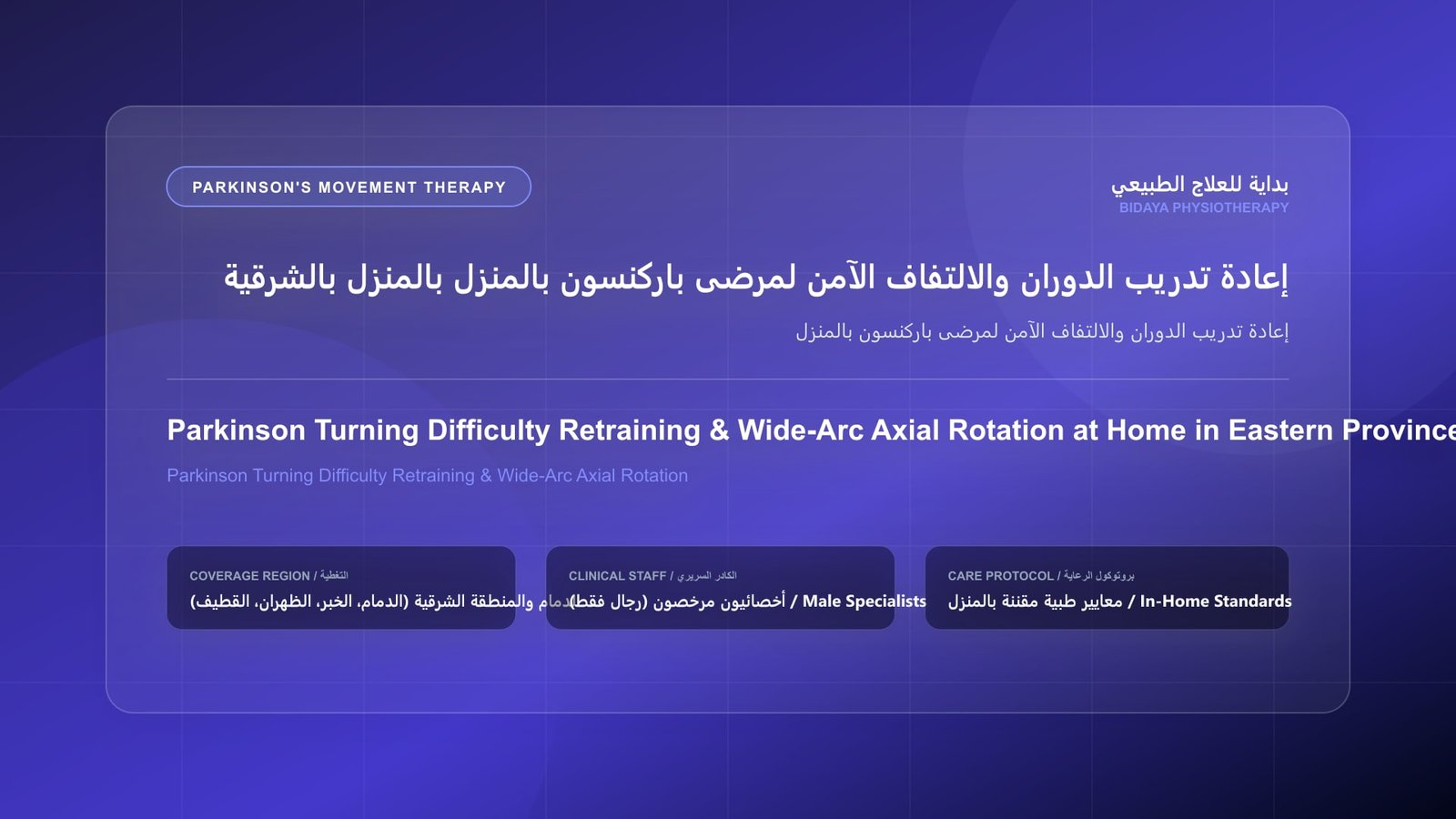
Parkinson Turning Difficulty Retraining & Wide-Arc Axial Rotation
Advanced in-home physical therapy restoring gait fluidity, dynamic balance, and overcoming rigidity for Parkinson patients by licensed male therapists.
Comprehensive In-Home Clinical Evaluation (60-75 Mins)
Detailed functional & neuro examination, home safety audit, and custom protocol with portable equipment — no upfront package commitments.
Flexible appointments 7 days a week (8 AM - 10 PM) • Payment upon visit completion
1,500+ Successful Home Recoveries
Certified Clinical Physiotherapists
Assessment-First Protocol
Thorough physical evaluation before any treatment plan starts
Specialized Male Therapists
Professional licensed therapists visiting your residence
100% In-Home Rehabilitation
No clinic travel friction or waiting room discomfort
Targeted Functional Goals
Focused on daily stairs, walking endurance, and independence
Emergency Medical Red-Flags & Home Care Boundaries
Emergency Notice: In the event of a fall with head trauma, acute loss of consciousness, or severe sudden respiratory or swallowing distress, immediately dial ambulance (997) or 911.
Parkinson Turning Difficulty Retraining & Wide-Arc Axial Rotation constitutes a premier clinical focus within Bidaya's home neurological rehabilitation framework in Eastern Province. We provide precision therapeutic interventions leveraging sensory cueing and large-amplitude movement training inside the comfort of the patient residence guided by licensed male clinicians.
Clinical Pathophysiology & Tissue Biomechanics for (Parkinson Turning Difficulty Retraining & Wide-Arc Axial Rotation) in Dammam & Eastern Province
Biomechanical Dysfunction, Tissue Overload, and Kinetic Chain Compensations
Bidaya's advanced residential clinical protocol for Parkinson Turning Difficulty Retraining & Wide-Arc Axial Rotation delivers comprehensive functional restoration throughout Dammam & Eastern Province. The primary anatomical disturbance involves axial skeleton, hip rotators, and vestibulo-ocular orienting motor reflexes, expressing clinically as en bloc turning behavior with unsegmented body rotation predisposing to falls.
This mechanical insufficiency disturbs harmonious kinetic force transmission, placing excessive compensatory stress upon axial rigidity, trunk stiffness, wide-arc step redirection, and equilibrium stabilization. As a consequence, patients develop chronic postural guarding, reduced joint lubrication, and progressive movement apprehension during everyday domestic tasks.
Daily routines in Eastern Province households, from prolonged prayer Sujud to navigating multi-level residences, require optimal biomechanical resilience. Visiting therapists provide precision manual techniques and individualized therapeutic exercises directly within the home, dismantling mechanical restrictions safely.
Empirical rehabilitation data demonstrates that guided home physical therapy yields superior functional recovery by retraining movement patterns in the exact environment where daily activities occur.
Comprehensive In-Home Diagnostic Assessment & Special Tests for (Parkinson Turning Difficulty Retraining & Wide-Arc Axial Rotation)
Standardized Evaluation Battery: Precision Goniometry, MMT, and Provocation Tests
Bidaya initiates clinical care with an exhaustive 60-minute diagnostic consultation conducted inside your residence in Dammam & Eastern Province: 1. Thorough sensorimotor screening assessing dermatomal sensation and deep tendon reflexes to ensure clinical safety. 2. Precise inclinometric tracking quantifying directional motion restrictions compared to physiological norms. 3. High-sensitivity clinical provocation tests isolating exact pain-generating tissues and staging irritability. 4. Comprehensive kinetic chain analysis evaluating postural alignment during domestic movement transitions.
Conducting this standardized diagnostic battery within your home provides real-world biomechanical insight impossible in outpatient clinics, enabling our specialist to tailor an accurate recovery trajectory.
Visiting therapists arrive equipped with calibrated diagnostic tools, recording objective baseline measurements in an encrypted digital portal shared with your orthopedic physician for coordinated medical oversight.
Evaluating your functional movement within familiar surroundings removes travel-induced musculoskeletal tension, providing a reliable clinical baseline from which to monitor therapeutic progress. Every diagnostic finding is thoroughly discussed with you, fostering an informed and collaborative healing partnership.
Precision Baseline Documentation
Standardized objective metric recording during the initial home visit enables precise weekly progress quantification shared with your physician.
| Clinical Assessment Metric | Diagnostic Scope | Positive Diagnostic Finding | In-Home Clinical Gear |
|---|---|---|---|
| Movement Disorder Society UPDRS (MDS-UPDRS Part III Motor Examination) | Quantifying bradykinesia, rigidity, tremor amplitude, and postural reflexes | Composite motor score tracking severity and on/off medication responsiveness | Standardized UPDRS motor score sheet and stopwatch |
| Timed Up and Go with Dual-Task Cognitive Interference (TUG-Cognitive) | Timing sit-to-stand, 3-meter walk, turn, and sit while counting backwards by threes | Time >14 seconds establishing elevated fall hazard during divided domestic attention | Standard armchair, 3-meter measured floor track, and digital timer |
| Mini-Balance Evaluation Systems Test (Mini-BESTest Dynamic Equilibrium) | Evaluating 14 balance domains including anticipatory postural adjustments and reactive stepping | Score <20/28 identifying dynamic postural instability requiring reactive balance therapy | High-density foam pad, ramp incline, and stopwatch |
Evidence-Based Exercise Prescription & Staged Loading Protocol for (Parkinson Turning Difficulty Retraining & Wide-Arc Axial Rotation)
Integrated Clinical Pathway Combining Manual Mobilization, Core Stabilization, and Kinetic Reconditioning
Bidaya's home rehabilitation protocol for (Parkinson Turning Difficulty Retraining & Wide-Arc Axial Rotation) utilizes a systematic neuromuscular re-education model structured across four tiers: - Phase 1: Calming irritated tissues around axial skeleton, hip rotators, and vestibulo-ocular orienting motor reflexes and reducing protective hypertonicity using gentle manual therapy. - Phase 2: Sensorimotor retraining re-establishing balanced co-contraction between prime movers and deep stabilizing sleeves. - Phase 3: Antigravity kinetic chain strengthening expanding load-bearing capacity during sustained upright standing and walking. - Phase 4: Ecological task simulation preparing the patient for full family, professional, and recreational engagement.
Advancing between phases requires fulfilling strict objective criteria, ensuring previous gains are cemented before increasing intensity.
This methodical framework shields patients from reinjury, providing lasting, dependable recovery in the comfort of home.
Safe Loading Threshold Rule
Therapeutic exercise discomfort must not exceed 3/10 on the Visual Analog Scale and must completely subside within one hour post-session.
- Large-amplitude functional movement patterns (LSVT BIG motor recalibration drills)
- Rhythmic auditory metronome cueing to bypass basal ganglia motor freezing blockades
- Segmental axial trunk rotation drills decoupling rigid pelvic-shoulder girdle synchronization
- Reactive compensatory stepping drills training rapid wide base-of-support recovery
Step-by-Step In-Home Exercise Execution Guide for (Parkinson Turning Difficulty Retraining & Wide-Arc Axial Rotation)
Detailed Movement Mechanics, Postural Cues, and Repetition Guidelines for Independent Care
To optimize functional gains while safeguarding healing structures in (Parkinson Turning Difficulty Retraining & Wide-Arc Axial Rotation), our visiting clinician directly supervises the following home exercise protocol:
1. Restorative Tissue Decompression & Activation: High-amplitude forward stepping with visual strip cue: upright stance, execute explosive exaggerated forward step across marked floor line while throwing arms wide open, hold 3s, return, 10 reps per leg, 3 sets.
2. Capsular Extensibility & Muscle Lengthening: Seated axial rotation with exaggerated reach: sit upright, extend arms, rotate trunk and head fully toward right periphery tracking hand visually, hold 2s, reverse to left, 12 reps, 3 sets.
3. Progressive Dynamic Stabilization & Neuromuscular Coordination: Reactive lateral compensatory stepping: standing feet together, tilt trunk laterally and initiate immediate rapid wide side-step to establish broadened base of support, 8 reps each side, 2 sets.
Clinicians fine-tune body alignment, cue diaphragmatic breathing, and structure individualized rest intervals ensuring exercises stimulate remodeling without overload.
Movement precision and movement quality supersede repetition volume; patients are advised to stop immediately and alert their therapist should sharp atypical discomfort occur.
Therapeutic movements are systematically integrated into your domestic rhythm, ensuring each exercise directly facilitates easier bed transfers, smoother prayer transitions, and effortless household mobility.
- Strictly avoid provocative faulty movement patterns, particularly: permitting rapid pivot turning on a planted foot inducing centrifugal balance collapse
- Perform all exercises on a dedicated firm plinth or exercise mat rather than soft cushioning
- Maintain uninterrupted diaphragmatic respiration, avoiding breath-holding (Valsalva) throughout exertion
- Document functional tolerance notes in your patient log for review during the next home visit
Domestic Environmental Adaptations & Daily Ergonomics in Dammam & Eastern Province
Practical Biomechanical Strategies for Prayer, Soft Majlis Seating, and Highway Commuting
In-home physical therapy is integrated with practical environmental modifications tailored to residential architecture across Dammam & Eastern Province: - Prayer Biomechanics: Training safe transitional mechanics during Ruku and Sujud, introducing temporary supportive seating when indicated while preserving joint engagement. - Transfers and Seating: Coaching hip-hinge sit-to-stand transitions powered by gluteal strength, avoiding soft low sofas that overload irritable tissues. - Highway Commuting: Adjusting vehicular lumbar and cervical angles to dissipate road vibration along Eastern Province expressways. - Sleep Ergonomics: Recommending orthopedic mattresses and supportive pillow placement to preserve neutral musculoskeletal alignment without focal pressure.
Visiting therapists inspect the immediate residential layout to provide immediate ergonomic recommendations concerning hallway pathways, bed mattress heights, and bathroom grab rails, safeguarding against repetitive movement fatigue.
Domestic environmental ergonomics are continuously refined during subsequent home visits as functional capacity improves. Our clinicians provide actionable strategies for navigating multi-story residential stairs, kitchen workstations, and leisure activities, ensuring your living space actively reinforces clinical gains.
- Eliminate loose rugs, door thresholds, and floor clutter that trigger freezing at narrow chokepoints
- Apply high-contrast colored floor stripes spaced along hallways providing unambiguous visual stepping targets
- Synchronize in-home rehabilitation sessions with peak dopamine medication on-state windows
- Install rigid wall grab bars adjacent to bed, favorite armchair, and toilet ensuring secure sit-to-stand transitions
Clinical Recovery Milestones & Long-Term Recurrence Prevention for (Parkinson Turning Difficulty Retraining & Wide-Arc Axial Rotation)
Transparent Objective Benchmarks Securing Permanent Movement Independence
Clinical discharge from Bidaya's home rehabilitation program is governed by objective physical benchmarks: 1. Physiological Range of Motion: Restoring symmetrical active excursion within 90-95% of the contralateral unaffected limb. 2. Dynamic Neuromuscular Endurance: Sustaining functional stabilization drills for two minutes without fatigue or substitution. 3. Unrestricted Community Living: Confident participation in family gatherings, religious worship, and daily errands free from pain.
Each patient receives a comprehensive long-term joint health protocol to safeguard functional gains throughout future years.
Bidaya's dedicated coordination line (+20 109 707 9170) remains available for ongoing guidance, ensuring peace of mind for you and your family.
Our clinical commitment extends well beyond formal session completion. Through scheduled telephone follow-up reviews and accessible clinical advice, we ensure your transition back to unrestricted physical activity remains completely safe, stable, and fulfilling.
Strategies for Overcoming Freezing of Gait (FOG) & Turning Difficulties in Parkinson's
Rhythmic Auditory Stimulation, Visual Ground Cues & Wide-Arc Stepping Manoeuvres
Freezing of Gait (FOG) represents one of the most disabling manifestations of Parkinson's disease, wherein patients experience a sudden, paroxysmal sensation of their feet being glued to the floor—most frequently occurring during gait initiation, doorway negotiation, or rapid axial turning. Attempting to rotate precipitously prompts en bloc turning, causing immediate retropulsive center-of-mass displacement and catastrophic falls.
Bidaya's home therapists train patients in compensatory cortical cueing strategies that bypass dysfunctional basal ganglia circuitry by engaging intact conscious cortical motor planning: 1. Visual Cueing: Stepping intentionally over high-contrast floor strips or imagined obstacles. 2. Rhythmic Auditory Stimulation (RAS): Utilizing metronomic cadences or verbal counting to synchronize stride initiation. 3. Wide-Arc Turning Mechanics: Substituting pivot-twisting with wide multi-step semicircular arcs that maintain a stable base of support.
These neuro-behavioral techniques restore rhythmic motor automaticity within the home environment.
Unfreezing Action Protocol
When gait freezes, advise the patient to immediately halt, shift lateral body weight deliberately from side to side, and initiate a deliberate high-knee forward step.
- Replace tight pivot turns with broad, multi-step semicircular stepping trajectories
- Install high-contrast horizontal visual tape cues across domestic transition thresholds
- Utilize rhythmic verbal cadence (step-two-step) to facilitate gait initiation
- Clear corridors of loose scatter rugs and visual clutter that provoke freezing episodes
Frequently Asked Questions about In-Home Physiotherapy
Therapists train patients in sensory cueing bypass strategies—such as laser line projections, floor markers, or rhythmic metronome beats—routing movement commands through conscious frontal cortex pathways.
Related Clinical & Regional Pathways
Parkinson Bradykinesia & Hypometria Large-Amplitude Exercise Therapy→
Advanced in-home physical therapy restoring gait fluidity
Parkinson Freezing of Gait (FOG) Cueing Strategies & Rehabilitation→
Advanced in-home physical therapy restoring gait fluidity
Parkinson Postural Instability & Retropulsion Fall Prevention Therapy→
Advanced in-home physical therapy restoring gait fluidity
Neurological Physiotherapy→
Evidence-based neurological physical therapy harnessing neuroplasticity
Stroke Rehabilitation & Neurological Physiotherapy→
Evidence-based neurological rehabilitation engineered to stimulate corticomotor neuroplasticity
Geriatric Physiotherapy & Fall Prevention→
Evidence-based clinical rehabilitation tailored specifically to preserve functional independence
Parkinson Bed Mobility & Nocturnal Axial Rigidity Rolling Retraining→
Advanced in-home physical therapy restoring gait fluidity
Parkinson Camptocormia & Severe Stooped Posture Correction Exercises→
Advanced in-home physical therapy restoring gait fluidity